
Determine whether the following objects are chiral or achiral.
Read moreTable of Contents
1
Structure and Bonding
2
Acids and Bases; Functional Groups
3
Structure and Stereochemistry of Alkanes
4
The Study of Chemical Reactions
5
Stereochemistry
6
Alkyl Halides; Nucleophilic Substitution
7
Structure and Synthesis of Alkenes; Elimination
8
Reactions of Alkenes
9
Alkynes
10
Structure and Synthesis of Alcohols
11
Reactions of Alcohols
12
Infrared Spectroscopy and Mass Spectrometry
13
Nuclear Magnetic Resonance Spectroscopy
14
Ethers, Epoxides, and Thioethers
15
Conjugated Systems, Orbital Symmetry, and Ultraviolet Spectroscopy
16
Aromatic Compounds
17
Reactions of Aromatic Compounds
18
Ketones and Aldehydes
19
Amines
20
Carboxylic Acids
21
Carboxylic Acid Derivatives
22
Condensations and Alpha Substitutions of Carbonyl Compounds
23
Carbohydrates and Nucleic Acids
24
Amino Acids, Peptides, and Proteins
25
Lipids
26
Synthetic Polymers
Textbook Solutions for Organic Chemistry
Chapter 5 Problem PROBLEM 5-17
Question
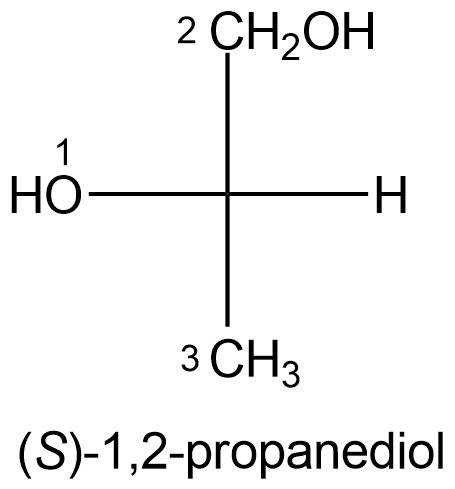
Draw a Fischer projection for each compound. Remember that the cross represents an asymmetric carbon atom, and the carbon chain should be along the vertical, with the IUPAC numbering from top to bottom. (a) (S)-propane-1,2-diol (b) (R)-2-bromobutan-1-ol (c) (S)-1,2-dibromobutane (d) (R)-butan-2-ol (R)-glyceraldehyde, 1 CHO
Solution
Step 1 of 5
Part A.
The Fischer projection is drawn as:
Subscribe to view the
full solution
full solution
Title
Organic Chemistry 9
Author
Leroy G. Wade, Jan W. Simek
ISBN
9780321971371
Draw a Fischer projection for each compound. Remember that the cross represents an
Chapter 5 textbook questions
-
Chapter 5: Problem 0 Organic Chemistry 9
-
Chapter 5: Problem 0 Organic Chemistry 9
Make a model and draw a three-dimensional structure for each compound. Then draw the mirror image of your original structure and determine whether the mirror image is the same compound. Label each structure as being chiral or achiral, and label pairs of enantiomers. cis-1,2-dimethylcyclobutane (b) trans-1,2-dimethylcyclobutane (c) cis- and trans-1,3-dimethylcyclobutane (d) 2-bromobutane (e) O (f) O OH CH3
Read more -
Chapter 5: Problem 0 Organic Chemistry 9
Draw a three-dimensional structure for each compound, and star all asymmetric carbon atoms. Draw the mirror image for each structure, and state whether you have drawn a pair of enantiomers or just the same molecule twice. Build molecular models of any of these examples that seem difficult to you.
Read more -
Chapter 5: Problem 0 Organic Chemistry 9
For each of the stereocenters (circled) in Figure 5-5, (a) draw the compound with two of the groups on the stereocenter interchanged. (b) give the relationship of the new compound to the original compound.
Read more -
Chapter 5: Problem 0 Organic Chemistry 9
For each compound, determine whether the molecule has an internal mirror plane of symmetry. If it does, draw the mirror plane on a three-dimensional drawing of the molecule. If the molecule does not have an internal mirror plane, determine whether the structure is chiral. (a) methane (b) cis-1,2-dibromocyclobutane (c) trans-1,2-dibromocyclobutane (d) 1,2-dichloropropane (e) (f) (g) (h)
Read more -
Chapter 5: Problem 0 Organic Chemistry 9
Star (*) each asymmetric carbon atom in the following examples, and determine whether it has the (R) or (S) configuration.
Read more -
Chapter 5: Problem 0 Organic Chemistry 9
In Problem 5-3, you drew the enantiomers for a number of chiral compounds. Now go back and designate each asymmetric carbon atom as either (R) or (S).
Read more -
Chapter 5: Problem 0 Organic Chemistry 9
A solution of 2.0 g of (+)-glyceraldehyde, \(HOCH_2CHOHCHO\), in 10.0 mL of water was placed in a 100-mm cell. Using the sodium D line, a rotation of \(+1.74^{\circ}\) was found at \(25 ^{\circ}C\). Determine the specific rotation of (+)-glyceraldehyde.
Read more -
Chapter 5: Problem 0 Organic Chemistry 9
A solution of 0.50 g of (-)@epinephrine (see Figure 5-16) dissolved in 10.0 mL of dilute aqueous HCl was placed in a 20-cm polarimeter tube. Using the sodium D line, the rotation was found to be -5.1 at 25 C. Determine the specific rotation of epinephrine.
Read more -
Chapter 5: Problem 0 Organic Chemistry 9
A chiral sample gives a rotation that is close to 180. How can one tell whether this rotation is +180 or -180?
Read more -
Chapter 5: Problem 0 Organic Chemistry 9
If you had the two enantiomers of carvone in unmarked bottles, could you use just your nose and a polarimeter to determine (a) whether it is the (+) or (-) enantiomer that smells like spearmint? (b) whether it is the (R) or (S) enantiomer that smells like spearmint? (c) With the information given in the drawings of carvone above, what can you add to your answers to (a) and (b)?
Read more -
Chapter 5: Problem 0 Organic Chemistry 9
When optically pure (R)-2-bromobutane is heated with water, butan-2-ol is the product. The reaction forms twice as much (S)-butan-2-ol as (R)-butan-2-ol. Calculate the e.e. and the specific rotation expected for the product.
Read more -
Chapter 5: Problem 0 Organic Chemistry 9
A chemist finds that the addition of (+)@epinephrine to the catalytic reduction of butan2-one (Figure 5-17) gives a product that is slightly optically active, with a specific rotation of +0.45. Calculate the percentages of (+)@butan@2@ol and (-)@butan@2@ol formed in this reaction.
Read more -
Chapter 5: Problem 0 Organic Chemistry 9
1. Make a model of each compound, draw it in its most symmetric conformation, and determine whether it is capable of showing optical activity. (a) 1-bromo-1-chloroethane (b) 1-bromo-2-chloroethane (c) 1,2-dichloropropane (d) cis-1,3-dibromocyclohexane (e) trans-1,3-dibromocyclohexane (f) trans-1,4-dibromocyclohexane 2. Star (*) each asymmetric carbon atom in part (1), label each as (R) or (S), and compare your result from part (1) with the prediction you would make based on the asymmetric carbons.
Read more -
Chapter 5: Problem 0 Organic Chemistry 9
Draw three-dimensional representations of the following compounds. Which have asymmetric carbon atoms? Which have no asymmetric carbons but are chiral anyway? Use your models for parts (a) through (d) and any others that seem unclear.
Read more -
Chapter 5: Problem 0 Organic Chemistry 9
For each set of examples, make a model of the first structure, and indicate the relationship of each of the other structures to the first structure. Examples of relationships: same compound, enantiomer, structural isomer. H OH COOH CH3 (R)-butan-2-ol HO H COOH CH3 H3C COOH H OH H COOH
Read more -
Chapter 5: Problem 0 Organic Chemistry 9
Draw a Fischer projection for each compound. Remember that the cross represents an asymmetric carbon atom, and the carbon chain should be along the vertical, with the IUPAC numbering from top to bottom. (a) (S)-propane-1,2-diol (b) (R)-2-bromobutan-1-ol (c) (S)-1,2-dibromobutane (d) (R)-butan-2-ol (R)-glyceraldehyde, 1 CHO
Read more -
Chapter 5: Problem 0 Organic Chemistry 9
For each Fischer projection, 1. make a model. 2. draw the mirror image. 3. determine whether the mirror image is the same as, or different from, the original structure. 4. draw any mirror planes of symmetry that are apparent from the Fischer projections.
Read more -
Chapter 5: Problem 0 Organic Chemistry 9
For each Fischer projection, label each asymmetric carbon atom as (R) or (S). (a)–(f) the structures in Problem 5-18
Read more -
Chapter 5: Problem 0 Organic Chemistry 9
For each pair, give the relationship between the two compounds. Making models will be helpful. (a) (2R,3S)-2,3-dibromohexane and (2S,3R)-2,3-dibromohexane (b) (2R,3S)-2,3-dibromohexane and (2R,3R)-2,3-dibromohexane
Read more -
Chapter 5: Problem 0 Organic Chemistry 9
Which of the following compounds are chiral? Draw each compound in its most symmetric conformation, star (*) any asymmetric carbon atoms, and draw any mirror planes. Label any meso compounds. You may use Fischer projections if you prefer. (a) meso-2,3-dibromo-2,3-dichlorobutane (b) ({)-2,3-dibromo-2,3-dichlorobutane (c) (2R,3S)-2-bromo-3-chlorobutane (d) (2R,3S)-2,3-dibromobutane (e) (R,R)-2,3-dibromobutane (f) HO CH2OH CHO H H OH (f) (g) H Br H CH3 H H Br CH3 (*h) Br H CH3 H CH3 H H Br
Read more -
Chapter 5: Problem 0 Organic Chemistry 9
Draw all the distinct stereoisomers for each structure. Show the relationships (enantiomers, diastereomers, etc.) between the isomers. Label any meso isomers, and draw any mirror planes of symmetry. (a) CH3CHClCHOHCOOH (b) tartaric acid, HOOCCHOHCHOHCOOH (c) HOOCCHBrCHOHCHOHCOOH (d) HO CH3 CH3
Read more -
Chapter 5: Problem 0 Organic Chemistry 9
Which of the following pairs of compounds could be separated by recrystallization or distillation? (a) meso-tartaric acid and ({)-tartaric acid (HOOCCHOHCHOHCOOH) CH2CH3 OH CH3 C O H OH CH3 and C O H OH CH3 O H CH2CH3 CH3 (b) Br O Br and Br O Br (c) (d)* C CH3 H NH3 + PhCH2 H COOH HO H OH COO COO and C CH3 NH3 + PhCH2 H H COOH HO
Read more -
Chapter 5: Problem 0 Organic Chemistry 9
To show that (R)-2-butyl (R,R)-tartrate and (S)-2-butyl (R,R)-tartrate are not enantiomers, draw and name the mirror images of these compounds.
Read more -
Chapter 5: Problem 1 Organic Chemistry 9
Draw all the stereoisomers of a given structure, and identify the relationships between the stereoisomers.
Read more -
Chapter 5: Problem 2 Organic Chemistry 9
Classify molecules as chiral or achiral, and draw their mirror images. Identify and draw any mirror planes of symmetry.
Read more -
Chapter 5: Problem 3 Organic Chemistry 9
Identify asymmetric carbon atoms and other chiral centers and name them using the (R) and (S) nomenclature. (Problems 5-25, 26, 27, 36, 37, and 38)
Read more -
Chapter 5: Problem 4 Organic Chemistry 9
Calculate specific rotations from polarimetry data, and use specific rotations to determine the optical purity and the enantiomeric excess of mixtures. (Problems 5-32, 33, and 34)
Read more -
Chapter 5: Problem 5 Organic Chemistry 9
Use Fischer projections to represent the stereochemistry of compounds with one or more asymmetric carbon atoms. (Problems 5-28, 29, 30, and 37)
Read more -
Chapter 5: Problem 6 Organic Chemistry 9
Identify pairs of enantiomers, diastereomers, and meso compounds, and explain how they differ in their physical and chemical properties.
Read more -
Chapter 5: Problem 7 Organic Chemistry 9
Explain how different types of stereoisomers can be separated. (Problems 5-30 and 36)
Read more -
Chapter 5: Problem 5 Organic Chemistry 9
The following four structures are naturally occurring optically active compounds. Star (*) the asymmetric carbon atoms in these structures. C COOH H H H O H H2N OH H CHO OH H CH2OH CH3 CH2OH OH serine erythrose menthol camphor
Read more -
Chapter 5: Problem 5 Organic Chemistry 9
For each structure, 1. star (*) any asymmetric carbon atoms. 2. label each asymmetric carbon as (R) or (S). 3. draw any internal mirror planes of symmetry. 4. label the structure as chiral or achiral. 5. label any meso structures. C HO Cl H CH3 (a) CH3 CH2OH H OH (b) C H C H H H OH C H Br (c) Cl C H C CH3 H3C H CH3 CH2 C (d) H CH2Br CH2Br Br BrH H (e) CH2Br CH2Br Br BrH H (f) CH3 CH3 OH BrH H (g) H CH3 H3C NH2 F Br (h) C C C Br Br Cl Cl (i) (j) Br Br (k) H3C CH3
Read more -
Chapter 5: Problem 5 Organic Chemistry 9
For each of the compounds described by the following names, 1. draw a three-dimensional representation. 2. star (*) each chiral center. 3. draw any planes of symmetry. 4. draw any enantiomer. 5. draw any diastereomers. 6. label each structure you have drawn as chiral or achiral. (a) (S)-2-chlorobutane (b) (R)-1,1,2-trimethylcyclohexane (c) (2R,3S)-2,3-dibromohexane (d) (1R,2R)-1,2-dibromocyclohexane (e) meso-hexane-3,4-diol, CH3CH2CH(OH)CH(OH)CH2CH3 (f) ({)-hexane-3,4-diol
Read more -
Chapter 5: Problem 5 Organic Chemistry 9
Convert the following perspective formulas to Fischer projections.
Read more -
Chapter 5: Problem 5 Organic Chemistry 9
Convert the following Fischer projections to perspective formulas. (a) CH3 COOH 2N HH (b) CH2OH CHO H OH (c) CH3 CH2OH Br Cl (d) CH3 CH2OH Cl
Read more -
Chapter 5: Problem 5 Organic Chemistry 9
Give the stereochemical relationships between each pair of structures. Examples are same compound, structural isomers, enantiomers, diastereomers. Which pairs could you (theoretically) separate by distillation or recrystallization?
Read more -
-
Chapter 5: Problem 5 Organic Chemistry 9
Calculate the specific rotations of the following samples taken at 25 C using the sodium D line. (a) 1.00 g of sample is dissolved in 20.0 mL of ethanol. Then 5.00 mL of this solution is placed in a 20.0-cm polarimeter tube. The observed rotation is 1.25 counterclockwise. (b) 0.050 g of sample is dissolved in 2.0 mL of ethanol, and this solution is placed in a 2.0-cm polarimeter tube. The observed rotation is clockwise 0.043.
Read more -
Chapter 5: Problem 5 Organic Chemistry 9
(+)-Tartaric acid has a specific rotation of +12.0. Calculate the specific rotation of a mixture of 68% (+)@tartaric acid and 32% (-)@tartaric acid.
Read more -
Chapter 5: Problem 5 Organic Chemistry 9
The specific rotation of (S)-2-iodobutane is \(+15.90^{\circ}\). (a) Draw the structure of (S)-2-iodobutane. (b) Predict the specific rotation of (R)-2-iodobutane. (c) Determine the percentage composition of a mixture of (R)- and (S)-2-iodobutane with a specific rotation of \(-7.95^{\circ}\).
Read more -
Chapter 5: Problem 5 Organic Chemistry 9
For each structure, 1. draw all the stereoisomers. 2. label each structure as chiral or achiral. 3. give the relationships between the stereoisomers (enantiomers, diastereomers).
Read more -
Chapter 5: Problem 5 Organic Chemistry 9
Free-radical bromination of the following compound introduces bromine primarily at the benzylic position next to the aromatic ring. If the reaction stops at the monobromination stage, two stereoisomers result. CH3 Br2 h H H HO H ? benzylic position (a) Propose a mechanism to show why free-radical halogenation occurs almost exclusively at the benzylic position. (b) Draw the two stereoisomers that result from monobromination at the benzylic position. (c) Assign R and S configurations to the asymmetric carbon atoms in the products. (d) What is the relationship between the two isomeric products? (e) Will these two products be produced in identical amounts? That is, will the product mixture be exactly 50:50? (f) Will these two stereoisomers have identical physical properties such as boiling point, melting point, solubility, etc.? Could they be separated (theoretically, at least) by distillation or recrystallization?
Read more -
Chapter 5: Problem 5 Organic Chemistry 9
If you think you know your definitions, try this difficult problem. (a) Draw all the stereoisomers of 2,3,4-tribromopentane. (Using Fischer projections may be helpful.) You should find two meso structures and one pair of enantiomers. (b) Star (*) the asymmetric carbon atoms, and label each as (R) or (S). (c) In the meso structures, show how C3 is not asymmetric, nor is it a chiral center, yet it is a stereocenter. (d) In the enantiomers, show how C3 is not a stereocenter.
Read more -
Chapter 5: Problem 5 Organic Chemistry 9
3,4-Dimethylpent-1-ene has the formula CH2CHCH(CH3)CH(CH3)2. When pure (R)-3,4-dimethylpent-1-ene is treated with hydrogen over a platinum catalyst, the product is (S)-2,3-dimethylpentane. (a) Draw the equation for this reaction. Show the stereochemistry of the reactant and the product. (b) Has the chiral center retained its configuration during this hydrogenation, or has it been inverted? (c) The reactant is named (R), but the product is named (S). Does this name change imply a change in the spatial arrangement of the groups around the chiral center? So why does the name switch from (R) to (S)? (d) How useful is the (R) or (S) designation for predicting the sign of an optical rotation? Can you predict the sign of the rotation of the reactant? Of the product? (Hint from Juliet Capulet: Whats in a name? That which we call a rose/By any other name would smell as sweet.)
Read more -
Chapter 5: Problem 5 Organic Chemistry 9
A graduate student was studying enzymatic reductions of cyclohexanones when she encountered some interesting chemistry. When she used an enzyme and NADPH to reduce the following ketone, she was surprised to find that the product was optically active. She carefully repurified the product so that no enzyme, NADPH, or other contaminants were present. Still, the product was optically active. H COOH O H COOH H HO optically active NADPH enzyme (a) Does the product have any asymmetric carbon atoms or other stereocenters? (b) Is the product capable of showing optical activity? If it is, explain how. (c) If this reaction could be accomplished using H2 and a nickel catalyst, would the product be optically active? Explain.
Read more -
Chapter 5: Problem 5 Organic Chemistry 9
d-(-)-Erythrose has the formula HOCH2CH(OH)CH(OH)CHO, and the d in its name implies that it can be degraded to d-(+)-glyceraldehyde. The (-) in its name implies that d-(-)-erythrose is optically active (levorotatory). When d-(-)-erythrose is reduced (using H2 and a nickel catalyst), it gives an optically inactive product of formula HOCH2CH(OH)CH(OH)CH2OH. Knowing the absolute configuration of d-(+)-glyceraldehyde (Section 5-14), determine the absolute configuration of d-(-)-erythrose.
Read more -
Chapter 5: Problem 5 Organic Chemistry 9
The original definition of meso is “an achiral compound that has chiral diastereomers.” Our working definition of meso is “an achiral compound that has chiral centers (usually asymmetric carbon atoms).” The working definition is much easier to apply, because we don’t have to envision all possible chiral diastereomers of the compound. Still, the working definition is not quite as complete as the original definition. (a) Show how cis-cyclooctene is defined as a meso compound under the original definition, but not under our working definition. (Review Figure 5-19.) (b) See if you can construct a double allene that is achiral, although it has chiral diastereomers, and is therefore a meso compound under the original definition. The allene structure is not a chiral center, but it can be a chiral axis.
Read more