
Draw a graph showing the reaction pathway for an overall exothermic reaction with two intermediates that are produced at different rates. On your graph indicate the reactants, products, intermediates, transition states, and activation energies. [Sections 14.6 and 14.7]
Read more
Table of Contents
1
Introduction:Matter, Energy, and Measurement
2
Atoms, Molecules, and Ions
3
Chemical Reactions and Reaction Stoichiometry
4
Reactions in Aqueous Solution
5
Thermochemistry
6
Electronic Structure of Atoms
7
Periodic Properties of the Elements
8
Basic Concepts of Chemical Bonding
9
Molecular Geometry and Bonding Theories
10
Gases
11
Liquids and Intermolecular Forces
12
Solids and Modern Materials
13
Properties of Solutions
14
Chemical Kinetics
15
Chemical Equilibrium
16
Acid-Base Equilibria
17
Additional Aspects of Aqueous Equilibria
18
Chemistry of the Environment
19
Chemical Thermodynamics
20
Electrochemistry
20
Electrochemistry
21
Nuclear Chemistry
21
Nuclear Chemistry
22
Chemistry of the Nonmetals
22
Chemistry of the Nonmetals
23
Transition Metals and Coordination Chemistry
23
Transition Metals and Coordination Chemistry
24
The Chemistry of Life: Organic and Biological Chemistry
24
The Chemistry of Life: Organic and Biological Chemistry
Textbook Solutions for Chemistry: The Central Science
Chapter 14 Problem 14.8
Question
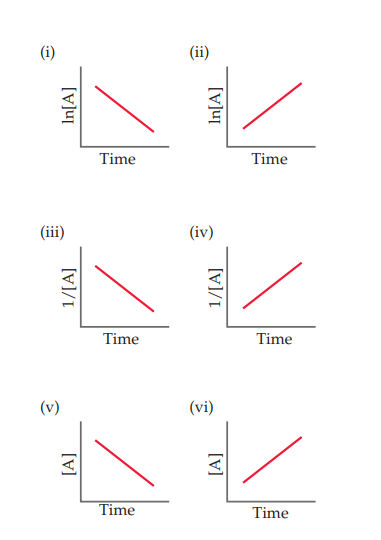
Which of the following linear plots do you expect for a reaction \(A \longrightarrow\) products if the kinetics are
(a) zero order,
(b) first order, or
(c) second order? [Section 14.4]
Text Transcription:
A \longrightarrow
Solution
The first step in solving 14 problem number trying to solve the problem we have to refer to the textbook question: Which of the following linear plots do you expect for a reaction \(A \longrightarrow\) products if the kinetics are (a) zero order, (b) first order, or (c) second order? [Section 14.4] Text Transcription:A \longrightarrow
From the textbook chapter Chemical Kinetics you will find a few key concepts needed to solve this.
Visible to paid subscribers only
Step 3 of 7)Visible to paid subscribers only
Subscribe to view the
full solution
full solution
Title
Chemistry: The Central Science 14
Author
Theodore E. Brown; H. Eugene LeMay; Bruce E. Bursten; Catherine Murphy; Patrick Woodward; Matthew E. Stoltzfus
ISBN
9780134414232
?Which of the following linear plots do you expect for a reaction \(A \longrightarrow\) products if the kinetics are (a) zero order,
Chapter 14 textbook questions
-
Chapter 14: Problem 14 Chemistry: The Central Science 14
-
Chapter 14: Problem 14 Chemistry: The Central Science 14
(a) What is meant by the term reaction rate? (b) Name three factors that can affect the rate of a chemical reaction. (c) Is the rate of disappearance of reactants always the same as the rate of appearance of products?
Read more -
Chapter 14: Problem 14 Chemistry: The Central Science 14
(a) What are the units usually used to express the rates of reactions occurring in solution? (b) As the temperature increases, does the reaction rate increase or decrease? (c) As a reaction proceeds, does the instantaneous reaction rate increase or decrease?
Read more -
Chapter 14: Problem 14 Chemistry: The Central Science 14
Consider a hypothetical reaction between A, B, and C that is first order in A, zero order in B, and second order in C. (a) Write the rate law for the reaction. (b) How does the rate change when [A] is doubled and the other reactant concentrations are held constant? (c) How does the rate change when [B] is tripled and the other reactant concentrations are held constant? (d) How does the rate change when [C] is tripled and the other reactant concentrations are held constant? (e) By what factor does the rate change when the concentrations of all three reactants are tripled? (f) By what factor does the rate change when the concentrations of all three reactants are cut in half?
Read more -
Chapter 14: Problem 14 Chemistry: The Central Science 14
Consider the data presented in Exercise 14.19. (a) By using appropriate graphs, determine whether the reaction is first order or second order. (b) What is the rate constant for the reaction? (c) What is the half-life for the reaction?
Read more -
Chapter 14: Problem 14 Chemistry: The Central Science 14
Consider the data presented in Exercise 14.20. (a) Determine whether the reaction is first order or second order. (b) What is the rate constant? (c) What is the half-life?
Read more -
Chapter 14: Problem 14 Chemistry: The Central Science 14
An automotive fuel injector dispenses a fine spray of gasoline into the automobile cylinder, as shown in the bottom drawing here. When an injector gets clogged, as shown in the top drawing, the spray is not as fine or even and the performance of the car declines. How is this observation related to chemical kinetics? [Section 14.1]
Read more -
Chapter 14: Problem 14 Chemistry: The Central Science 14
Consider the following graph of the concentration of a substance X over time. Is each of the following statements true or false? (a) X is a product of the reaction. (b) The rate of the reaction remains the same as time progresses. (c) The average rate between points 1 and 2 is greater than the average rate between points 1 and 3. (d) As time progresses, the curve will eventually turn downward toward the x-axis. [Section 14.2]
Read more -
Chapter 14: Problem 14 Chemistry: The Central Science 14
You study the rate of a reaction, measuring both the concentration of the reactant and the concentration of the product as a function of time, and obtain the following results: (a) Which chemical equation is consistent with these data: (i) (\mathrm{A} \longrightarrow \mathrm{B}), (ii) \(\mathrm{B} \longrightarrow \mathrm{A}\), (iii) \(\mathrm{A} \longrightarrow 2 \mathrm{~B}\), (iv) \(\mathrm{B} \longrightarrow 2 \mathrm{~A}\)? (b) Write equivalent expressions for the rate of the reaction in terms of the appearance or disappearance of the two substances. [Section 14.2] Text Transcription: A \longrightarrow B B \longrightarrow A A \longrightarrow 2B B \longrightarrow 2A
Read more -
Chapter 14: Problem 14 Chemistry: The Central Science 14
Suppose that for the reaction \(\mathrm{K}+\mathrm{L} \longrightarrow \mathrm{M}\), you monitor the production of M over time, and then plot the following graph from your data: (a) Is the reaction occurring at a constant rate from t = 0 to t = 15 min? (b) Is the reaction completed at t = 15 min? (c) Suppose the reaction as plotted here were started with 0.20 mol K and 0.40 mol L. After 30 min, an additional 0.20 mol K are added to the reaction mixture. Which of the following correctly describes how the plot would look from t = 30 min to t = 60 min? (i) [M] would remain at the same constant value it has at t = 30 min, (ii) [M] would increase with the same slope as t = 0 to 15 min, until t = 45 min at which point the plot becomes horizontal again, or (iii) [M] decreases and reaches 0 at t = 45 min. [Section 14.2] Text Transcription: K + {L \longrightarrow M
Read more -
Chapter 14: Problem 14 Chemistry: The Central Science 14
The following diagrams represent mixtures of \(\mathrm{NO}(g)\) and \(\mathrm{O}_{2}(g)\). These two substances react as follows: \(2 \mathrm{NO}(g)+\mathrm{O}_{2}(g) \longrightarrow 2 \mathrm{NO}_{2}(g)\) It has been determined experimentally that the rate is second order in NO and first order in \(\mathrm{O}_{2}\). Based on this fact, which of the following mixtures will have the fastest initial rate? [Section 14.3] Text Transcription: NO(g) O_2(g) 2 NO(g) + O_2(g) \longrightarrow 2 NO_2(g) O_2
Read more -
Chapter 14: Problem 14 Chemistry: The Central Science 14
A friend studies a first-order reaction and obtains the following three graphs for experiments done at two different temperatures. (a) Which two graphs represent experiments done at the same temperature? What accounts for the difference in these two graphs? In what way are they the same? (b) Which two graphs represent experiments done with the same starting concentration but at different temperatures? Which graph probably represents the lower temperature? How do you know? [Section 14.4]
Read more -
Chapter 14: Problem 14 Chemistry: The Central Science 14
(a) Given the following diagrams at t = 0 min and t = 30 min, what is the half-life of the reaction if it follows first-order kinetics? (b) After four half-life periods for a first-order reaction, what fraction of reactant remains? [Section 14.4]
Read more -
Chapter 14: Problem 14 Chemistry: The Central Science 14
Which of the following linear plots do you expect for a reaction \(A \longrightarrow\) products if the kinetics are (a) zero order, (b) first order, or (c) second order? [Section 14.4] Text Transcription: A \longrightarrow
Read more -
Chapter 14: Problem 14 Chemistry: The Central Science 14
The following diagram shows a reaction profile. Label the components indicated by the boxes. [Section 14.5]
Read more -
Chapter 14: Problem 14 Chemistry: The Central Science 14
The accompanying graph shows plots of ln k versus 1/T for two different reactions. The plots have been extrapolated to the y-intercepts. Which reaction (red or blue) has (a) the larger value for \(E_{a}\), and (b) the larger value for the frequency factor, A? [Section 14.5] Text Transcription: E_{a}
Read more -
Chapter 14: Problem 14 Chemistry: The Central Science 14
The following graph shows two different reaction pathways for the same overall reaction at the same temperature. Is each of the following statements true or false? (a) The rate is faster for the red path than for the blue path. (b) For both paths, the rate of the reverse reaction is slower than the rate of the forward reaction. (c) The energy change ?E is the same for both paths. [Section 14.6]
Read more -
Chapter 14: Problem 14 Chemistry: The Central Science 14
Consider the diagram that follows, which represents two steps in an overall reaction. The red spheres are oxygen, the blue ones nitrogen, and the green ones fluorine. (a) Write the chemical equation for each step in the reaction. (b) Write the equation for the overall reaction. (c) Identify the intermediate in the mechanism. (d) Write the rate law for the overall reaction if the first step is the slow, rate-determining step. [Section 14.6]
Read more -
Chapter 14: Problem 14 Chemistry: The Central Science 14
Based on the following reaction profile, how many intermediates are formed in the reaction \(\mathrm{A} \longrightarrow \mathrm{C}\)? How many transition states are there? Which step, \(\mathrm{A} \longrightarrow \mathrm{B}\) or \(\mathrm{B} \longrightarrow \mathrm{C}\), is the faster? For the reaction \(\mathrm{A} \longrightarrow \mathrm{C}\), is \(\Delta E\) positive, negative, or zero? [Section 14.6] Text Transcription: A \longrightarrow C A \longrightarrow B B \longrightarrow C A \longrightarrow C \Delta E
Read more -
Chapter 14: Problem 14 Chemistry: The Central Science 14
Draw a possible transition state for the bimolecular reaction depicted here. (The blue spheres are nitrogen atoms, and the red ones are oxygen atoms.) Use dashed lines to represent the bonds that are in the process of being broken or made in the transition state. [Section 14.6]
Read more -
Chapter 14: Problem 14 Chemistry: The Central Science 14
The following diagram represents an imaginary two-step mechanism. Let the red spheres represent element A, the green ones element B, and the blue ones element C. (a) Write the equation for the net reaction that is occurring. (b) Identify the intermediate. (c) Identify the catalyst. [Sections 14.6 and 14.7]
Read more -
Chapter 14: Problem 14 Chemistry: The Central Science 14
Consider the following hypothetical aqueous reaction: \(\mathrm{A}(a q) \rightarrow \mathrm{B}(a q)\). A flask is charged with 0.065 mol of A in a total volume of 100.0 mL. The following data are collected: (a) Calculate the number of moles of B at each time in the table, assuming that there are no molecules of B at time zero and that A cleanly converts to B with no intermediates. (b) Calculate the average rate of disappearance of A for each 10-min interval in units of M/s. (c) Between t = 10 min and t = 30 min, what is the average rate of appearance of B in units of M/s? Assume that the volume of the solution is constant. Text Transcription: A(aq) \rightarrow B(aq)
Read more -
Chapter 14: Problem 14 Chemistry: The Central Science 14
A flask is charged with 0.100 mol of A and allowed to react to form B according to the hypothetical gas-phase reaction \(\mathrm{A}(g) \longrightarrow \mathrm{B}(g)\). The following data are collected: (a) Calculate the number of moles of B at each time in the table, assuming that A is cleanly converted to B with no intermediates. (b) Calculate the average rate of disappearance of A for each 40 s interval in units of mol/s. (c) Which of the following would be needed to calculate the rate in units of concentration per time: (i) the pressure of the gas at each time, (ii) the volume of the reaction flask, (iii) the temperature, or (iv) the molecular weight of A? Text Transcription: A(g) \longrightarrow B(g)
Read more -
Chapter 14: Problem 14 Chemistry: The Central Science 14
The isomerization of methyl isonitrile \(\left(\mathrm{CH}_{3} \mathrm{NC}\right)\) to acetonitrile \(\left(\mathrm{CH}_{3} \mathrm{CN}\right)\) was studied in the gas phase at \(215^{\circ} \mathrm{C}\), and the following data were obtained: (a) Calculate the average rate of reaction, in M/s, for the time interval between each measurement. (b) Calculate the average rate of reaction over the entire time of the data from t = 0 to t = 15,000 s. (c) Which is greater, the average rate between t = 2000 and t = 12,000 s, or between t = 8000 and t = 15,000 s? (d) Graph \(\left[\mathrm{CH}_{3} \mathrm{NC}\right]\) versus time and determine the instantaneous rates in M/s at t = 5000 s and t = 8000 s. Text Transcription: (CH_3NC) (CH_3CN) 215^{\circ} C [CH_3NC]
Read more -
Chapter 14: Problem 14 Chemistry: The Central Science 14
The rate of disappearance of HCl was measured for the following reaction: \(\mathrm{CH}_{3} \mathrm{OH}(a q)+\mathrm{HCl}(a q) \longrightarrow \mathrm{CH}_{3} \mathrm{Cl}(a q)+\mathrm{H}_{2} \mathrm{O}(l)\) The following data were collected: (a) Calculate the average rate of reaction, in M/s, for the time interval between each measurement. (b) Calculate the average rate of reaction for the entire time for the data from t = 0.0 min to t = 430.0 min. (c) Which is greater, the average rate between t = 54.0 and t = 215.0 min, or between t = 107.0 and t = 430.0 min? (d) Graph [HCl] versus time and determine the instantaneous rates in M/min and M/s at t = 75.0 min and t = 250 min. Text Transcription: CH_3OH(aq) + HCl(aq) \longrightarrow CH_3Cl(aq) + H_2O(l)
Read more -
Chapter 14: Problem 14 Chemistry: The Central Science 14
For each of the following gas-phase reactions, indicate how the rate of disappearance of each reactant is related to the rate of appearance of each product: (a) \(\mathrm{H}_{2} \mathrm{O}_{2}(g) \longrightarrow \mathrm{H}_{2}(g)+\mathrm{O}_{2}(g)\) (b) \(2 \mathrm{~N}_{2} \mathrm{O}(g) \longrightarrow 2 \mathrm{~N}_{2}(g)+\mathrm{O}_{2}(g)\) (c) \(\mathrm{N}_{2}(g)+3 \mathrm{H}_{2}(g) \longrightarrow 2 \mathrm{NH}_{3}(g)\) (d) \(\mathrm{C}_{2} \mathrm{H}_{5} \mathrm{NH}_{2}(g) \longrightarrow \mathrm{C}_{2} \mathrm{H}_{4}(g)+\mathrm{NH}_{3}(g)\) Text Transcription: H_2O_2(g) \longrightarrow H_2(g) + O_2(g) 2 N_2O(g) \longrightarrow 2 N_2(g) + O_2(g) N_2(g) + 3 H_2(g) \longrightarrow 2 NH_3(g) C_2H_5NH_2(g) \longrightarrow C_2H_4(g) + NH_3(g)
Read more -
Chapter 14: Problem 14 Chemistry: The Central Science 14
For each of the following gas-phase reactions, write the rate expression in terms of the appearance of each product and disappearance of each reactant: (a) \(2 \mathrm{H}_{2} \mathrm{O}(g) \longrightarrow 2 \mathrm{H}_{2}(g)+\mathrm{O}_{2}(g)\) (b) \(2 \mathrm{SO}_{2}(g)+\mathrm{O}_{2}(g) \longrightarrow 2 \mathrm{SO}_{3}(g)\) (c) \(2 \mathrm{NO}(g)+2 \mathrm{H}_{2}(g) \longrightarrow \mathrm{N}_{2}(g)+2 \mathrm{H}_{2} \mathrm{O}(g)\) (d) \(\mathrm{N}_{2}(g)+2 \mathrm{H}_{2}(g) \longrightarrow \mathrm{N}_{2} \mathrm{H}_{4}(g)\) Text Transcription: 2 H2O(g) \longrightarrow 2 H2(g) + O2(g) 2 SO2(g) + O2(g) \longrightarrow 2 SO3(g) 2 NO(g) + 2 H2(g) \longrightarrow N2(g) + 2 H2O(g) N2(g) + 2 H2(g) \longrightarrow N2H4(g)
Read more -
Chapter 14: Problem 14 Chemistry: The Central Science 14
(a) Consider the combustion of hydrogen, \(2 \mathrm{H}_{2}(g)+ \mathrm{O}_{2}(g) \longrightarrow 2 \mathrm{H}_{2} \mathrm{O}(g)\). If hydrogen is burning at the rate of 0.48 mol/s, what is the rate of consumption of oxygen? What is the rate of formation of water vapor? (b) The reaction \(2 \mathrm{NO}(g)+\mathrm{Cl}_{2}(g) \longrightarrow 2 \mathrm{NOCl}(g)\) is carried out in a closed vessel. If the partial pressure of NO is decreasing at the rate of 56 torr/min, what is the rate of change of the total pressure of the vessel? Text Transcription: 2 H_2(g) + O_2(g) \longrightarrow 2 H_2O(g) 2 NO(g) + Cl_2(g) \longrightarrow 2 NOCl(g)
Read more -
Chapter 14: Problem 14 Chemistry: The Central Science 14
(a) Consider the combustion of ethylene, \(\mathrm{C}_{2} \mathrm{H}_{4}(g)+ 3 \mathrm{O}_{2}(g) \longrightarrow 2 \mathrm{CO}_{2}(g)+2 \mathrm{H}_{2} \mathrm{O}(g)\). If the concentration of \(\mathrm{C}_{2} \mathrm{H}_{4}\) is decreasing at the rate of 0.036 M/s, what are the rates of change in the concentrations of \(\mathrm{CO}_{2}\) and \(\mathrm{H}_{2} \mathrm{O}\)? (b) The rate of decrease in \(\mathrm{N}_{2} \mathrm{H}_{4}\) partial pressure in a closed reaction vessel from the reaction \(\mathrm{N}_{2} \mathrm{H}_{4}(g)+\mathrm{H}_{2}(g) \longrightarrow 2 \mathrm{NH}_{3}(g)\) is 74 torr per hour. What are the rates of change of \(\mathrm{NH}_{3}\) partial pressure and total pressure in the vessel? Text Transcription: C_2H_4(g) + 3 O_2(g) \longrightarrow 2 CO_2(g) + 2 H_2O(g) C_2H_4 CO_2 H_2O N_2H_4 N_2H_4(g) + H_2(g) ¡ 2 NH_3(g) NH_3
Read more -
Chapter 14: Problem 14 Chemistry: The Central Science 14
A reaction \(\mathrm{A}+\mathrm{B} \longrightarrow \mathrm{C}\) obeys the following rate law: Rate = \(k[\mathrm{~B}]^{2}\). (a) If [A] is doubled, how will the rate change? Will the rate constant change? (b) What are the reaction orders for A and B? What is the overall reaction order? (c) What are the units of the rate constant? Text Transcription: A + B \longrightarrow C k[B]^ 2
Read more -
Chapter 14: Problem 14 Chemistry: The Central Science 14
The decomposition reaction of \(\mathrm{N}_{2} \mathrm{O}_{5}\) in carbon tetrachloride is \(2 \mathrm{~N}_{2} \mathrm{O}_{5} \longrightarrow 4 \mathrm{NO}_{2}+\mathrm{O}_{2}\). The rate law is first order in \(\mathrm{N}_{2} \mathrm{O}_{5}\). At \(64^{\circ} \mathrm{C}\) the rate constant is \(4.82 \times 10^{-3} \mathrm{~s}^{-1}\). (a) Write the rate law for the reaction. (b) What is the rate of reaction when \(\left[\mathrm{N}_{2} \mathrm{O}_{5}\right]=0.0240 \mathrm{M}\)? (c) What happens to the rate when the concentration of \(\mathrm{N}_{2} \mathrm{O}_{5}\) is doubled to 0.0480 M? (d) What happens to the rate when the concentration of \(\mathrm{N}_{2} \mathrm{O}_{5}\) is halved to 0.0120 M? Text Transcription: N_2O_5 2 N_2O_5 \longrightarrow 4 NO_2 + O_2 64^{\circ} C 4.82 X 10⁻³ s-1 [N2O5] = 0.0240 M?
Read more -
Chapter 14: Problem 14 Chemistry: The Central Science 14
Consider the following reaction: \(2 \mathrm{NO}(g)+2 \mathrm{H}_{2}(g) \longrightarrow \mathrm{N}_{2}(g)+2 \mathrm{H}_{2} \mathrm{O}(g)\) (a) The rate law for this reaction is first order in \(\mathrm{H}_{2}\) and second order in NO. Write the rate law. (b) If the rate constant for this reaction at 1000 K is \(6.0 \times 10^{4} \mathrm{M}^{-2} \mathrm{~s}^{-1}\), what is the reaction rate when [NO] = 0.035 M and \(\left[\mathrm{H}_{2}\right]\) = 0.015 M? (c) What is the reaction rate at 1000 K when the concentration of NO is increased to 0.10 M, while the concentration of \(\mathrm{H}_{2}\) is 0.010 M? (d) What is the reaction rate at 1000 K if [NO] is decreased to 0.010 M and \(\left[\mathrm{H}_{2}\right]\) is increased to 0.030 M? Text Transcription: 2 NO(g) + 2 H_2(g) \longrightarrow N_2(g) + 2 H_2O(g) H_2 6.0 X 10⁴ M -2 s-1 [H_2]
Read more -
Chapter 14: Problem 14 Chemistry: The Central Science 14
Consider the following reaction: \(\mathrm{CH}_{3} \mathrm{Br}(a q)+\mathrm{OH}^{-}(a q) \longrightarrow \mathrm{CH}_{3} \mathrm{OH}(a q)+\mathrm{Br}^{-}(a q)\) The rate law for this reaction is first order in \(\mathrm{CH}_{3} \mathrm{Br}\) and first order in \(\mathrm{OH}^{-}\). When \(\left[\mathrm{CH}_{3} \mathrm{Br}\right]\) is \(5.0 \times 10^{-3} \mathrm{M}\) and \(\left[\mathrm{OH}^{-}\right]\) is 0.050 M, the reaction rate at 298 K is 0.0432 M/s. (a) What is the value of the rate constant? (b) What are the units of the rate constant? (c) What would happen to the rate if the concentration of \(\mathrm{OH}^{-}\) were tripled? (d) What would happen to the rate if the concentration of both reactants were tripled? Text Transcription: CH_3Br(aq) + OH-(aq) \longrightarrow CH_3OH(aq) + Br-(aq) CH3Br OH- [CH3Br] 5.0 X 10⁻³ M [OH- ]
Read more -
Chapter 14: Problem 14 Chemistry: The Central Science 14
The reaction between ethyl bromide \(\left(\mathrm{C}_{2} \mathrm{H}_{5} \mathrm{Br}\right)\) and hydroxide ion in ethyl alcohol at 330 K, \(\mathrm{C}_{2} \mathrm{H}_{5} \mathrm{Br}(\text { alc })+\mathrm{OH}^{-}(\text {alc }) \longrightarrow \mathrm{C}_{2} \mathrm{H}_{5} \mathrm{OH}(l)+\mathrm{Br}^{-}(\text {alc })\), is first order each in ethyl bromide and hydroxide ion. When \(\left[\mathrm{C}_{2} \mathrm{H}_{5} \mathrm{Br}\right]\) is 0.0477 M and \(\left[\mathrm{OH}^{-}\right]\) is 0.100 M, the rate of disappearance of ethyl bromide is \(1.7 \times 10^{-7} \mathrm{M} / \mathrm{s}\). (a) What is the value of the rate constant? (b) What are the units of the rate constant? (c) How would the rate of disappearance of ethyl bromide change if the solution were diluted by adding an equal volume of pure ethyl alcohol to the solution? Text Transcription: (C_2H_5Br) C_2H_5Br(alc) + OH- (alc) \longrightarrow C_2H_5OH(l) + Br - (alc) [C_2H_5Br] [OH- ] 1.7 X 10⁻⁷ M/s
Read more -
Chapter 14: Problem 14 Chemistry: The Central Science 14
The iodide ion reacts with hypochlorite ion (the active ingredient in chlorine bleaches) in the following way: \(\mathrm{OCl}^{-}+\mathrm{I}^{-} \longrightarrow \mathrm{OI}^{-}+\mathrm{Cl}^{-}\). This rapid reaction gives the following rate data: (a) Write the rate law for this reaction. (b) Calculate the rate constant with proper units. (c) Calculate the rate when \(\left[\mathrm{OCl}^{-}\right]=2.0 \times 10^{-3} \mathrm{M}\) and \(\left[\mathrm{I}^{-}\right]=5.0 \times 10^{-4} \mathrm{M}\). Text Transcription: OCl - + I - \longrightarrow OI - + Cl - [OCl -] = 2.0 X 10⁻³ M [I - ] = 5.0 X 10 - 4 M
Read more -
Chapter 14: Problem 14 Chemistry: The Central Science 14
The reaction \(2 \mathrm{ClO}_{2}(a q)+2 \mathrm{OH}^{-}(a q) \longrightarrow \mathrm{ClO}_{3}^{-}(a q)+ \mathrm{ClO}_{2}^{-}(a q)+\mathrm{H}_{2} \mathrm{O}(l)\) was studied with the following results. (a) Determine the rate law for the reaction. (b) Calculate the rate constant with proper units. (c) Calculate the rate when \(\left[\mathrm{ClO}_{2}\right]=0.100 \mathrm{M}\) and \(\left[\mathrm{OH}^{-}\right]=0.050 \mathrm{M}\). Text Transcription: 2 ClO_2(aq) + 2 OH- (aq) \longrightarrow ClO_3 - (aq) + ClO_2 - (aq) + H_2O(l) [ClO_2] = 0.100 M [OH- ] = 0.050 M
Read more -
Chapter 14: Problem 14 Chemistry: The Central Science 14
The following data were measured for the reaction \(\mathrm{BF}_{3}(g)+\mathrm{NH}_{3}(g) \longrightarrow \mathrm{F}_{3} \mathrm{BNH}_{3}(g):\) (a) What is the rate law for the reaction? (b) What is the overall order of the reaction? (c) Calculate the rate constant with proper units? (d) What is the rate when \(\left[\mathrm{BF}_{3}\right]=0.100 \mathrm{M}\) and \(\left[\mathrm{NH}_{3}\right]=0.500 \mathrm{M}\)? Text Transcription: BF_3(g) + NH_3(g) \longrightarrow F_3BNH_3(g): [BF_3] = 0.100 M a [NH_3] = 0.500 M
Read more -
Chapter 14: Problem 14 Chemistry: The Central Science 14
The following data were collected for the rate of disappearance of NO in the reaction \(2 \mathrm{NO}(g)+\mathrm{O}_{2}(g) \longrightarrow 2 \mathrm{NO}_{2}(g):\) (a) What is the rate law for the reaction? (b) What are the units of the rate constant? (c) What is the average value of the rate constant calculated from the three data sets? (d) What is the rate of disappearance of NO when [NO] = 0.0750 M and \(\left[\mathrm{O}_{2}\right]\) = 0.0100 M ? (e) What is the rate of disappearance of \(\mathrm{O}_{2}\) at the concentrations given in part (d)? Text Transcription: 2 NO(g) + O_2(g) \longrightarrow 2 NO_2(g): [O_2] O_2
Read more -
Chapter 14: Problem 14 Chemistry: The Central Science 14
Consider the gas-phase reaction between nitric oxide and bromine at \(273{ }^{\circ} \mathrm{C}: 2 \mathrm{NO}(g)+\mathrm{Br}_{2}(g) \longrightarrow 2 \operatorname{NOBr}(g)\). The following data for the initial rate of appearance of NOBr were obtained: (a) Determine the rate law. (b) Calculate the average value of the rate constant for the appearance of NOBr from the four data sets. (c) How is the rate of appearance of NOBr related to the rate of disappearance of \(\mathrm{Br}_{2}\)? (d) What is the rate of disappearance of \(\mathrm{Br}_{2}\) when [NO] = 0.075 M and \(\left[\mathrm{Br}_{2}\right]\) = 0.25 M ? Text Transcription: 273{ }^{\circ} C:2 NO(g) + Br_2(g) \longrightarrow 2 NOBr(g) Br_2 [Br_2]
Read more -
Chapter 14: Problem 14 Chemistry: The Central Science 14
Consider the reaction of peroxydisulfate ion \(\left(\mathrm{S}_{2} \mathrm{O}_{8}{ }^{2-}\right)\) with iodide ion \(\left(\mathrm{I}^{-}\right)\) in aqueous solution: \(\mathrm{S}_{2} \mathrm{O}_{8}{ }^{2-}(a q)+3 \mathrm{I}^{-}(a q) \longrightarrow 2 \mathrm{SO}_{4}^{2-}(a q)+\mathrm{I}_{3}^{-}(a q)\) At a particular temperature, the initial rate of disappearance of \(\mathrm{S}_{2} \mathrm{O}_{8}^{2-}\) varies with reactant concentrations in the following manner: (a) Determine the rate law for the reaction and state the units of the rate constant. (b) What is the average value of the rate constant for the disappearance of \(\mathrm{S}_{2} \mathrm{O}_{8}^{2-}\) based on the four sets of data? (c) How is the rate of disappearance of \(\mathrm{S}_{2} \mathrm{O}_{8}^{2-}\) related to the rate of disappearance of \(\mathrm{I}^{-}\) ? (d) What is the rate of disappearance of \(\mathrm{I}^{-}\) when \(\left[\mathrm{S}_{2} \mathrm{O}_{8}^{2-}\right]\) = 0.025 M and 3I - 4 = 0.050 M ? Text Transcription: (S_2O_8 2-) (I - ) S_2O_8 2 - (aq) + 3 I - (aq) \longrightarrow 2 SO_4 2 - (aq) + I_3 - (aq) S_2O_8 2- I^- [S_2O_8 2-]
Read more -
Chapter 14: Problem 14 Chemistry: The Central Science 14
(a) For the generic reaction \(\mathrm{A} \rightarrow \mathrm{B}\) what quantity, when graphed versus time, will yield a straight line for a first-order reaction? (b) How can you calculate the rate constant for a first-order reaction from the graph you made in part (a)? Text Transcription: A \rightarrow B
Read more -
Chapter 14: Problem 14 Chemistry: The Central Science 14
(a) For a generic second-order reaction $\mathrm{A} \longrightarrow \mathrm{B}$, what quantity, when graphed versus time, will yield a straight line? (b) What is the slope of the straight line from part (a)? (c) Does the half-life of a second-order reaction increase, decrease, or remain the same as the reaction proceeds? Text Transcription: A \longrightarrow B
Read more -
Chapter 14: Problem 14 Chemistry: The Central Science 14
(a) The gas-phase decomposition of \(\mathrm{SO}_{2} \mathrm{Cl}_{2}, \mathrm{SO}_{2} \mathrm{Cl}_{2}(g) \longrightarrow \mathrm{SO}_{2}(g)+\mathrm{Cl}_{2}(g)\), is first order in \(\mathrm{SO}_{2} \mathrm{Cl}_{2}\). At 600 K the half-life for this process is \(2.3 \times 10^{5} \mathrm{~s}\). What is the rate constant at this temperature? (b) At \(320^{\circ} \mathrm{C}\) the rate constant is \(2.2 \times 10^{-5} \mathrm{~s}^{-1}\). What is the half-life at this temperature? Text Transcription: SO_2Cl_2, SO_2Cl_2(g) \longrightarrow SO_2(g) + Cl_2(g) SO_2Cl_2 2.3 X 10^5 s 320^{\circ} C 2.2 X 10⁻⁵ s-1
Read more -
Chapter 14: Problem 14 Chemistry: The Central Science 14
Molecular iodine, \(\mathrm{I}_{2}(g)\), dissociates into iodine atoms at 625 K with a first-order rate constant of \(0.271 \mathrm{~s}^{-1}\). (a) What is the half-life for this reaction? (b) If you start with \(0.050 \mathrm{MI}_{2}\) at this temperature, how much will remain after 5.12 s assuming that the iodine atoms do not recombine to form \(\mathrm{I}_{2}\)? Text Transcription: I_2(g) 0.271 s^-1 0.050 M I_2 I_2
Read more -
Chapter 14: Problem 14 Chemistry: The Central Science 14
As described in Exercise 14.41, the decomposition of sulfuryl chloride \(\left(\mathrm{SO}_{2} \mathrm{Cl}_{2}\right)\) is a first-order process. The rate constant for the decomposition at 660 K is \(4.5 \times 10^{-2} \mathrm{~s}^{-1}\). (a) If we begin with an initial \(\mathrm{SO}_{2} \mathrm{Cl}_{2}\) pressure of 450 torr, what is the partial pressure of this substance after 60 s ? (b) At what time will the partial pressure of \(\mathrm{SO}_{2} \mathrm{Cl}_{2}\) decline to one-tenth its initial value? Text Transcription: (SO_2Cl_2) 4.5 X 10⁻² s-1 SO_2Cl_2
Read more -
Chapter 14: Problem 14 Chemistry: The Central Science 14
The first-order rate constant for the decomposition of \(\mathrm{N}_{2} \mathrm{O}_{5}, 2 \mathrm{~N}_{2} \mathrm{O}_{5}(g) \longrightarrow 4 \mathrm{NO}_{2}(g)+\mathrm{O}_{2}(g)\), at \(70^{\circ} \mathrm{C}\) is \(6.82 \times 10^{-3} \mathrm{~s}^{-1}\). Suppose we start with 0.0250 mol of \(\mathrm{N}_{2} \mathrm{O}_{5}(g)\) in a volume of 2.0 L. (a) How many moles of \(\mathrm{N}_{2} \mathrm{O}_{5}\) will remain after 5.0 min? (b) How many minutes will it take for the quantity of \(\mathrm{N}_{2} \mathrm{O}_{5}\) to drop to 0.010 mol? (c) What is the half-life of \(\mathrm{N}_{2} \mathrm{O}_{5}\) at \(70^{\circ} \mathrm{C}\) ? Text Transcription: N_2O_5, 2 N_2O_5(g) \longrightarrow 4 NO_2(g) + O_2(g) 70^{\circ} C 6.82 X 10⁻³ s-1 N_2O_5(g) N_2O_5
Read more -
Chapter 14: Problem 14 Chemistry: The Central Science 14
The reaction \(\mathrm{SO}_{2} \mathrm{Cl}_{2}(g) \longrightarrow \mathrm{SO}_{2}(g)+\mathrm{Cl}_{2}(g)\) is first order in \(\mathrm{SO}_{2} \mathrm{Cl}_{2}\). Using the following kinetic data, determine the magnitude and units of the first-order rate constant: Text Transcription: SO_2Cl_2(g) \longrightarrow SO_2(g) + Cl_2(g) SO_2Cl_2
Read more -
Chapter 14: Problem 14 Chemistry: The Central Science 14
From the following data for the first-order gas-phase isomerization of \(\mathrm{CH}_{3} \mathrm{NC}\) at \(215^{\circ} \mathrm{C}\), calculate the first order rate constant and half-life for the reaction: Text Transcription: CH_3NC 215^{\circ} C
Read more -
Chapter 14: Problem 14 Chemistry: The Central Science 14
Draw a graph showing the reaction pathway for an overall exothermic reaction with two intermediates that are produced at different rates. On your graph indicate the reactants, products, intermediates, transition states, and activation energies. [Sections 14.6 and 14.7]
Read more -
Chapter 14: Problem 14 Chemistry: The Central Science 14
(a) What is meant by the term reaction rate? (b) Name three factors that can affect the rate of a chemical reaction. (c) Is the rate of disappearance of reactants always the same as the rate of appearance of products?
Read more -
Chapter 14: Problem 14 Chemistry: The Central Science 14
(a) What are the units usually used to express the rates of reactions occurring in solution? (b) As the temperature increases, does the reaction rate increase or decrease? (c) As a reaction proceeds, does the instantaneous reaction rate increase or decrease?
Read more -
Chapter 14: Problem 14 Chemistry: The Central Science 14
Consider a hypothetical reaction between A, B, and C that is first order in A, zero order in B, and second order in C. (a) Write the rate law for the reaction. (b) How does the rate change when [A] is doubled and the other reactant concentrations are held constant? (c) How does the rate change when [B] is tripled and the other reactant concentrations are held constant? (d) How does the rate change when [C] is tripled and the other reactant concentrations are held constant? (e) By what factor does the rate change when the concentrations of all three reactants are tripled? (f) By what factor does the rate change when the concentrations of all three reactants are cut in half?
Read more -
Chapter 14: Problem 14 Chemistry: The Central Science 14
Consider the data presented in Exercise 14.19. (a) By using appropriate graphs, determine whether the reaction is first order or second order. (b) What is the rate constant for the reaction? (c) What is the half-life for the reaction?
Read more -
Chapter 14: Problem 14 Chemistry: The Central Science 14
Consider the data presented in Exercise 14.20. (a) Determine whether the reaction is first order or second order. (b) What is the rate constant? (c) What is the half-life?
Read more -
Chapter 14: Problem 14 Chemistry: The Central Science 14
The gas-phase decomposition of \(\mathrm{NO}_{2}, 2 \mathrm{NO}_{2}(g) \longrightarrow\) \(2 \mathrm{NO}(g)+\mathrm{O}_{2}(g)\), is studied at \(383^{\circ} \mathrm{C}\), giving the following data: (a) Is the reaction first order or second order with respect to the concentration of \(\mathrm{NO}_{2}\)? (b) What is the rate constant? (c) Predict the reaction rates at the beginning of the reaction for initial concentrations of 0.200 M, 0.100 M, and \(0.050 \mathrm{MNO}_{2}\). Text Transcription: NO_2, 2 NO_2(g) longrightarrow 2 NO(g)+O_2(g) 383^circ C NO_2 0.050 MNO_2
Read more -
Chapter 14: Problem 14 Chemistry: The Central Science 14
Sucrose \(\left(\mathrm{C}_{12} \mathrm{H}_{22} \mathrm{O}_{11}\right)\), commonly known as table sugar, reacts in dilute acid solutions to form two simpler sugars, glucose and fructose, both of which have the formula \(\mathrm{C}_{6} \mathrm{H}_{12} \mathrm{O}_{6}\). At \(23{ }^{\circ} \mathrm{C}\) and in 0.5 M HCl, the following data were obtained for the disappearance of sucrose: (a) Is the reaction first order or second order with respect to \(\left[\mathrm{C}_{12} \mathrm{H}_{22} \mathrm{O}_{11}\right]\)? (b) What is the rate constant? (c) Using this rate constant, calculate the concentration of sucrose at 39 , 80,140 , and 210 min if the initial sucrose concentration was 0.316 M and the reaction were zero order in sucrose. Text Transcription: (C_12 H_22 O_11) C_6 H_12 O_6 23^circ C [C_12 H_22 O_11]
Read more -
Chapter 14: Problem 14 Chemistry: The Central Science 14
(a) In which of the following reactions would you expect the orientation factor to be least important in leading to reaction: \(\mathrm{NO}+\mathrm{O} \longrightarrow \mathrm{NO}_{2}\) or \(\mathrm{H}+\mathrm{Cl} \longrightarrow \mathrm{HCl}\)? (b) Does the orientation factor depend on temperature? Text Transcription: NO+O longrightarrow NO_2 H+Cl longrightarrow HCl
Read more -
Chapter 14: Problem 14 Chemistry: The Central Science 14
The gas-phase reaction \(\mathrm{Cl}(g)+\mathrm{HBr}(g) \longrightarrow \mathrm{HCl}(g)+\mathrm{Br}(g)\) has an overall energy change of -66 kJ. The activation energy for the reaction is 7 kJ. (a) Sketch the energy profile for the reaction, and label \(E_{a}\) and \(\Delta E\). (b) What is the activation energy for the reverse reaction? Text Transcription: Cl(g)+HBr(g) longrightarrow HCl(g)+Br(g) E_a Delta E
Read more -
Chapter 14: Problem 14 Chemistry: The Central Science 14
For the elementary process \(\mathrm{N}_{2} \mathrm{O}_{5}(g) \longrightarrow \mathrm{NO}_{2}(g)+\mathrm{NO}_{3}(g)\) the activation energy \(\left(E_{a}\right)\) and overall \(\Delta E\) are 154 kJ / mol and 136 kJ / mol, respectively. (a) Sketch the energy profile for this reaction, and label \(E_{a}\) and \(\Delta E\). (b) What is the activation energy for the reverse reaction? Text Transcription: N_2 O_5(g) longrightarrow NO_2(g)+NO_3(g) (E_a) Delta E
Read more -
Chapter 14: Problem 14 Chemistry: The Central Science 14
Based on their activation energies and energy changes and assuming that all collision factors are the same, rank the following reactions from slowest to fastest. (a) \(E_{a}=45 \mathrm{~kJ} / \mathrm{mol} ; \Delta E=-25 \mathrm{~kJ} / \mathrm{mol}\) (b) \(E_{a}=35 \mathrm{~kJ} / \mathrm{mol} ; \Delta E=-10 \mathrm{~kJ} / \mathrm{mol}\) (c) \(E_{a}=55 \mathrm{~kJ} / \mathrm{mol} ; \Delta E=10 \mathrm{~kJ} / \mathrm{mol}\) Text Transcription: E_a=45 kJ / mol ; \Delta E=-25 kJ / mol E_a=35 kJ / mol ; \Delta E=-10 kJ / mol E_a=55 kJ / mol ; Delta E=10 kJ / mol
Read more -
Chapter 14: Problem 14 Chemistry: The Central Science 14
(a) A certain first-order reaction has a rate constant of \(2.75 \times 10^{-2} \mathrm{~s}^{-1}\) at \(20^{\circ} \mathrm{C}\). What is the value of k at \(60^{\circ} \mathrm{C}\) if \(E_{a}=75.5 \mathrm{~kJ} / \mathrm{mol}\)? (b) Another first-order reaction also has a rate constant of \(2.75 \times 10^{-2} \mathrm{~s}^{-1}\) at \(20^{\circ} \mathrm{C}\). What is the value of k at \(60^{\circ} \mathrm{C}\) if \(E_{a}=125 \mathrm{~kJ} / \mathrm{mol}\)? (c) What assumptions do you need to make in order to calculate answers for parts (a) and (b)? Text Transcription: 2.75 \times 10^-2 s^-1 20^circ C 60^circ C E_a=75.5 kJ / mol E_a=125 kJ / mol
Read more -
Chapter 14: Problem 14 Chemistry: The Central Science 14
Understanding the high-temperature behavior of nitrogen oxides is essential for controlling pollution generated in automobile engines. The decomposition of nitric oxide (NO) to \(\mathrm{N}_{2}\) and \(\mathrm{O}_{2}\) is second order with a rate constant of \(0.0796 \mathrm{M}^{-1} \mathrm{~s}^{-1}\) at \(737{ }^{\circ} \mathrm{C}\) and \(0.0815 \mathrm{M}^{-1} \mathrm{~s}^{-1}\) at \(947^{\circ} \mathrm{C}\). Calculate the activation energy for the reaction. Text Transcription: N_2 O_2 0.0796 M^-1 s^-1 737^circ C 0.0815 M^-1 s^-1 947^circ C
Read more -
Chapter 14: Problem 14 Chemistry: The Central Science 14
The rate of the reaction \(\mathrm{CH}_{3} \mathrm{COOC}_{2} \mathrm{H}_{5}(a q)+\mathrm{OH}^{-}(a q) \longrightarrow \mathrm{CH}_{3} \mathrm{COO}^{-}(a q)+\mathrm{C}_{2} \mathrm{H}_{5} \mathrm{OH}(a q)\) was measured at several temperatures, and the following data were collected: Calculate the value of \(E_{a}\) by constructing an appropriate graph. Text Transcription: CH_3 COOC_2 H_5(a q)+OH^-(a q) longrightarrow CH_3 COO^-(a q)+C_2 H_5 OH(a q) E_a
Read more -
Chapter 14: Problem 14 Chemistry: The Central Science 14
The temperature dependence of the rate constant for a reaction is tabulated as follows: Calculate \(E_{a}\) and A. Text Transcription: E_a
Read more -
Chapter 14: Problem 14 Chemistry: The Central Science 14
(a) Can an intermediate appear as a reactant in the first step of a reaction mechanism? (b) On a reaction energy profile diagram, is an intermediate represented as a peak or a valley? (c) If a molecule like \(\mathrm{Cl}_{2}\) falls apart in an elementary reaction, what is the molecularity of the reaction? Text Transcription: Cl_2
Read more -
Chapter 14: Problem 14 Chemistry: The Central Science 14
What is the molecularity of each of the following elementary reactions? Write the rate law for each. (a) \(\mathrm{Cl}_{2}(g) \longrightarrow 2 \mathrm{Cl}(g)\) (b) \(\mathrm{OCl}^{-}(a q)+\mathrm{H}_{2} \mathrm{O}(l) \longrightarrow \operatorname{HOCl}(a q)+\mathrm{OH}^{-}(a q)\) (c) \(\mathrm{NO}(g)+\mathrm{Cl}_{2}(g) \longrightarrow \mathrm{NOCl}_{2}(g)\) Text Transcription: Cl_2(g) longrightarrow 2 Cl(g) OCl^-(a q)+H_2 O(l) longrightarrow HOCl(a q)+OH^-(a q) NO(g)+Cl_2(g) longrightarrow NOCl_2(g)
Read more -
Chapter 14: Problem 14 Chemistry: The Central Science 14
What is the molecularity of each of the following elementary reactions? Write the rate law for each. (a) \(2 \mathrm{NO}(g) \longrightarrow \mathrm{N}_{2} \mathrm{O}_{2}(g)\) (c) \(\mathrm{SO}_{3}(g) \longrightarrow \mathrm{SO}_{2}(g)+\mathrm{O}(g)\) Text Transcription: 2 NO(g) longrightarrow N_2 O_2(g) H_2 C-CH_2(g) longrightarrow CH_2=CH-CH_3(g) SO_3(g) longrightarrow SO_2(g)+O(g)
Read more -
Chapter 14: Problem 14 Chemistry: The Central Science 14
(a) Based on the following reaction profile, how many intermediates are formed in the reaction \(\mathrm{A} \longrightarrow \mathrm{D}\)? (b) How many transition states are there? (c) Which step is the fastest? (d) For the reaction \(\mathrm{A} \longrightarrow \mathrm{D}\), is \(\Delta E\) positive, negative, or zero? Text Transcription: A longrightarrow D Delta E
Read more -
Chapter 14: Problem 14 Chemistry: The Central Science 14
Consider the following energy profile. (a) How many elementary reactions are in the reaction mechanism? (b) How many intermediates are formed in the reaction? (c) Which step is rate limiting? (d) For the overall reaction, is \(\Delta E\) positive, negative, or zero? Text Transcription: Delta E
Read more -
Chapter 14: Problem 14 Chemistry: The Central Science 14
The following mechanism has been proposed for the gas phase reaction of \(\mathrm{H}_{2}\) with ICl: \(\mathrm{H}_{2}(g)+\mathrm{ICl}(g) \longrightarrow \mathrm{HI}(g)+\mathrm{HCl}(g)\) \(\mathrm{HI}(g)+\mathrm{ICl}(g) \longrightarrow \mathrm{I}_{2}(g)+\mathrm{HCl}(g)\) (a) Write the balanced equation for the overall reaction. (b) Identify any intermediates in the mechanism. (c) If the first step is slow and the second one is fast, which rate law do you expect to be observed for the overall reaction? Text Transcription: H_2 H_2(g)+ICl(g) longrightarrow HI(g)+HCl(g) HI(g)+ICl(g) longrightarrow I_2(g)+HCl(g)
Read more -
Chapter 14: Problem 14 Chemistry: The Central Science 14
The decomposition of hydrogen peroxide is catalyzed by iodide ion. The catalyzed reaction is thought to proceed by a two-step mechanism: \(\mathrm{H}_{2} \mathrm{O}_{2}(a q)+\mathrm{I}^{-}(a q) & \longrightarrow \mathrm{H}_{2} \mathrm{O}(l)+\mathrm{IO}^{-}(a q) \text { (slow) }\) \(\mathrm{IO}^{-}(a q)+\mathrm{H}_{2} \mathrm{O}_{2}(a q) & \longrightarrow \mathrm{H}_{2} \mathrm{O}(l)+\mathrm{O}_{2}(g)+\mathrm{I}^{-}(a q) \text { (fast) }\) (a) Write the chemical equation for the overall process. (b) Identify the intermediate, if any, in the mechanism. (c) Assuming that the first step of the mechanism is rate determining, predict the rate law for the overall process. Text Transcription: H_2 O_2(a q)+I^-(a q) longrightarrow H_2 O(l)+IO^-(a q) (slow) IO^-(a q)+H_2 O_2(a q) longrightarrow H_2 O(l)+O_2(g)+I^-(a q) (fast)
Read more -
Chapter 14: Problem 14 Chemistry: The Central Science 14
The reaction \(2 \mathrm{NO}(g)+\mathrm{Cl}_{2}(g) \longrightarrow 2 \mathrm{NOCl}(g)\) was performed and the following data were obtained under conditions of constant \(\left[\mathrm{Cl}_{2}\right]\) : (a) Is the following mechanism consistent with the data? \(\mathrm{NO}(g)+\mathrm{Cl}_{2}(g) & \rightleftharpoons \mathrm{NOCl}_{2}(g)\) (fast) \(\mathrm{NOCl}_{2}(g)+\mathrm{NO}(g) & \longrightarrow 2 \mathrm{NOCl}(g)\) (slow) (b) Does the linear plot guarantee that the overall rate law is second order? Text Transcription: 2 NO(g)+Cl_2(g) \longrightarrow 2 NOCl(g) [Cl_2] NO(g)+Cl_2(g) \rightleftharpoons NOCl_2(g) NOCl_2(g)+NO(g) \longrightarrow 2 NOCl(g)
Read more -
Chapter 14: Problem 14 Chemistry: The Central Science 14
You have studied the gas-phase oxidation of HBr by \(\mathrm{O}_{2}\) : \(4 \mathrm{HBr}(g)+\mathrm{O}_{2}(g) \longrightarrow 2 \mathrm{H}_{2} \mathrm{O}(g)+2 \mathrm{Br}_{2}(g)\) You find the reaction to be first order with respect to HBr and first order with respect to \(\mathrm{O}_{2}\). You propose the following mechanism: \(\mathrm{HBr}(g)+\mathrm{O}_{2}(g) & \longrightarrow \mathrm{HOOBr}(g)\) \(\mathrm{HOOBr}(g)+\mathrm{HBr}(g) & \longrightarrow 2 \mathrm{HOBr}(g)\) \(\mathrm{HOBr}(g)+\mathrm{HBr}(g) & \longrightarrow \mathrm{H}_{2} \mathrm{O}(g)+\mathrm{Br}_{2}(g)\) (a) Confirm that the elementary reactions add to give the overall reaction. (b) Based on the experimentally determined rate law, which step is rate determining? (c) What are the intermediates in this mechanism? (d) If you are unable to detect HOBr or HOOBr among the products, does this disprove your mechanism? Text Transcription: O_2 4 HBr(g)+O_2(g) longrightarrow 2 H_2 O(g)+2 Br_2(g) HBr(g)+O_2(g) longrightarrow HOOBr(g) HOOBr(g)+HBr(g) longrightarrow 2 HOBr(g) HOBr(g)+HBr(g) longrightarrow H_2 O(g)+Br_2(g)
Read more -
Chapter 14: Problem 14 Chemistry: The Central Science 14
In Figure 14.21, we saw that \(\mathrm{Br}^{-}(a q)\) catalyzes the decomposition of \(\mathrm{H}_{2} \mathrm{O}_{2}(a q)\) into \(\mathrm{H}_{2} \mathrm{O}(l)\) and \(\mathrm{O}_{2}(g)\). Suppose that some KBr(s) is added to an aqueous solution of hydrogen peroxide. Make a sketch of \(\left[\mathrm{Br}^{-}(a q)\right]\) versus time from the addition of the solid to the end of the reaction. Text Transcription: Br^-(a q) H_2 O_2(a q) H_2 O(l) [Br^-(a q)]
Read more -
Chapter 14: Problem 14 Chemistry: The Central Science 14
In solution, chemical species as simple as \(\mathrm{H}^{+}\) and \(\mathrm{OH}^{-}\) can serve as catalysts for reactions. Imagine you could measure the \(\left[\mathrm{H}^{+}\right]\) of a solution containing an acid catalyzed reaction as it occurs. Assume the reactants and products themselves are neither acids nor bases. Sketch the \(\left[\mathrm{H}^{+}\right]\) concentration profile you would measure as a function of time for the reaction, assuming t = 0 is when you add a drop of acid to the reaction. Text Transcription: H^+ OH^- [H^+]
Read more -
Chapter 14: Problem 14 Chemistry: The Central Science 14
The oxidation of \(\mathrm{SO}_{2}\) to \(\mathrm{SO}_{3}\) is accelerated by \(\mathrm{NO}_{2}\). The reaction proceeds according to: \(\mathrm{NO}_{2}(g)+\mathrm{SO}_{2}(g) \longrightarrow \mathrm{NO}(g)+\mathrm{SO}_{3}(g)\) \(2 \mathrm{NO}(g)+\mathrm{O}_{2}(g) \longrightarrow 2 \mathrm{NO}_{2}(g)\) (a) Show that, with appropriate coefficients, the two reactions can be summed to give the overall oxidation of \(\mathrm{SO}_{2}\) by \(\mathrm{O}_{2}\) to give \(\mathrm{SO}_{3}\). (b) Do we consider \(\mathrm{NO}_{2}\) a catalyst or an intermediate in this reaction? (c) Would you classify NO as a catalyst or as an intermediate? (d) Is this an example of homogeneous catalysis or heterogeneous catalysis? Text Transcription: SO_2 SO_3 NO_2 NO2(g) + SO2(g) longrightarrow NO(g) + SO3(g) 2 NO(g) + O2(g) longrightarrow 2 NO2(g)
Read more -
Chapter 14: Problem 14 Chemistry: The Central Science 14
The addition of NO accelerates the decomposition of \(\mathrm{N}_{2} \mathrm{O}\), possibly by the following mechanism: \(\mathrm{NO}(g)+\mathrm{N}_{2} \mathrm{O}(g) & \longrightarrow \mathrm{N}_{2}(g)+\mathrm{NO}_{2}(g)\) \(2 \mathrm{NO}_{2}(g) & \longrightarrow 2 \mathrm{NO}(g)+\mathrm{O}_{2}(g)\) (a) What is the chemical equation for the overall reaction? Show how the two steps can be added to give the overall equation. (b) Is NO serving as a catalyst or an intermediate in this reaction? (c) If experiments show that during the decomposition of \(\mathrm{N}_{2} \mathrm{O}, \mathrm{NO}_{2}\) does not accumulate in measurable quantities, does this rule out the proposed mechanism? Text Transcription: N_2 O NO(g)+N_2 O(g) longrightarrow N_2(g)+NO_2(g) 2 NO_2(g) longrightarrow 2 NO(g)+O_2(g) N_2 O, NO_2
Read more -
Chapter 14: Problem 14 Chemistry: The Central Science 14
Many metallic catalysts, particularly the precious-metal ones, are often deposited as very thin films on a substance of high surface area per unit mass, such as alumina \(\left(\mathrm{Al}_{2} \mathrm{O}_{3}\right)\) or silica \(\left(\mathrm{SiO}_{2}\right)\). (a) Why is this an effective way of utilizing the catalyst material compared to having powdered metals? (b) How does the surface area affect the rate of reaction? Text Transcription: (Al_2 O_3) (SiO_2)
Read more -
Chapter 14: Problem 14 Chemistry: The Central Science 14
When \(\mathrm{D}_{2}\) reacts with ethylene \(\left(\mathrm{C}_{2} \mathrm{H}_{4}\right)\) in the presence of a finely divided catalyst, ethane with two deuteriums, \(\mathrm{CH}_{2} \mathrm{D}-\mathrm{CH}_{2} \mathrm{D}\), is formed. (Deuterium, D, is an isotope of hydrogen of mass 2.) Very little ethane forms in which two deuteriums are bound to one carbon (for example, \(\mathrm{CH}_{3}-\mathrm{CHD}_{2}\)). Use the sequence of steps involved in the reaction (Figure 14.23) to explain why this is so. Text Transcription: D_2 (C_2 H_4) CH_2 D-CH_2 D CH_3-CHD_2
Read more -
Chapter 14: Problem 14 Chemistry: The Central Science 14
The enzyme carbonic anhydrase catalyzes the reaction \(\mathrm{CO}_{2}(g)+\mathrm{H}_{2} \mathrm{O}(l) \longrightarrow \mathrm{HCO}_{3}^{-}(a q)+\mathrm{H}^{+}(a q)\). In water, without the enzyme, the reaction proceeds with a rate constant of \(0.039 \mathrm{~s}^{-1}\) at \(25^{\circ} \mathrm{C}\). In the presence of the enzyme in water, the reaction proceeds with a rate constant of \(1.0 \times 10^{6} \mathrm{~s}^{-1}\) at \(25^{\circ} \mathrm{C}\). Assuming the collision factor is the same for both situations, calculate the difference in activation energies for the uncatalyzed versus enzyme catalyzed reaction. Text Transcription: CO_2(g)+H_2 O(l) longrightarrow HCO_3^-(a q)+H^+(a q) 0.039 s^-1 25^circ C 1.0 times 10^6 s^-1
Read more -
Chapter 14: Problem 14 Chemistry: The Central Science 14
The enzyme urease catalyzes the reaction of urea, \(\left(\mathrm{NH}_{2} \mathrm{CONH}_{2}\right)\), with water to produce carbon dioxide and ammonia. In water, without the enzyme, the reaction proceeds with a first-order rate constant of \(4.15 \times 10^{-5} \mathrm{~s}^{-1}\) at \(100^{\circ} \mathrm{C}\). In the presence of the enzyme in water, the reaction proceeds with a rate constant of \(3.4 \times 10^{4} \mathrm{~s}^{-1}\) at \(21^{\circ} \mathrm{C}\). (a) Write out the balanced equation for the reaction catalyzed by urease. (b) If the rate of the catalyzed reaction were the same at \(100^{\circ} \mathrm{C}\) as it is at \(21^{\circ} \mathrm{C}\), what would be the difference in the activation energy between the catalyzed and uncatalyzed reactions? (c) In actuality, what would you expect for the rate of the catalyzed reaction at \(100^{\circ} \mathrm{C}\) as compared to that at \(21^{\circ} \mathrm{C}\)? (d) On the basis of parts (c) and (d), what can you conclude about the difference in activation energies for the catalyzed and uncatalyzed reactions? Text Transcription: (NH_2 CONH_2) 4.15 times 10^-5 s^-1 100^circ C 3.4 times 10^4 s^-1 21^circ C
Read more -
Chapter 14: Problem 14 Chemistry: The Central Science 14
The activation energy of an uncatalyzed reaction is 95 kJ/mol. The addition of a catalyst lowers the activation energy to 55 kJ/mol. Assuming that the collision factor remains the same, by what factor will the catalyst increase the rate of the reaction at (a) \(25^{\circ} \mathrm{C}\), (b) \(125^{\circ} \mathrm{C}\)? Text Transcription: 25 circ C 125 circ C
Read more -
Chapter 14: Problem 14 Chemistry: The Central Science 14
Suppose that a certain biologically important reaction is quite slow at physiological temperature \(\left(37^{\circ} \mathrm{C}\right)\) in the absence of a catalyst. Assuming that the collision factor remains the same, by how much must an enzyme lower the activation energy of the reaction to achieve a \(1 \times 10^{5}\)-fold increase in the reaction rate? Text Transcription: (37^circ C) 1 times 10^5
Read more -
Chapter 14: Problem 14 Chemistry: The Central Science 14
Consider the reaction \(\mathrm{A}+\mathrm{B} \longrightarrow \mathrm{C}+\mathrm{D}\). Is each of the following statements true or false? (a) The rate law for the reaction must be Rate =k[A][B]. (b) If the reaction is an elementary reaction, the rate law is second order. (c) If the reaction is an elementary reaction, the rate law of the reverse reaction is first order. (d) The activation energy for the reverse reaction must be greater than that for the forward reaction. Text Transcription: A+B longrightarrow C+D
Read more -
Chapter 14: Problem 14 Chemistry: The Central Science 14
Hydrogen sulfide \(\left(\mathrm{H}_{2} \mathrm{~S}\right)\) is a common and troublesome pollutant in industrial wastewaters. One way to remove \(\mathrm{H}_{2} \mathrm{~S}\) is to treat the water with chlorine, in which case the following reaction occurs: \(\mathrm{H}_{2} \mathrm{~S}(a q)+\mathrm{Cl}_{2}(a q) \longrightarrow \mathrm{S}(s)+2 \mathrm{H}^{+}(a q)+2 \mathrm{Cl}^{-}(a q)\) The rate of this reaction is first order in each reactant. The rate constant for the disappearance of \(\mathrm{H}_{2} \mathrm{~S}\) at \(28^{\circ} \mathrm{C}\) is \(3.5 \times 10^{-2} \mathrm{M}^{-1} \mathrm{~s}^{-1}\). If at a given time the concentration of \(\mathrm{H}_{2} \mathrm{~S}\) is \(2.0 \times 10^{-4} \mathrm{M}\) and that of \(\mathrm{Cl}_{2}\) is 0.025 M, what is the rate of formation of \(\mathrm{Cl}^{-}\)? Text Transcription: (H_2 S) H_2 S(a q)+Cl_2(a q) longrightarrow S(s)+2 H^+(a q)+2 Cl^-(a q) 28^circ C 3.5 times 10^-2 M^-1 s^-1 2.0 times 10^-4 M Cl_2 Cl^-
Read more -
Chapter 14: Problem 14 Chemistry: The Central Science 14
The reaction \(2 \mathrm{NO}(g)+\mathrm{O}_{2}(g) \longrightarrow 2 \mathrm{NO}_{2}(g)\) is second order in NO and first order in \(\mathrm{O}_{2}\). When [NO]=0.040 M, and \(\left[\mathrm{O}_{2}\right]=0.035 \mathrm{M}\), the observed rate of disappearance of NO is \(9.3 \times 10^{-5} \mathrm{M} / \mathrm{s}\). (a) What is the rate of disappearance of \(\mathrm{O}_{2}\) at this moment? (b) What is the value of the rate constant? (c) What are the units of the rate constant? (d) What would happen to the rate if the concentration of NO were increased by a factor of 1.8? Text Transcription: 2 NO(g)+O_2(g) longrightarrow 2 NO_2(g) O_2 [O_2]=0.035 M 9.3 times 10^-5 M / s
Read more -
Chapter 14: Problem 14 Chemistry: The Central Science 14
You perform a series of experiments for the reaction \(\mathrm{A} \longrightarrow \mathrm{B}+\mathrm{C}\) and find that the rate law has the form rate \(=k[\mathrm{~A}]^{x}\). Determine the value of x in each of the following cases: (a) There is no rate change when \([\mathrm{A}]_{0}\) is tripled. (b) The rate increases by a factor of 9 when \([\mathrm{A}]_{0}\) is tripled. (c) When \([\mathrm{A}]_{0}\) is doubled, the rate increases by a factor of 8 . Text Transcription: A longrightarrow B+C =k[A]^x [A]_0
Read more -
Chapter 14: Problem 14 Chemistry: The Central Science 14
Consider the following reaction between mercury(II) chloride and oxalate ion: \(2 \mathrm{HgCl}_{2}(a q)+\mathrm{C}_{2} \mathrm{O}_{4}^{2-}(a q) \longrightarrow 2 \mathrm{Cl}^{-}(a q)+2 \mathrm{CO}_{2}(g)+\mathrm{Hg}_{2} \mathrm{Cl}_{2}(s)\) The initial rate of this reaction was determined for several concentrations of \(\mathrm{HgCl}_{2}\) and \(\mathrm{C}_{2} \mathrm{O}_{4}^{2-}\), and the following rate data were obtained for the rate of disappearance of \(\mathrm{C}_{2} \mathrm{O}_{4}^{2-}\) : (a) What is the rate law for this reaction? (b) What is the value of the rate constant with proper units? (c) What is the reaction rate when the initial concentration of \(\mathrm{HgCl}_{2}\) is 0.100 M and that of \(\mathrm{C}_{2} \mathrm{O}_{4}^{2-}\) is 0.25 M if the temperature is the same as that used to obtain the data shown? Text Transcription: 2 HgCl_2(a q)+C_2 O_4^2-(a q) longrightarrow 2 Cl^-(a q)+2 CO_2(g)+Hg_2 Cl_2(s) HgCl_2 C_2 O_4^2-
Read more -
Chapter 14: Problem 14 Chemistry: The Central Science 14
The following kinetic data are collected for the initial rates of a reaction \(2 X+Z \longrightarrow\) products: (a) What is the rate law for this reaction? (b) What is the value of the rate constant with proper units? (c) What is the reaction rate when the initial concentration of X is 0.75 M and that of Z is 1.25 M? Text Transcription: 2 X+Z longrightarrow
Read more -
Chapter 14: Problem 14 Chemistry: The Central Science 14
The reaction \(2 \mathrm{NO}_{2} \longrightarrow 2 \mathrm{NO}+\mathrm{O}_{2}\) has the rate constant \(k=0.63 \mathrm{M}^{-1} \mathrm{~s}^{-1}\). (a) Based on the units for k, is the reaction first or second order in \(\mathrm{NO}_{2}\)? (b) If the initial concentration of \(\mathrm{NO}_{2}\) is 0.100 M, how would you determine how long it would take for the concentration to decrease to 0.025 M? Text Transcription: 2 NO_2 longrightarrow 2 NO+O_2 k=0.63 M^-1 s^-1 NO_2
Read more -
Chapter 14: Problem 14 Chemistry: The Central Science 14
A first-order reaction \(\mathrm{A} \longrightarrow \mathrm{B}\) has the rate constant \(k=3.2 \times 10^{-3} \mathrm{~s}^{-1}\). If the initial concentration of A is \(2.5 \times 10^{-2} \mathrm{M}\), what is the rate of the reaction at t = 660 s? Text Transcription: A longrightarrow B k=3.2 times 10^-3 s^-1 2.5 times 10^-2 M
Read more -
Chapter 14: Problem 14 Chemistry: The Central Science 14
(a) The reaction \(\mathrm{H}_{2} \mathrm{O}_{2}(a q) \longrightarrow \mathrm{H}_{2} \mathrm{O}(l)+\frac{1}{2} \mathrm{O}_{2}(g)\) is first order. At 300 K the rate constant equals \(7.0 \times 10^{-4} \mathrm{~s}^{-1}\). Calculate the half-life at this temperature. (b) If the activation energy for this reaction is 75 kJ / mol, at what temperature would the reaction rate be doubled? Text Transcription: H_2 O_2(a q) longrightarrow H_2 O(l)+frac 1 2 O_2(g) 7.0 times 10^-4 s^-1
Read more -
Chapter 14: Problem 14 Chemistry: The Central Science 14
Americium-241 is used in smoke detectors. It has a first-order rate constant for radioactive decay of \(k=1.6 \times 10^{-3} \mathrm{yr}^{-1}\). By contrast, iodine- 125 , which is used to test for thyroid functioning, has a rate constant for radioactive decay of k = 0.011 day \(^{-1}\). (a) What are the half-lives of these two isotopes? (b) Which one decays at a faster rate? (c) How much of a 1.00-mg sample of each isotope remains after three half-lives? (d) How much of a 1.00-mg sample of each isotope remains after 4 days? Text Transcription: k=1.6 \times 10^-3 yr^-1 ^-1
Read more -
Chapter 14: Problem 14 Chemistry: The Central Science 14
Urea \(\left(\mathrm{NH}_{2} \mathrm{CONH}_{2}\right)\) is the end product in protein metabolism in animals. The decomposition of urea in 0.1 M HCl occurs according to the reaction \(\mathrm{NH}_{2} \mathrm{CONH}_{2}(a q)+\mathrm{H}^{+}(a q)+2 \mathrm{H}_{2} \mathrm{O}(l) \longrightarrow 2 \mathrm{NH}_{4}^{+}(a q)+\mathrm{HCO}_{3}^{-}(a q)\) The reaction is first order in urea and first order overall. When \(\left[\mathrm{NH}_{2} \mathrm{CONH}_{2}\right]=0.200 \mathrm{M}\), the rate at \(61.05^{\circ} \mathrm{C}\) is \(8.56 \times 10^{-5} \mathrm{M} / \mathrm{s}\). (a) What is the rate constant, k? (b) What is the concentration of urea in this solution after \(4.00 \times 10^{3} \mathrm{~s}\) if the starting concentration is 0.500 M? (c) What is the half-life for this reaction at \(61.05^{\circ} \mathrm{C}\)? Text Transcription: (NH_2 CONH_2) NH_2 CONH_2(a q)+H^+(a q)+2 H_2 O(l) longrightarrow 2 NH_4^+(a q)+HCO_3^-(a q) [NH_2 CONH_2]=0.200 M 61.05^circ C 8.56 times 10^-5 M / s 4.00 times 10^3 s
Read more -
Chapter 14: Problem 14 Chemistry: The Central Science 14
The rate of a first-order reaction is followed by spectroscopy, monitoring the absorbance of a colored reactant at 520 nm. The reaction occurs in a 1.00-cm sample cell, and the only colored species in the reaction has an extinction coefficient of \(5.60 \times 10^{3} \mathrm{M}^{-1} \mathrm{~cm}^{-1}\) at 520 nm. (a) Calculate the initial concentration of the colored reactant if the absorbance is 0.605 at the beginning of the reaction. (b) The absorbance falls to 0.250 at 30.0 min. Calculate the rate constant in units of \(\mathrm{s}^{-1}\). (c) Calculate the half-life of the reaction. (d) How long does it take for the absorbance to fall to 0.100? Text Transcription: 5.60 times 10^3 M^-1 cm^-1 s^-1
Read more -
Chapter 14: Problem 14 Chemistry: The Central Science 14
A colored dye compound decomposes to give a colorless product. The original dye absorbs at 608 nm and has an extinction coefficient of \(4.7 \times 10^{4} \mathrm{M}^{-1} \mathrm{~cm}^{-1}\) at that wavelength. You perform the decomposition reaction in a 1-cm cuvette in a spectrometer and obtain the following data: From these data, determine the rate law for the reaction "dye \(\longrightarrow\) product" and determine the rate constant. Text Transcription: 4.7 times 10^4 M^-1 cm^-1 longrightarrow
Read more -
Chapter 14: Problem 14 Chemistry: The Central Science 14
Cyclopentadiene \(\left(\mathrm{C}_{5} \mathrm{H}_{6}\right)\) reacts with itself to form dicyclopentadiene \(\left(\mathrm{C}_{10} \mathrm{H}_{12}\right)\). A 0.0400 M solution of \(\mathrm{C}_{5} \mathrm{H}_{6}\) was monitored as a function of time as the reaction \(2 \mathrm{C}_{5} \mathrm{H}_{6} \longrightarrow \mathrm{C}_{10} \mathrm{H}_{12}\) proceeded. The following data were collected: Plot \(\left[\mathrm{C}_{5} \mathrm{H}_{6}\right]\) versus time, \(\ln \left[\mathrm{C}_{5} \mathrm{H}_{6}\right]\) versus time, and \(1 /\left[\mathrm{C}_{5} \mathrm{H}_{6}\right]\) versus time. (a) What is the order of the reaction? (b) What is the value of the rate constant? Text Transcription: (C_5 H_6) (C_10 H_12) 2 C_5 H_6 longrightarrow C_10 H_12 ln [C_5 H_6] 1 / [C_5 H_6]
Read more -
Chapter 14: Problem 14 Chemistry: The Central Science 14
The first-order rate constant for reaction of a particular organic compound with water varies with temperature as follows: From these data, calculate the activation energy in units of kJ/mol.
Read more -
Chapter 14: Problem 14 Chemistry: The Central Science 14
At \(28^{\circ} \mathrm{C}\), raw milk sours in 4.0 h but takes 48 h to sour in a refrigerator at \(5{ }^{\circ} \mathrm{C}\). Estimate the activation energy in kJ / mol for the reaction that leads to the souring of milk. Text Transcription: 28^circ C 5^circ C
Read more -
Chapter 14: Problem 14 Chemistry: The Central Science 14
The following is a quote from an article in the August 18, 1998, issue of The New York Times about the breakdown of cellulose and starch: "A drop of 18 degrees Fahrenheit [from \(77^{\circ} \mathrm{F}\) to \(\left.59^{\circ} \mathrm{F}\right]\) lowers the reaction rate six times; a 36-degree drop [from \(77^{\circ} \mathrm{F}\) to \(41^{\circ} \mathrm{F}\) ] produces a fortyfold decrease in the rate." (a) Calculate activation energies for the breakdown process based on the two estimates of the effect of temperature on rate. Are the values consistent? (b) Assuming the value of \(E_{a}\) calculated from the \(36^{\circ}\) drop and that the rate of breakdown is first order with a half-life at \(25^{\circ} \mathrm{C}\) of 2.7 yr, calculate the half-life for breakdown at a temperature of \(-15^{\circ} \mathrm{C}\). Text Transcription: 77^circ F 59^circ F] 77^circ F 41^circ F E_a 36^circ 25^circ -15^circ C
Read more -
Chapter 14: Problem 14 Chemistry: The Central Science 14
The following mechanism has been proposed for the reaction of NO with \(\mathrm{H}_{2}\) to form \(\mathrm{N}_{2} \mathrm{O}\) and \(\mathrm{H}_{2} \mathrm{O}\) : \(\mathrm{NO}(g)+\mathrm{NO}(g) \longrightarrow \mathrm{N}_{2} \mathrm{O}_{2}(g)\) \(\mathrm{N}_{2} \mathrm{O}_{2}(g)+\mathrm{H}_{2}(g) \mathrm{N}_{2} \mathrm{O}(g)+\mathrm{H}_{2} \mathrm{O}(g)\) (a) Show that the elementary reactions of the proposed mechanism add to provide a balanced equation for the reaction. (b) Write a rate law for each elementary reaction in the mechanism. (c) Identify any intermediates in the mechanism. (d) The observed rate law is rate \(=k[\mathrm{NO}]^{2}\left[\mathrm{H}_{2}\right]\). If the proposed mechanism is correct, what can we conclude about the relative speeds of the first and second reactions? Text Transcription: NO(g)+NO(g) longrightarrow N_2 O_2(g) N_2 O_2(g)+H_2(g) N_2 O(g)+H_2 O(g) H_2 N_2 O H_2 O =k[NO]^2[H_2]
Read more -
Chapter 14: Problem 14 Chemistry: The Central Science 14
Ozone in the upper atmosphere can be destroyed by the following two-step mechanism: \(\mathrm{Cl}(g)+\mathrm{O}_{3}(g) \longrightarrow \mathrm{ClO}(g)+\mathrm{O}_{2}(g)\) \(\mathrm{ClO}(g)+\mathrm{O}(g) \longrightarrow \mathrm{Cl}(g)+\mathrm{O}_{2}(g)\) (a) What is the overall equation for this process? (b) What is the catalyst in the reaction? (c) What is the intermediate in the reaction? Text Transcription: Cl(g)+O_3(g) longrightarrow ClO(g)+O_2(g) ClO(g)+O(g) longrightarrow Cl(g)+O_2(g)
Read more -
Chapter 14: Problem 14 Chemistry: The Central Science 14
The gas-phase decomposition of ozone is thought to occur by the following two-step mechanism. Step 1: \(\quad \mathrm{O}_{3}(g) \rightleftharpoons \mathrm{O}_{2}(g)+\mathrm{O}(g)\) (fast) Step 2: \(\mathrm{O}(g)+\mathrm{O}_{3}(\mathrm{~g}) \longrightarrow 2 \mathrm{O}_{2}(g)\) (slow) (a) Write the balanced equation for the overall reaction. (b) Derive the rate law that is consistent with this mechanism. (Hint: The product appears in the rate law.) (c) Is O a catalyst or an intermediate? (d) If instead the reaction occurred in a single step, would the rate law change? If so, what would it be? Text Transcription: O_3(g) \rightleftharpoons O_2(g)+O(g) O(g)+O_3(g) \longrightarrow 2 O_2(g)
Read more -
Chapter 14: Problem 14 Chemistry: The Central Science 14
The following mechanism has been proposed for the gasphase reaction of chloroform \(\left(\mathrm{CHCl}_{3}\right)\) and chlorine: Step 1: \(\mathrm{Cl}_{2}(g) \underset{k_{-1}}{\stackrel{k_{1}}{\rightleftharpoons}} 2 \mathrm{Cl}(g)\) (fast) Step 2: \(\mathrm{Cl}(g)+\mathrm{CHCl}_{3}(g) \stackrel{k_{2}}{\longrightarrow} \mathrm{HCl}(g)+\mathrm{CCl}_{3}(g)\) (slow) Step 3: \(\mathrm{Cl}(g)+\mathrm{CCl}_{3}(g) \stackrel{k_{3}}{\longrightarrow} \mathrm{CCl}_{4}\) (fast) (a) What is the overall reaction? (b) What are the intermediates in the mechanism? (c) What is the molecularity of each of the elementary reactions? (d) What is the rate-determining step? (e) What is the rate law predicted by this mechanism? (Hint: The overall reaction order is not an integer.) Text Transcription: (CHCl_3) Cl_2(g) underset k_-1 stackrel k_1 rightleftharpoons 2 Cl(g) Cl(g)+CHCl_3(g) \stackrel k_2 longrightarrow HCl(g)+CCl_3(g) Cl(g)+CCl_3(g) \stackrel k_3 longrightarrow CCl_4
Read more -
Chapter 14: Problem 14 Chemistry: The Central Science 14
Consider the hypothetical reaction \(2 \mathrm{~A}+\mathrm{B} \longrightarrow 2 \mathrm{C}+\mathrm{D}\). The following two-step mechanism is proposed for the reaction: Step 1: \(\mathrm{A}+\mathrm{B} \longrightarrow \mathrm{C}+\mathrm{X}\) Step 2: \(\mathrm{A}+\mathrm{X} \longrightarrow \mathrm{C}+\mathrm{D}\) X is an unstable intermediate. (a) What is the predicted rate law expression if Step 1 is rate determining? (b) What is the predicted rate law expression if Step 2 is rate determining? (c) Your result for part (b) might be considered surprising for which of the following reasons: (i) The concentration of a product is in the rate law. (ii) There is a negative reaction order in the rate law. (iii) Both reasons (i) and (ii). (iv) Neither reasons (i) nor (ii). Text Transcription: 2 A+B longrightarrow 2 C+D A+B longrightarrow C+X A+X longrightarrow C+D
Read more -
Chapter 14: Problem 14 Chemistry: The Central Science 14
In a hydrocarbon solution, the gold compound \(\left(\mathrm{CH}_{3}\right)_{3} \mathrm{AuPH}_{3}\) decomposes into ethane \(\left(\mathrm{C}_{2} \mathrm{H}_{6}\right)\) and a different gold compound, \(\left(\mathrm{CH}_{3}\right) \mathrm{AuPH}_{3}\). The following mechanism has been proposed for the decomposition of \(\left(\mathrm{CH}_{3}\right)_{3} \mathrm{AuPH}_{3}\) : Step 1: \(\left(\mathrm{CH}_{3}\right)_{3} \mathrm{AuPH}_{3} \underset{k_{-1}}{\stackrel{k_{1}}{\rightleftharpoons}}\left(\mathrm{CH}_{3}\right)_{3} \mathrm{Au}+\mathrm{PH}_{3}\) (fast) Step 2: \(\left(\mathrm{CH}_{3}\right)_{3} \mathrm{Au} \stackrel{k_{2}}{\longrightarrow} \mathrm{C}_{2} \mathrm{H}_{6}+\left(\mathrm{CH}_{3}\right) \mathrm{Au}\) (slow) Step 3: \(\left(\mathrm{CH}_{3}\right) \mathrm{Au}+\mathrm{PH}_{3} \stackrel{k_{3}}{\longrightarrow}\left(\mathrm{CH}_{3}\right) \mathrm{AuPH}_{3}\) (fast) (a) What is the overall reaction? (b) What are the intermediates in the mechanism? (c) What is the molecularity of each of the elementary steps? (d) What is the rate determining step? (e) What is the rate law predicted by this mechanism? (f) What would be the effect on the reaction rate of adding \(\mathrm{PH}_{3}\) to the solution of \(\left(\mathrm{CH}_{3}\right)_{3} \mathrm{AuPH}_{3}\)? Text Transcription: (CH_3)_3 AuPH_3 (C_2 H_6) (CH_3) AuPH_3 (CH_3)_3 AuPH_3 underset k_-1 k_1 rightleftharpoons (CH_3)_3 Au+PH_3 CH_3)_3 Au stackrel k_2 longrightarrow C_2 H_6+(CH_3) Au (CH_3) Au+PH_3 \stackrel k_3 longrightarrow (CH_3) AuPH_3 PH_3
Read more -
Chapter 14: Problem 14 Chemistry: The Central Science 14
Platinum nanoparticles of diameter \(\sim 2 \mathrm{~nm}\) are important catalysts in carbon monoxide oxidation to carbon dioxide. Platinum crystallizes in a face-centered cubic arrangement with an edge length of \(3.924 \AA\). (a) Estimate how many platinum atoms would fit into a 2.0-nm sphere; the volume of a sphere is \((4 / 3) \pi r^{3}\). Recall that \(1 \AA=1 \times 10^{-10} \mathrm{~m}\) and \(1 \mathrm{~nm}=1 \times 10^{-9} \mathrm{~m}\). (b) Estimate how many platinum atoms are on the surface of a 2.0-nm Pt sphere, using the surface area of a sphere \(\left(4 \pi r^{2}\right)\) and assuming that the "footprint" of one Pt atom can be estimated from its atomic diameter of \(2.8 \AA\). (c) Using your results from (a) and (b), calculate the percentage of Pt atoms that are on the surface of a 2.0-nm nanoparticle. (d) Repeat these calculations for a 5.0-nm platinum nanoparticle. (e) Which size of nanoparticle would you expect to be more catalytically active and why? Text Transcription: sim 2 nm 3.924 AA (4 / 3) pi r^3 1 AA=1 times 10^-10 m 1 nm=1 times 10^-9 m (4 pi r^2) 2.8 AA
Read more -
Chapter 14: Problem 14 Chemistry: The Central Science 14
One of the many remarkable enzymes in the human body is carbonic anhydrase, which catalyzes the interconversion of carbon dioxide and water with bicarbonate ion and protons. If it were not for this enzyme, the body could not rid itself rapidly enough of the \(\mathrm{CO}_{2}\) accumulated by cell metabolism. The enzyme catalyzes the dehydration (release to air) of up to \(10^{7} \mathrm{CO}_{2}\) molecules per second. Which components of this description correspond to the terms enzyme, substrate, and turnover number? Text Transcription: CO_2 10^7 CO_2
Read more -
Chapter 14: Problem 14 Chemistry: The Central Science 14
Suppose that, in the absence of a catalyst, a certain biochemical reaction occurs x times per second at normal body temperature \(\left(37^{\circ} \mathrm{C}\right)\). In order to be physiologically useful, the reaction needs to occur 5000 times faster than when it is uncatalyzed. By how many kJ / mol must an enzyme lower the activation energy of the reaction to make it useful? Text Transcription: (37^circ C)
Read more -
Chapter 14: Problem 14 Chemistry: The Central Science 14
Enzymes are often described as following the two-step mechanism: \(\mathrm{E}+\mathrm{S} \rightleftharpoons \mathrm{ES}\) (fast) \(\mathrm{ES} \longrightarrow \mathrm{E}+\mathrm{P}\) (slow) where E = enzyme, S = substrate, ES = enzyme-substrate complex, and P = product. (a) If an enzyme follows this mechanism, what rate law is expected for the reaction? (b) Molecules that can bind to the active site of an enzyme but are not converted into product are called enzyme inhibitors. Write an additional elementary step to add into the preceding mechanism to account for the reaction of E with I, an inhibitor. Text Transcription: E+S rightleftharpoons ES ES longrightarrow E+P
Read more -
Chapter 14: Problem 12 Chemistry: The Central Science 14
Dinitrogen pentoxide \(\left(\mathrm{N}_{2} \mathrm{O}_{5}\right)\) decomposes in chloroform as a solvent to yield \(\mathrm{NO}_{2}\) and \(\mathrm{O}_{2}\). The decomposition is first order with a rate constant at \(45^{\circ} \mathrm{C}\) of \(1.0 \times 10^{-5} \mathrm{~s}^{-1}\). Calculate the partial pressure of \(\mathrm{O}_{2}\) produced from 1.00 L of \(0.600 \mathrm{M} \mathrm{N}_{2} \mathrm{O}_{5}\) solution at \(45^{\circ} \mathrm{C}\) over a period of 20.0 h if the gas is collected in a 10.0-L container. (Assume that the products do not dissolve in chloroform.) Text Transcription: (N_2 O_5) NO_2 O_2 45^circ C 1.0 times 10^-5 s^-1 0.600 M N_2 O_5
Read more -
Chapter 14: Problem 14 Chemistry: The Central Science 14
The reaction between ethyl iodide and hydroxide ion in ethanol \(\left(\mathrm{C}_{2} \mathrm{H}_{5} \mathrm{OH}\right)\) solution, \(\mathrm{C}_{2} \mathrm{H}_{5} \mathrm{I}(\) alc \()+\mathrm{OH}^{-}(\)alc \() \longrightarrow\) \(\mathrm{C}_{2} \mathrm{H}_{5} \mathrm{OH}(l)+\mathrm{I}^{-}(a l c)\), has an activation energy of 86.8 kJ / mol and a frequency factor of \(2.10 \times 10^{11} \mathrm{M}^{-1} \mathrm{~s}^{-1}\). (a) Predict the rate constant for the reaction at \(35^{\circ} \mathrm{C}\). (b) A solution of KOH in ethanol is made up by dissolving 0.335 g KOH in ethanol to form 250.0 mL of solution. Similarly, 1.453 g of \(\mathrm{C}_{2} \mathrm{H}_{5} \mathrm{I}\) is dissolved in ethanol to form 250.0 mL of solution. Equal volumes of the two solutions are mixed. Assuming the reaction is first order in each reactant, what is the initial rate at \(35^{\circ} \mathrm{C}\)? (c) Which reagent in the reaction is limiting, assuming the reaction proceeds to completion? (d) Assuming the frequency factor and activation energy do not change as a function of temperature, calculate the rate constant for the reaction at \(50^{\circ} \mathrm{C}\). Text Transcription: (C_2 H_5 OH) C2H5I(alc) + OH- (alc) longrightarrow C2H5OH(l) + I - (alc) 2.10 times 10^11 M^-1 s^-1 35^circ C C_2 H_5 I 50^circ C
Read more -
Chapter 14: Problem 14 Chemistry: The Central Science 14
You obtain kinetic data for a reaction at a set of different temperatures. You plot ln k versus 1/T and obtain the following graph: Suggest a molecular-level interpretation of these unusual data.
Read more -
Chapter 14: Problem 14 Chemistry: The Central Science 14
The gas-phase reaction of NO with \(\mathrm{F}_{2}\) to form NOF and F has an activation energy of \(E_{a}=6.3 \mathrm{~kJ} / \mathrm{mol}\). and a frequency factor of \(A=6.0 \times 10^{8} \mathrm{M}^{-1} \mathrm{~s}^{-1}\). The reaction is believed to be bimolecular: \(\mathrm{NO}(g)+\mathrm{F}_{2}(g) \longrightarrow \mathrm{NOF}(g)+\mathrm{F}(g)\) (a) Calculate the rate constant at \(100^{\circ} \mathrm{C}\). (b) Draw the Lewis structures for the NO and the NOF molecules, given that the chemical formula for NOF is misleading because the nitrogen atom is actually the central atom in the molecule. (c) Predict the shape for the NOF molecule. (d) Draw a possible transition state for the formation of NOF, using dashed lines to indicate the weak bonds that are beginning to form. (e) Suggest a reason for the low activation energy for the reaction. Text Transcription: F_2 E_a=6.3 kJ / mol A=6.0 times 10^8 M^-1 s^-1 NO(g)+F_2(g) longrightarrow NOF(g)+F(g) 100^circ C
Read more -
Chapter 14: Problem 12 Chemistry: The Central Science 14
The mechanism for the oxidation of HBr by \(\mathrm{O}_{2}\) to form \(2 \mathrm{H}_{2} \mathrm{O}\) and \(\mathrm{Br}_{2}\) is shown in Exercise 14.74. (a) Calculate the overall standard enthalpy change for the reaction process. (b) HBr does not react with \(\mathrm{O}_{2}\) at a measurable rate at room temperature under ordinary conditions. What can you infer from this about the magnitude of the activation energy for the rate-determining step? (c) Draw a plausible Lewis structure for the intermediate HOOBr. To what familiar compound of hydrogen and oxygen does it appear similar? Text Transcription: O_2 2 H_2 O Br_2
Read more -
Chapter 14: Problem 14 Chemistry: The Central Science 14
The rates of many atmospheric reactions are accelerated by the absorption of light by one of the reactants. For example, consider the reaction between methane and chlorine to produce methyl chloride and hydrogen chloride: Reaction 1: \(\mathrm{CH}_{4}(g)+\mathrm{Cl}_{2}(g) \longrightarrow \mathrm{CH}_{3} \mathrm{Cl}(g)+\mathrm{HCl}(g)\) This reaction is very slow in the absence of light. However, \(\mathrm{Cl}_{2}(g)\) can absorb light to form Cl atoms: Reaction 2: \(\mathrm{Cl}_{2}(g)+h v \longrightarrow 2 \mathrm{Cl}(g)\) Once the Cl atoms are generated, they can catalyze the reaction of \(\mathrm{CH}_{4}\) and \(\mathrm{Cl}_{2}\), according to the following proposed mechanism: Reaction 3: \(\mathrm{CH}_{4}(g)+\mathrm{Cl}(g) \longrightarrow \mathrm{CH}_{3}(g)+\mathrm{HCl}(g)\) Reaction 4: \(\mathrm{CH}_{3}(g)+\mathrm{Cl}_{2}(g) \longrightarrow \mathrm{CH}_{3} \mathrm{Cl}(g)+\mathrm{Cl}(g)\) The enthalpy changes and activation energies for these two reactions are tabulated as follows: (a) By using the bond enthalpy for \(\mathrm{Cl}_{2}\) (Table 8.4), determine the longest wavelength of light that is energetic enough to cause reaction 2 to occur. In which portion of the electromagnetic spectrum is this light found? (b) By using the data tabulated here, sketch a quantitative energy profile for the catalyzed reaction represented by reactions 3 and 4 . (c) By using bond enthalpies, estimate where the reactants, \(\mathrm{CH}_{4}(g)+\mathrm{Cl}_{2}(g)\), should be placed on your diagram in part (b). Use this result to estimate the value of \(E_{a}\) for the reaction \(\mathrm{CH}_{4}(g)+\mathrm{Cl}_{2}(g) \longrightarrow \mathrm{CH}_{3}(g)+\mathrm{HCl}(g)+\mathrm{Cl}(g)\) . (d) The species Cl(g) and \(\mathrm{CH}_{3}(\mathrm{~g})\) in reactions 3 and 4 are radicals, that is, atoms or molecules with unpaired electrons. Draw a Lewis structure of \(\mathrm{CH}_{3}\), and verify that it is a radical. (e) The sequence of reactions 3 and 4 comprises a radical chain mechanism. Why do you think this is called a "chain reaction"? Propose a reaction that will terminate the chain reaction. Text Transcription: CH_4(g)+Cl_2(g) longrightarrow CH_3 Cl(g)+HCl(g) Cl_2(g) Cl_2(g)+h v longrightarrow 2 Cl(g) CH_4 Cl_2 CH_4(g)+Cl(g) longrightarrow CH_3(g)+HCl(g) CH_3(g)+Cl_2(g) longrightarrow CH_3 Cl(g)+Cl(g) CH_4(g)+Cl_2(g) E_a CH_4(g)+Cl_2(g) \longrightarrow CH_3(g)+HCl(g)+Cl(g) CH_3g CH_3
Read more -
Chapter 14: Problem 14 Chemistry: The Central Science 14
Many primary amines, \(\mathrm{RNH}_{2}\), where R is a carbon containing fragment such as \(\mathrm{CH}_{3}, \mathrm{CH}_{3} \mathrm{CH}_{2}\), and so on, undergo reactions where the transition state is tetrahedral. (a) Draw a hybrid orbital picture to visualize the bonding at the nitrogen in a primary amine (just use a C atom for " R "). (b) What kind of reactant with a primary amine can produce a tetrahedral intermediate? Text Transcription: RNH_2 CH_3, CH_3 CH_2
Read more -
Chapter 14: Problem 14 Chemistry: The Central Science 14
The \(\mathrm{NO}_{x}\) waste stream from automobile exhaust includes species such as NO and \(\mathrm{NO}_{2}\). Catalysts that convert these species to \(\mathrm{N}_{2}\) are desirable to reduce air pollution. (a) Draw the Lewis dot and VSEPR structures of \(\mathrm{NO}, \mathrm{NO}_{2}\), and \(\mathrm{N}_{2}\). (b) Using a resource such as Table 8.3, look up the energies of the bonds in these molecules. In what region of the electromagnetic spectrum are these energies? (c) Design a spectroscopic experiment to monitor the conversion of \(\mathrm{NO}_{x}\) into \(\mathrm{N}_{2}\), describing what wavelengths of light need to be monitored as a function of time. Text Transcription: NO_x NO_2 N_2 NO, NO_2
Read more -
Chapter 14: Problem 14 Chemistry: The Central Science 14
As shown in Figure 14.23, the first step in the heterogeneous hydrogenation of ethylene is adsorption of the ethylene molecule on a metal surface. One proposed explanation for the "sticking" of ethylene to a metal surface is the interaction of the electrons in the \(\mathrm{C}-\mathrm{C} \pi\) bond with vacant orbitals on the metal surface. (a) If this notion is correct, would ethane be expected to adsorb to a metal surface, and, if so, how strongly would ethane bind compared to ethylene? (b) Based on its Lewis structure, would you expect ammonia to adsorb to a metal surface using a similar explanation as for ethylene? Text Transcription: C-C pi
Read more -
Chapter 14: Problem 14 Chemistry: The Central Science 14
(a) What factors determine whether a collision between two molecules will lead to a chemical reaction? (b) Does the rate constant for a reaction generally increase or decrease with an increase in reaction temperature? (c) Which factor is most sensitive to changes in temperature—the frequency of collisions, the orientation factor, or the fraction of molecules with energy greater than the activation energy?
Read more -
Chapter 14: Problem 14 Chemistry: The Central Science 14
Calculate the fraction of atoms in a sample of argon gas at 400 K that has an energy of 10.0 kJ or greater.
Read more -
Chapter 14: Problem 14 Chemistry: The Central Science 14
(a) The activation energy for the isomerization of methyl isonitrile (Figure 14.6) is 160 kJ/mol. Calculate the fraction of methyl isonitrile molecules that has an energy equal to or greater than the activation energy at 500 K. (b) Calculate this fraction for a temperature of 520 K. What is the ratio of the fraction at 520 K to that at 500 K?
Read more -
Chapter 14: Problem 14 Chemistry: The Central Science 14
Indicate whether each statement is true or false. (a) If you compare two reactions with similar collision factors, the one with the larger activation energy will be faster. (b) A reaction that has a small rate constant must have a small frequency factor. (c) Increasing the reaction temperature increases the fraction of successful collisions between reactants.
Read more -
Chapter 14: Problem 14 Chemistry: The Central Science 14
Indicate whether each statement is true or false. (a) If you measure the rate constant for a reaction at different temperatures, you can calculate the overall enthalpy change for the reaction. (b) Exothermic reactions are faster than endothermic reactions. (c) If you double the temperature for a reaction, you cut the activation energy in half.
Read more -
Chapter 14: Problem 14 Chemistry: The Central Science 14
Which of the reactions in Exercise 14.59 will be fastest in the reverse direction? Which will be slowest?
Read more -
Chapter 14: Problem 14 Chemistry: The Central Science 14
(a) What is meant by the term elementary reaction? (b) What is the difference between a unimolecular and a bimolecular elementary reaction? (c) What is a reaction mechanism? (d) What is meant by the term rate determining step?
Read more -
Chapter 14: Problem 14 Chemistry: The Central Science 14
(a) What is a catalyst? (b) What is the difference between a homogeneous and a heterogeneous catalyst? (c) Do catalysts affect the overall enthalpy change for a reaction, the activation energy, or both?
Read more -
Chapter 14: Problem 14 Chemistry: The Central Science 14
(a) Most commercial heterogeneous catalysts are extremely finely divided solid materials. Why is particle size important? (b) What role does adsorption play in the action of a heterogeneous catalyst?
Read more -
Chapter 14: Problem 14 Chemistry: The Central Science 14
(a) If you were going to build a system to check the effectiveness of automobile catalytic converters on cars, what substances would you want to look for in the car exhaust? (b) Automobile catalytic converters have to work at high temperatures, as hot exhaust gases stream through them. In what ways could this be an advantage? In what ways a disadvantage? (c) Why is the rate of flow of exhaust gases over a catalytic converter important?
Read more -
Chapter 14: Problem 14 Chemistry: The Central Science 14
Heterogeneous catalysts that perform hydrogenation reactions, as illustrated in Figure 14.23, are subject to “poisoning,” which shuts down their catalytic ability. Compounds of sulfur are often poisons. Suggest a mechanism by which such compounds might act as poisons.
Read more -
Chapter 14: Problem 14 Chemistry: The Central Science 14
Consider two reactions. Reaction (1) has a constant halflife, whereas reaction (2) has a half-life that gets longer as the reaction proceeds. What can you conclude about the rate laws of these reactions from these observations?
Read more