


What is a derived unit? List an example.
Read moreTable of Contents
1
Matter, Measurement, and
2
Atoms and Elements
3
Molecules, Compounds, and Chemical Equations
3.10SE
3.1SE
3.11SE
3.12SE
3.13SE
3.14SE
3.15SE
3.16
3.16SE
3.17
3.17SE
3.18SE
3.19SE
3.20SE
3.2SE
3.3SE
3.4SE
3.5SE
3.6SE
3.7SE
3.8SE
3.9SE
4
Chemical Quantities and Aqueous Reactions
5
Gases
6
Thermochemistry
6.1SE
6.2SE
6.3SE
6.4SE
6.5SE
6.6SE
6.7SE
6.8SE
6.9SE
7
The Quantum-Mechanical Model of the Atom
7.10
Schrödinger's Cat
7.10SE
7.1SE
7.2SE
7.3SE
7.4SE
7.5SE
7.6SE
7.7SE
7.8
8
Periodic Properties of the Elements
8.12SE
8.2SE
8.3SE
8.4SE
8.5SE
9
Chemical Bonding I: The Lewis Model
10
Chemical Bonding II: Molecular Shapes, Valence Bond Theory, and Molecular Orbital Theory
11
Liquids, Solids, and Intermolecular Forces
12
Solutions
13
Chemical Kinetics
14
Chemical Equilibrium
14
Chemical Equilibrium
15
Acids and Bases
15
Acids and Bases
16
Aqueous Ionic Equilibrium
16
Aqueous Ionic Equilibrium
17
Free Energy and Thermodynamics
17
Free Energy and Thermodynamics
18
Electrochemistry
18
Electrochemistry
19
Radioactivity and Nuclear Chemistry
19
Radioactivity and Nuclear Chemistry
20
Organic Chemistry
20
Organic Chemistry
21
Biochemistry
21
Biochemistry
22
Chemistry of the Nonmetals
22
Chemistry of the Nonmetals
23
Metals and Metallurgy
23
Metals and Metallurgy
24
Transition Metals and Coordination Compounds
24
Transition Metals and Coordination Compounds
25
Textbook Solutions for Chemistry: A Molecular Approach
Chapter 1 Problem 69E
Question
Ethylene glycol (antifreeze) has a density of .
a. What is the mass in g of 417 mL of this liquid?
b. What is the volume in L of 4.1 kg of this liquid?
Solution
Step 1 of 2
(a)
From the given,
Density of ethylene glycol =
Volume of liquid = 417 ml
Let’s calculate the mass of liquid;
Density can be calculated by the following formula;

Rearrange the formula (1)

Substitute the values in the formula (2)

Therefore, the mass of the substance is 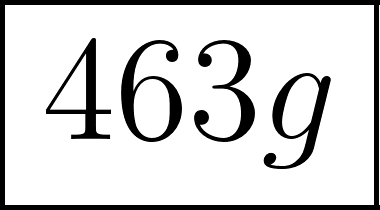
____________________________________________________________________________
Subscribe to view the
full solution
full solution
Title
Chemistry: A Molecular Approach 3
Author
Nivaldo J. Tro
ISBN
9780321809247
Ethylene glycol (antifreeze) has a density of 1.11 g/cm3
Chapter 1 textbook questions
-
Chapter 1: Problem 23 Chemistry: A Molecular Approach 3
-
Chapter 1: Problem 12 Chemistry: A Molecular Approach 3
Explain the difference between an element and a compound.
Read more -
Chapter 1: Problem 19 Chemistry: A Molecular Approach 3
What kind of energy is chemical energy? In what way is an elevated weight similar to a tank of gasoline?
Read more -
Chapter 1: Problem 7 Chemistry: A Molecular Approach 3
What is wrong with the expression “That is just a theory,” if by theory the speaker is referring to a scientific theory?
Read more -
Chapter 1: Problem 20 Chemistry: A Molecular Approach 3
What are the standard SI base units of length, mass, time, and temperature?
Read more -
Chapter 1: Problem 6 Chemistry: A Molecular Approach 3
What theory did John Dalton formulate?
Read more -
Chapter 1: Problem 24 Chemistry: A Molecular Approach 3
Explain the difference between density and mass.
Read more -
Chapter 1: Problem 68 Chemistry: A Molecular Approach 3
Problem 68AE Which of the following would you characterize as a pure or nearly pure substance? (a) baking powder; (b) lemon juice; (c) propane gas, used in outdoor gas grills; (d) aluminum foil; (e) ibuprofen; (f) bourbon whiskey; (g) helium gas; (h) clear water pumped from a deep aquifer.
Read more -
Chapter 1: Problem 57 Chemistry: A Molecular Approach 3
Use scientific notation to express each quantity with only the base units (no prefix multipliers). a. 4.5 ns b. 18 fs c. 128 pm d. 35 m
Read more -
Chapter 1: Problem 69 Chemistry: A Molecular Approach 3
Problem 69AE The U.S. quarter has a mass of 5.67 g and is approximately 1.55 mm thick, (a) How many quarters would have to be stacked to reach 575 ft, the height of the Washington Monument? (b) How much would this stack weigh? (c) How much money would this stack contain? (d) The U.S. National Debt Clock showed the outstanding public debt to be $16,213,166,914,811 on October 28, 2012. How many stacks like the one described would be necessary to pay off this debt?
Read more -
Chapter 1: Problem 70 Chemistry: A Molecular Approach 3
Problem 70AE In the United States, water used for irrigation is measured in acre-feet. An acre-foot of water covers an acre to a depth of exactly 1 ft. An acre is 4840 yd2. An acre-foot is enough water to supply two typical households for 1.00 yr. (a) If desalinated water costs $1950 per acre-foot, how much does desalinated water cost per liter? (b) How much would it cost one household per day if it were the only source of water?
Read more -
Chapter 1: Problem 71 Chemistry: A Molecular Approach 3
Problem 71AE By using estimation techniques, determine which of the following is the heaviest and which is the lightest: a 5-lb bag of potatoes, a 5-kg bag of sugar, or 1 gal of water (density = 1.0 g/mL).
Read more -
Chapter 1: Problem 72 Chemistry: A Molecular Approach 3
Problem 72AE Suppose you decide to define your own temperature scale with units of 0, using the freezing point (13 °C) and boiling point (360 °C) of oleic acid, the main component of olive oil. If you set the freezing point of oleic acid as 0 °0 and the boiling point as 100 °0, what is the freezing point of water on this new scale?
Read more -
Chapter 1: Problem 75 Chemistry: A Molecular Approach 3
Problem 75AE Water has a density of 0.997 g/cm3 at 25 °C; ice has a density of 0.917 g/cm3 at -10 °C. (a) If a soft-drink bottle whose volume is 1.50 L is completely filled with water and then frozen to -10 °C, what volume does the ice occupy? (b) Can the ice be contained within the bottle?
Read more -
Chapter 1: Problem 82 Chemistry: A Molecular Approach 3
Problem 82AE In 2005, J. Robin Warren and Barry J. Marshall shared the Nobel Prize in Medicine for discovery of the bacterium Helicobacter pylori, and for establishing experimental proof that it plays a major role in gastritis and peptic ulcer disease. The story began when Warren, a pathologist, noticed that bacilli were associated with the tissues taken from patients suffering from ulcers. Look up the history of this case and describe Warren's first hypothesis. What sorts of evidence did it take to create a credible theory based on it?
Read more -
Chapter 1: Problem 2 Chemistry: A Molecular Approach 3
Explain the main goal of chemistry.
Read more -
Chapter 1: Problem 4 Chemistry: A Molecular Approach 3
Explain the differences between a hypothesis, a law, and a theory.
Read more -
Chapter 1: Problem 9 Chemistry: A Molecular Approach 3
How do solids, liquids, and gases differ?
Read more -
Chapter 1: Problem 8 Chemistry: A Molecular Approach 3
What are two different ways to classify matter?
Read more -
Chapter 1: Problem 5 Chemistry: A Molecular Approach 3
What observations did Antoine Lavoisier make? What law did he formulate?
Read more -
Chapter 1: Problem 10 Chemistry: A Molecular Approach 3
What is the difference between a crystalline solid and an amorphous solid?
Read more -
Chapter 1: Problem 11 Chemistry: A Molecular Approach 3
Explain the difference between a pure substance and a mixture.
Read more -
Chapter 1: Problem 13 Chemistry: A Molecular Approach 3
Explain the difference between a homogeneous and a heterogeneous mixture.
Read more -
Chapter 1: Problem 14 Chemistry: A Molecular Approach 3
What kind of mixtures can be separated by filtration?
Read more -
Chapter 1: Problem 15 Chemistry: A Molecular Approach 3
Explain how distillation is used to separate mixtures.
Read more -
Chapter 1: Problem 16 Chemistry: A Molecular Approach 3
What is the difference between a physical property and a chemical property?
Read more -
Chapter 1: Problem 17 Chemistry: A Molecular Approach 3
What is the difference between a physical change and a chemical change? List some examples of each.
Read more -
Chapter 1: Problem 21 Chemistry: A Molecular Approach 3
What are the three common temperature scales? Does the size of a degree differ among them?
Read more -
Chapter 1: Problem 22 Chemistry: A Molecular Approach 3
What are prefix multipliers? List some examples.
Read more -
Chapter 1: Problem 18 Chemistry: A Molecular Approach 3
Explain the significance of the law of conservation of energy.
Read more -
Chapter 1: Problem 25 Chemistry: A Molecular Approach 3
Explain the difference between intensive and extensive properties.
Read more -
Chapter 1: Problem 26 Chemistry: A Molecular Approach 3
What is the meaning of the number of digits reported in a measured quantity?
Read more -
Chapter 1: Problem 27 Chemistry: A Molecular Approach 3
When multiplying or dividing measured quantities, what determines the number of significant figures in the result?
Read more -
Chapter 1: Problem 28 Chemistry: A Molecular Approach 3
When adding or subtracting measured quantities, what determines the number of significant figures in the result?
Read more -
Chapter 1: Problem 29 Chemistry: A Molecular Approach 3
What are the rules for rounding off the results of calculations?
Read more -
Chapter 1: Problem 30 Chemistry: A Molecular Approach 3
Explain the difference between precision and accuracy.
Read more -
Chapter 1: Problem 31 Chemistry: A Molecular Approach 3
Explain the difference between random error and systematic error.
Read more -
-
Chapter 1: Problem 33 Chemistry: A Molecular Approach 3
Classify each statement as an observation, a law, or a theory. a. All matter is made of tiny, indestructible particles called atoms. b. When iron rusts in a closed container, the mass of the container and its contents does not change. c. In chemical reactions, matter is neither created nor destroyed. d. When a match burns, heat is released.
Read more -
Chapter 1: Problem 35 Chemistry: A Molecular Approach 3
A chemist decomposes several samples of carbon monoxide into carbon and oxygen and weighs the resultant elements. The results are shown in the table. a. Do you notice a pattern in these results? Next, the chemist decomposes several samples of hydrogen peroxide into hydrogen and oxygen. The results are shown in the table: b. Do you notice a similarity between these results and those for carbon monoxide in part a? c. Can you formulate a law from the observations in a and b? d. Can you formulate a hypothesis that might explain your law in c?
Read more -
Chapter 1: Problem 34 Chemistry: A Molecular Approach 3
Classify each statement as an observation, a law, or a theory. a. Chlorine is a highly reactive gas. b. If elements are listed in order of increasing mass of their atoms, their chemical reactivity follows a repeating pattern. c. Neon is an inert (or nonreactive) gas. d. The reactivity of elements depends on the arrangement of their electrons.
Read more -
Chapter 1: Problem 36 Chemistry: A Molecular Approach 3
When astronomers observe distant galaxies, they can tell that most of them are moving away from one another. In addition, the more distant the galaxies, the more rapidly they are likely to be moving away from each other. Can you devise a hypothesis to explain these observations?
Read more -
Chapter 1: Problem 37 Chemistry: A Molecular Approach 3
Classify each substance as a pure substance or a mixture. If it is a pure substance, classify it as an element or a compound. If it is a mixture, classify it as homogeneous or heterogeneous. a. sweat b. carbon dioxide c. aluminum d. vegetable soup
Read more -
-
-
Chapter 1: Problem 41 Chemistry: A Molecular Approach 3
Determine whether each molecular diagram represents a pure substance or a mixture. If it represents a pure substance, classify the substance as an element or a compound. If it represents a mixture, classify the mixture as homogeneous or heterogeneous.
Read more -
Chapter 1: Problem 42 Chemistry: A Molecular Approach 3
Determine whether each molecular diagram represents a pure substance or a mixture. If it represents a pure substance, classify the substance as an element or a compound. If it represents a mixture, classify the mixture as homogeneous or heterogeneous.
Read more -
Chapter 1: Problem 43 Chemistry: A Molecular Approach 3
Classify each of the listed properties of isopropyl alcohol (also known as rubbing alcohol) as physical or chemical. a. colorless b. flammable c. liquid at room temperature d. density = 0.79 g/mL e. mixes with water
Read more -
Chapter 1: Problem 44 Chemistry: A Molecular Approach 3
Classify each of the listed properties of ozone (a pollutant in the lower atmosphere but part of a protective shield against UV light in the upper atmosphere) as physical or chemical. a. bluish color b. pungent odor c. very reactive d. decomposes on exposure to ultraviolet light e. gas at room temperature
Read more -
Chapter 1: Problem 45 Chemistry: A Molecular Approach 3
Classify each property as physical or chemical. a. the tendency of ethyl alcohol to burn b. the shine on silver c. the odor of paint thinner d. the flammability of propane gas
Read more -
Chapter 1: Problem 46 Chemistry: A Molecular Approach 3
Classify each property as physical or chemical. a. the boiling point of ethyl alcohol b. the temperature at which dry ice evaporates c. the tendency of iron to rust d. the color of gold
Read more -
Chapter 1: Problem 47 Chemistry: A Molecular Approach 3
Classify each change as physical or chemical. a. Natural gas burns in a stove. b. The liquid propane in a gas grill evaporates because the valve was left open. c. The liquid propane in a gas grill burns in a flame. d. A bicycle frame rusts on repeated exposure to air and water.
Read more -
Chapter 1: Problem 48 Chemistry: A Molecular Approach 3
Classify each change as physical or chemical. a. Sugar burns when heated in a skillet. b. Sugar dissolves in water. c. A platinum ring becomes dull because of continued abrasion. d. A silver surface becomes tarnished after exposure to air for a long period of time.
Read more -
Chapter 1: Problem 49 Chemistry: A Molecular Approach 3
Based on the molecular diagram, classify each change as physical or chemical.
Read more -
Chapter 1: Problem 50 Chemistry: A Molecular Approach 3
Problem 50 Based on the molecular diagram, classify each change as physical or chemical.
Read more -
Chapter 1: Problem 51 Chemistry: A Molecular Approach 3
Convert each temperature. a. 32 °F to °C (temperature at which water freezes) b. 77 K to °F (temperature of liquid nitrogen) c. –109 °F to °C (temperature of dry ice) d. 98.6 °F to K (body temperature)
Read more -
Chapter 1: Problem 52 Chemistry: A Molecular Approach 3
Convert each temperature. a. 212 °F to °C (temperature of boiling water at sea level) b. 22 °C to K (approximate room temperature) c. 0.00 K to °F (coldest temperature possible, also known as absolute zero) d. 2.735 K to °C (average temperature of the universe as measured from background black body radiation)
Read more -
Chapter 1: Problem 53 Chemistry: A Molecular Approach 3
The coldest temperature ever measured in the United States is –80 °F on January 23, 1971, in Prospect Creek, Alaska. Convert that temperature to °C and K. (Assume that –80 °F is precise to two significant figures.)
Read more -
Chapter 1: Problem 55 Chemistry: A Molecular Approach 3
Use the prefix multipliers to express each measurement without any exponents. a. 1.2 x 10⁻⁹ m b. 22 x 10-15 s c. 1.5 x 10⁹ g d. 3.5 x 10⁶ L
Read more -
Chapter 1: Problem 54 Chemistry: A Molecular Approach 3
The warmest temperature ever measured in the United States is 134 °F on July 10, 1913, in Death Valley, California. Convert that temperature to °C and K.
Read more -
Chapter 1: Problem 56 Chemistry: A Molecular Approach 3
Use prefix multipliers to express each measurement without any exponents. a. 38.8 x 10⁵ g b. 55.2 x 10⁻¹⁰ s c. 23.4 x 10¹¹ m d. 87.9 x 10⁻⁷ L
Read more -
Chapter 1: Problem 58 Chemistry: A Molecular Approach 3
Use scientific notation to express each quantity with only the base units (no prefix multipliers). a. 35 b. 225 Mn c. 133 Tg d. 1.5 eg
Read more -
Chapter 1: Problem 59 Chemistry: A Molecular Approach 3
(a) Classify each of the following as a pure substance, a solution, or a heterogeneous mixture: a gold coin, a cup of coffee, a wood plank, (b) What ambiguities are there in answering part (a) from the descriptions given?
Read more -
Chapter 1: Problem 60 Chemistry: A Molecular Approach 3
(a) What is the difference between a hypothesis and a theory? (b) Explain the difference between a theory and a scientific law. Which addresses how matter behaves, and which addresses why it behaves that way?
Read more -
Chapter 1: Problem 61 Chemistry: A Molecular Approach 3
A sample of ascorbic acid (vitamin C) is synthesized in the laboratory. It contains 1.50 g of carbon and 2.00 g of oxygen. Another sample of ascorbic acid isolated from citrus fruits contains 6.35 g of carbon. How many grams of oxygen does it contain? Which law are you assuming in answering this question?
Read more -
Chapter 1: Problem 62 Chemistry: A Molecular Approach 3
Problem 62AE Ethyl chloride is sold as a liquid (see photo) under pressure for use as a local skin anesthetic. Ethyl chloride boils at 12 °C at atmospheric pressure. When the liquid is sprayed onto the skin, it boils off, cooling and numbing the skin as it vaporizes, (a) What changes of state are involved in this use of ethyl chloride? (b) What is the boiling point of ethyl chloride in degrees Fahrenheit? (c) The bottle shown contains 103.5 ml of ethyl chloride. The density of ethyl chloride at 25 °C is 0.765 g/cm3. What is the mass of ethyl chloride in the bottle?
Read more -
Chapter 1: Problem 63 Chemistry: A Molecular Approach 3
Problem 63AE Two students determine the percentage of lead in a sample as a laboratory exercise. The true percentage is 22.52%. The students' results for three determinations are as follows: (1) 22.52,22.48,22.54 (2) 22.64, 22.58, 22.62 (a) Calculate the average percentage for each set of data and state which set is the more accurate based on the average. (b) Precision can be judged by examining the average of the deviations from the average value for that data set. (Calculate the average value for each data set; then calculate the average value of the absolute deviations of each measurement from the average.) Which set is more precise?
Read more -
Chapter 1: Problem 64 Chemistry: A Molecular Approach 3
Is the use of significant figures in each of the following statements appropriate? Why or why not? (a) Apple sold 22,727,000 iPods during the last three months of 2008. (b) New York City receives 49.7 inches of rain, on average, per year, (c) In the United States, 0.621% of the population has the surname Brown, (d) You calculate your grade point average to be 3.87562.
Read more -
Chapter 1: Problem 65 Chemistry: A Molecular Approach 3
What type of quantity (for example, length, volume, density) do the following units indicate? (a) ml, (b) cm2, (c) mm3, (d) mg/L, (e) ps, (f) nm, (g) K.
Read more -
Chapter 1: Problem 66 Chemistry: A Molecular Approach 3
Give the derived SI units for each of the following quantities in base SI units: (a) (b) (c) (d) (e) (f) (g)
Read more -
Chapter 1: Problem 67 Chemistry: A Molecular Approach 3
The distance from Earth to the Moon is approximately 240,000 mi. (a) What is this distance in meters? (b) The peregrine falcon has been measured as traveling up to 350 km/ hr in a dive. If this falcon could fly to the Moon at this speed, how many seconds would it take? (c) The speed of light is 3.00 * 108 m/s. How long does it take for light to travel from Earth to the Moon and back again? (d) Earth travels around the Sun at an average speed of 29.783 km/s. Convert this speed to miles per hour.
Read more -
Chapter 1: Problem 81 Chemistry: A Molecular Approach 3
The total rate at which power is used by humans worldwide is approximately 15 TW (terawatts). The solar flux averaged over the sunlit half of Earth is 680 W/m2. (assuming no clouds). The area of Earth's disc as seen from the sun is $$ 1.28 \times 10^{}14} m^2 $$. The surface area of Earth is approximately 197,000,000 square miles. How much of Earth's surface would we need to cover with solar energy collectors to power the planet for use by all humans? Assume that the solar energy collectors can convert only 10% of the available sunlight into useful power.
Read more -
Chapter 1: Problem 83 Chemistry: A Molecular Approach 3
A 25.0-cm long cylindrical glass tube, sealed at one end, is filled with ethanol. The mass of ethanol needed to fill the tube is found to be 45.23 g. The density of ethanol is 0.789 g/ml. Calculate the inner diameter of the tube in centimeters.
Read more -
Chapter 1: Problem 84 Chemistry: A Molecular Approach 3
Calculate to the correct number of significant figures. a. 89.3 x 77.0 x 0.08 b. (5.01 x 10⁵ ) ÷ (7.8 x 10² ) c. 4.005 x 74 x 0.007 d. 453 ÷ 2.031
Read more -
Chapter 1: Problem 86 Chemistry: A Molecular Approach 3
Judge the following statements as true or false. If you believe a statement to be false, provide a corrected version. (a) Air and water are both elements. (b) All mixtures contain at least one element and one compound. (c) Compounds can be decomposed into two or more other substances; elements cannot. (d) Elements can exist in any of the three states of matter. (e) When yellow stains in a kitchen sink are treated with bleach water, the disappearance of the stains is due to a physical change. (f) A hypothesis is more weakly supported by experimental evidence than a theory. (g) The number 0.0033 has more significant figures than 0.033. (h) Conversion factors used in converting units always have a numerical value of one. (i) Compounds always contain at least two different elements
Read more -
Chapter 1: Problem 87 Chemistry: A Molecular Approach 3
You are assigned the task of separating a desired granular material with a density of 3.62 g/cm3 from an undesired granular material that has a density of 2.04 g/cm3. You want to do this by shaking the mixture in a liquid in which the heavier material will fall to the bottom and the lighter material will float. A solid will float on any liquid that is more dense. Using an Internet-based source or a handbook of chemistry, find the densities of the following substances: carbon tetrachloride, hexane, benzene, and diiodomethane. Which of these liquids will serve your purpose, assuming no chemical interaction between the liquid and the solids?
Read more -
Chapter 1: Problem 88 Chemistry: A Molecular Approach 3
In 2009, a team from Northwestern University and Western Washington University reported the preparation of a new ‘spongy” material composed of nickel, molybdenum, and sulfur that excels at removing mercury from water. The density of this new material is 0.20 g/cm3, and its surface area is 1242 m2 per gram of material, (a) Calculate the volume of a 10.0-mg sample of this material, (b) Calculate the surface area for a 10.0-mg sample of this material, (c) A 10.0-mL sample of contaminated water had 7.748 mg of mercury in it. After treatment with 10.0 mg of the new spongy material, 0.001 mg of mercury remained in the contaminated water. What percentage of the mercury was removed from the water? (d) What is the final mass of the spongy material after the exposure to mercury?
Read more -
Chapter 1: Problem 77 Chemistry: A Molecular Approach 3
Problem 77AE A thief plans to steal a gold sphere with a radius of 28.9 cm from a museum. If the gold has a density of 19.3 g/cm3, what is the mass of the sphere in pounds? [The volume of a sphere is . Is the thief likely to be able to walk off with the gold sphere unassisted?
Read more -
Chapter 1: Problem 76 Chemistry: A Molecular Approach 3
A 32.65-g sample of a solid is placed in a flask. Toluene, in which the solid is insoluble, is added to the flask so that the total volume of solid and liquid together is 50.00 ml. The solid and toluene together weigh 58.58 g. The density of toluene at the temperature of the experiment is 0.864 g/ml. What is the density of the solid?
Read more -
Chapter 1: Problem 74 Chemistry: A Molecular Approach 3
Two spheres of equal volume are placed on the scales as shown. Which one is more dense?
Read more -
Chapter 1: Problem 78 Chemistry: A Molecular Approach 3
Automobile batteries contain sulfuric acid, which is commonly referred to as 'battery acid.” Calculate the number of grams of sulfuric acid in 1.00 gal of battery acid if the solution has a density of 1.28 g/ml and is 38.1% sulfuric acid by mass.
Read more -
Chapter 1: Problem 73 Chemistry: A Molecular Approach 3
The liquid substances mercury (density = 13.6 g/mL), water (1.00 g/mL), and cyclohexane (0.778 g/mL) do not form a solution when mixed but separate in distinct layers. Sketch how the liquids would position themselves in a test tube.
Read more -
Chapter 1: Problem 79 Chemistry: A Molecular Approach 3
Problem 79 AE A 40-lb container of peat moss measures 14 * 20 * 30 in. A 40-lb container of topsoil has a volume of 1.9 gal. (a) Calculate the average densities of peat moss and topsoil in units of g/cm3. Would it be correct to say that peat moss is lighter” than topsoil? Explain, (b) How many bags of peat moss are needed to cover an area measuring 15.0 ft * 20.0 ft to a depth of 3.0 in.?
Read more -
Chapter 1: Problem 80 Chemistry: A Molecular Approach 3
A package of aluminum foil contains 50 ft2 of foil, which weighs approximately 8.0 oz. Aluminum has a density of 2.70 g/cm3. What is the approximate thickness of the foil in millimeters?
Read more -
Chapter 1: Problem 1 Chemistry: A Molecular Approach 3
What is the number of known elements?
Read more -
Chapter 1: Problem 1 Chemistry: A Molecular Approach 3
Does each of the following describe a physical change or a chemical change? (a) The helium gas inside a balloon tends to leak out after a few hours. (b) A flashlight beam slowly gets dimmer and finally goes out. (c) Frozen orange juice is reconstituted by adding water to it. (d) The growth of plants depends on the suns energy in a process called photosynthesis. (e) A spoonful of table salt dissolves in a bowl of soup.
Read more -
Chapter 1: Problem 1 Chemistry: A Molecular Approach 3
Give the names of the elements represented by the chemical symbols Li, F, P, Cu, As, Zn, Cl, Pt, Mg, U, Al, Si, Ne. (See Table 1.1 and the inside front cover.)
Read more -
Chapter 1: Problem 1 Chemistry: A Molecular Approach 3
Give the chemical symbols for the following elements: (a) cesium, (b) germanium, (c) gallium, (d) strontium, (e) uranium, (f) selenium, (g) neon, (h) cadmium. (See Table 1.1 and the inside front cover.)
Read more -
Chapter 1: Problem 1 Chemistry: A Molecular Approach 3
Classify each of the following substances as an element or a compound: (a) hydrogen, (b) water, (c) gold, (d) sugar
Read more -
Chapter 1: Problem 1 Chemistry: A Molecular Approach 3
Classify each of the following as an element, a compound, a homogeneous mixture, or a heterogeneous mixture: (a) water from a well, (b) argon gas, (c) sucrose, (d) a bottle of red wine, (e) chicken noodle soup, (f) blood flowing in a capillary, (g) ozone.
Read more -
Chapter 1: Problem 1 Chemistry: A Molecular Approach 3
Name the SI base units that are important in chemistry. Give the SI units for expressing the following: (a) length, (b) volume, (c) mass, (d) time, (e) energy, (f) temperature.
Read more -
Chapter 1: Problem 1 Chemistry: A Molecular Approach 3
Write the numbers represented by the following prefixes: (a) mega-, (b) kilo-, (c) deci-, (d) centi-, (e) milli-, (f) micro-, (g) nano-, (h) pico-.
Read more -
Chapter 1: Problem 1 Chemistry: A Molecular Approach 3
What units do chemists normally use for density of liquids and solids? For gas density? Explain the differences
Read more -
Chapter 1: Problem 1 Chemistry: A Molecular Approach 3
Describe the three temperature scales used in the laboratory and in everyday life: the Fahrenheit scale, the Celsius scale, and the Kelvin scale.
Read more -
Chapter 1: Problem 1 Chemistry: A Molecular Approach 3
Bromine is a reddish-brown liquid. Calculate its density (in g/mL) if 586 g of the substance occupies 188 mL.
Read more -
Chapter 1: Problem 1 Chemistry: A Molecular Approach 3
The density of methanol, a colorless organic liquid used as solvent, is 0.7918 g/mL. Calculate the mass of 89.9 mL of the liquid.
Read more -
Chapter 1: Problem 1 Chemistry: A Molecular Approach 3
Convert the following temperatures to degrees Celsius or Fahrenheit: (a) , the temperature on a hot summer day; (b) , the temperature on a cold winter day; (c) a fever; (d) a furnace operating at ; (e) (theoretically the lowest attainable temperature).
Read more -
Chapter 1: Problem 1 Chemistry: A Molecular Approach 3
(a) Normally the human body can endure a temperature of for only short periods of time without permanent damage to the brain and other vital organs. What is this temperature in degrees Celsius? (b) Ethylene glycol is a liquid organic compound that is used as an antifreeze in car radiators. It freezes at . Calculate its freezing temperature in degrees Fahrenheit. (c) The temperature on the surface of the sun is about . What is this temperature in degrees Fahrenheit? (d) The ignition temperature of paper is . What is the temperature in degrees Celsius?
Read more -
Chapter 1: Problem 1 Chemistry: A Molecular Approach 3
Convert the following temperatures to kelvin: (a) , the melting point of sulfur, (b) , the normal body temperature, (c) , the boiling point of mercury.
Read more -
Chapter 1: Problem 1 Chemistry: A Molecular Approach 3
Convert the following temperatures to degrees Celsius: (a) 77 K, the boiling point of liquid nitrogen, (b) 4.2 K, the boiling point of liquid helium, (c) 601 K, the melting point of lead.
Read more -
Chapter 1: Problem 1 Chemistry: A Molecular Approach 3
What is the advantage of using scientific notation over decimal notation?
Read more -
Chapter 1: Problem 1 Chemistry: A Molecular Approach 3
Define a significant figure. Discuss the importance of using the proper number of significant figures in measurements and calculations.
Read more -
Chapter 1: Problem 1 Chemistry: A Molecular Approach 3
Express the following numbers in scientific notation: (a) 0.000000027, (b) 356, (c) 47,764, (d) 0.096.
Read more -
Chapter 1: Problem 1 Chemistry: A Molecular Approach 3
Express the following numbers as decimals: (a) (b) .
Read more -
Chapter 1: Problem 1 Chemistry: A Molecular Approach 3
Express the answers to the following calculations in scientific notation: (a) 145.75 1 (2.3 3 1021 ) (b) 79,500 4 (2.5 3 102 ) (c) (7.0 3 1023 ) 2 (8.0 3 1024 ) (d) (1.0 3 104 ) 3 (9.9 3 106 )
Read more -
Chapter 1: Problem 1 Chemistry: A Molecular Approach 3
Express the answers to the following calculations in scientific notation: 1. 2. 3. 4.
Read more -
Chapter 1: Problem 1 Chemistry: A Molecular Approach 3
What is the number of significant figures in each of the following measurements? (a) 4867 mi (b) 56 mL (c) 60,104 tons (d) 2900 g (e) 40.2 g/cm3 (f) 0.0000003 cm (g) 0.7 min (h) 4.6 3 1019 atoms
Read more -
Chapter 1: Problem 1 Chemistry: A Molecular Approach 3
How many significant figures are there in each of the following? (a) 0.006 L, (b) 0.0605 dm, (c) 60.5 mg, (d) 605.5 cm2 , (e) 960 3 1023 g, (f) 6 kg, (g) 60 m.
Read more -
Chapter 1: Problem 1 Chemistry: A Molecular Approach 3
Carry out the following operations as if they were calculations of experimental results, and express each answer in the correct units with the correct number of significant figures: 1. 2. 3. 4.
Read more -
Chapter 1: Problem 1 Chemistry: A Molecular Approach 3
Carry out the following operations as if they were calculations of experimental results, and express each answer in the correct units with the correct number of significant figures:
Read more -
Chapter 1: Problem 1 Chemistry: A Molecular Approach 3
Three students (A, B, and C) are asked to determine the volume of a sample of ethanol. Each student measures the volume three times with a graduated cylinder. The results in milliliters are: A (87.1, 88.2, 87.6); B (86.9, 87.1, 87.2); C (87.6, 87.8, 87.9). The true volume is 87.0 mL. Comment on the precision and the accuracy of each student's results.
Read more -
Chapter 1: Problem 1 Chemistry: A Molecular Approach 3
Three apprentice tailors (X, Y, and Z) are assigned the task of measuring the seam of a pair of trousers. Each one makes three measurements. The results in inches are X (31.5, 31.6, 31.4); Y (32.8, 32.3, 32.7); Z (31.9, 32.2, 32.1). The true length is 32.0 in. Comment on the precision and the accuracy of each tailor's measurements.
Read more -
Chapter 1: Problem 1 Chemistry: A Molecular Approach 3
Carry out the following conversions: (a) 22.6 m to decimeters, (b) 25.4 mg to kilograms, (c) 556 mL to liters, (d) 10.6 kg/m3 to g/cm3 .
Read more -
Chapter 1: Problem 1 Chemistry: A Molecular Approach 3
Carry out the following conversions: (a) 242 lb to milligrams, (b) to cubic meters, (c) to liters, (d) 28.3 g to pounds.
Read more -
Chapter 1: Problem 1 Chemistry: A Molecular Approach 3
The average speed of helium at 258C is 1255 m/s. Convert this speed to miles per hour (mi/h).
Read more -
Chapter 1: Problem 1 Chemistry: A Molecular Approach 3
How many seconds are there in a solar year (365.24 days)?
Read more -
Chapter 1: Problem 1 Chemistry: A Molecular Approach 3
How many minutes does it take light from the sun to reach Earth? (The distance from the sun to Earth is 93 million mi; the speed of light .)
Read more -
Chapter 1: Problem 1 Chemistry: A Molecular Approach 3
A jogger runs a mile in 8.92 min. Calculate the speed in (a) in/s, (b) m/min, (c) km/h. (1 mi 5 1609 m; 1 in 5 2.54 cm.)
Read more -
Chapter 1: Problem 1 Chemistry: A Molecular Approach 3
A 6.0-ft person weighs 168 lb. Express this persons height in meters and weight in kilograms. (1 lb = 453.6 g; 1 m = 3.28 ft.)
Read more -
Chapter 1: Problem 1 Chemistry: A Molecular Approach 3
The speed limit on parts of the German autobahn was once set at 286 kilometers per hour (km/h). Calculate the speed limit in miles per hour (mph).
Read more -
Chapter 1: Problem 1 Chemistry: A Molecular Approach 3
For a fighter jet to take off from the deck of an aircraft carrier, it must reach a speed of 62 m/s. Calculate the speed in miles per hour (mph).
Read more -
Chapter 1: Problem 1 Chemistry: A Molecular Approach 3
The normal lead content in human blood is about 0.40 part per million (that is, 0.40 g of lead per million grams of blood). A value of 0.80 part per million (ppm) is considered to be dangerous. How many grams of lead are contained in of blood (the amount in an average adult) if the lead content is 0.62 ppm?
Read more -
Chapter 1: Problem 1 Chemistry: A Molecular Approach 3
Carry out the following conversions: (a) 1.42 light years to miles (a light-year is an astronomical measure of distance traveled by light in a year, or 365 days; the speed of light is ). (b) 32.4 yd to centimeters. (c) to ft/s.
Read more -
Chapter 1: Problem 1 Chemistry: A Molecular Approach 3
Carry out the following conversions: (a) 70 kg, the average weight of a male adult, to pounds. (b) 14 billion years (roughly the age of the universe) to seconds. (Assume there are 365 days in a year.) (c) 7 ft 6 in, the height of the basketball player Yao Ming, to meters. (d) 88.6 m3 to liters
Read more -
Chapter 1: Problem 1 Chemistry: A Molecular Approach 3
Aluminum is a lightweight metal (density ) used in aircraft construction, high-voltage transmission lines, beverage cans, and foils. What is its density in kg/m3 ?
Read more -
Chapter 1: Problem 1 Chemistry: A Molecular Approach 3
Ammonia gas is used as a refrigerant in large-scale cooling systems. The density of ammonia gas under certain conditions is 0.625 g/L. Calculate its density in .
Read more -
Chapter 1: Problem 1 Chemistry: A Molecular Approach 3
Give one qualitative and one quantitative statement about each of the following: (a) water, (b) carbon, (c) iron, (d) hydrogen gas, (e) sucrose (cane sugar), (f) table salt (sodium chloride), (g) mercury, (h) gold, (i) air.
Read more -
Chapter 1: Problem 1 Chemistry: A Molecular Approach 3
Which of the following statements describe physical properties and which describe chemical properties? (a) Iron has a tendency to rust. (b) Rainwater in industrialized regions tends to be acidic. (c) Hemoglobin molecules have a red color. (d) When a glass of water is left out in the sun, the water gradually disappears. (e) Carbon dioxide in air is converted to more complex molecules by plants during photosynthesis.
Read more -
Chapter 1: Problem 1 Chemistry: A Molecular Approach 3
In 2008, about 95.0 billion lb of sulfuric acid were produced in the United States. Convert this quantity to tons.
Read more -
Chapter 1: Problem 1 Chemistry: A Molecular Approach 3
In determining the density of a rectangular metal bar, a student made the following measurements: length, 8.53 cm; width, 2.4 cm; height, 1.0 cm; mass, 52.7064 g. Calculate the density of the metal to the correct number of significant figures.
Read more -
Chapter 1: Problem 1 Chemistry: A Molecular Approach 3
Calculate the mass of each of the following: (a) a sphere of gold with a radius of 10.0 cm [the volume of a sphere with a radius r is ; the density of gold ], (b) a cube of platinum of edge length 0.040 mm (the density of platinum ), (c) 50.0 mL of ethanol (the density of ethanol 0.798 g/mL).
Read more -
Chapter 1: Problem 1 Chemistry: A Molecular Approach 3
A cylindrical glass bottle 21.5 cm in length is filled with cooking oil of density 0.953 g/mL. If the mass of the oil needed to fill the bottle is 1360 g, calculate the inner diameter of the bottle.
Read more -
Chapter 1: Problem 1 Chemistry: A Molecular Approach 3
The following procedure was used to determine the volume of a flask. The flask was weighed dry and then filled with water. If the masses of the empty flask and filled flask were 56.12 g and 87.39 g, respectively, and the density of water is 0.9976 g/cm3 , calculate the volume of the flask in cm3 .
Read more -
Chapter 1: Problem 1 Chemistry: A Molecular Approach 3
The speed of sound in air at room temperature is about 343 m/s. Calculate this speed in miles per hour. (1 mi 5 1609 m.)
Read more -
Chapter 1: Problem 1 Chemistry: A Molecular Approach 3
A piece of silver (Ag) metal weighing 194.3 g is placed in a graduated cylinder containing 242.0 mL of water. The volume of water now reads 260.5 mL. From these data calculate the density of silver
Read more -
Chapter 1: Problem 1 Chemistry: A Molecular Approach 3
The experiment described in 1.61 is a crude but convenient way to determine the density of some solids. Describe a similar experiment that would enable you to measure the density of ice. Specifically, what would be the requirements for the liquid used in your experiment?
Read more -
Chapter 1: Problem 1 Chemistry: A Molecular Approach 3
A lead sphere of diameter 48.6 cm has a mass of 6.852 3 105 g. Calculate the density of lead.
Read more -
Chapter 1: Problem 1 Chemistry: A Molecular Approach 3
Lithium is the least dense metal known (density: ). What is the volume occupied by of lithium?
Read more -
Chapter 1: Problem 1 Chemistry: A Molecular Approach 3
The medicinal thermometer commonly used in homes can be read 60.18F, whereas those in the doctors office may be accurate to . In degrees Celsius, express the percent error expected from each of these thermometers in measuring a persons body temperature of 38.98C.
Read more -
Chapter 1: Problem 1 Chemistry: A Molecular Approach 3
Vanillin (used to flavor vanilla ice cream and other foods) is the substance whose aroma the human nose detects in the smallest amount. The threshold limit is per liter of air. If the current price of 50 g of vanillin is $112, determine the cost to supply enough vanillin so that the aroma could be detected in a large aircraft hangar with a volume of .
Read more -
Chapter 1: Problem 1 Chemistry: A Molecular Approach 3
At what temperature does the numerical reading on a Celsius thermometer equal that on a Fahrenheit thermometer?
Read more -
Chapter 1: Problem 1 Chemistry: A Molecular Approach 3
Suppose that a new temperature scale has been devised on which the melting point of ethanol ( ) and the boiling point of ethanol ( ) are taken as and , respectively, where S is the symbol for the new temperature scale. Derive an equation relating a reading on this scale to a reading on the Celsius scale. What would this thermometer read at ?
Read more -
Chapter 1: Problem 1 Chemistry: A Molecular Approach 3
A resting adult requires about 240 mL of pure oxygen/min and breathes about 12 times every minute. If inhaled air contains 20 percent oxygen by volume and exhaled air 16 percent, what is the volume of air per breath? (Assume that the volume of inhaled air is equal to that of exhaled air.)
Read more -
Chapter 1: Problem 1 Chemistry: A Molecular Approach 3
(a) Referring to 1.69, calculate the total volume (in liters) of air an adult breathes in a day. (b) In a city with heavy traffic, the air contains of carbon monoxide (a poisonous gas) per liter. Calculate the average daily intake of carbon monoxide in liters by a person.
Read more -
Chapter 1: Problem 1 Chemistry: A Molecular Approach 3
Three different 25.0-g samples of solid pellets are added to 20.0 mL of water in three different measuring cylinders. The results are shown here. Given the densities of the three metals used, identify the cylinder that contains each sample of solid pellets: .
Read more -
Chapter 1: Problem 1 Chemistry: A Molecular Approach 3
The circumference of an NBA-approved basketball is 29.6 in. Given that the radius of Earth is about 6400 km, how many basketballs would it take to circle around the equator with the basketballs touching one another? Round off your answer to an integer with three significant figures.
Read more -
Chapter 1: Problem 1 Chemistry: A Molecular Approach 3
A student is given a crucible and asked to prove whether it is made of pure platinum. She first weighs the crucible in air and then weighs it suspended in water (density 5 0.9986 g/mL). The readings are 860.2 g and 820.2 g, respectively. Based on these measurements and given that the density of platinum is 21.45 g/cm3 , what should her conclusion be? (Hint: An object suspended in a fluid is buoyed up by the mass of the fluid displaced by the object. Neglect the buoyancy of air.)
Read more -
Chapter 1: Problem 1 Chemistry: A Molecular Approach 3
The surface area and average depth of the Pacific Ocean are and , respectively. Calculate the volume of water in the ocean in liters. and , respectively. Calculate the volume of water in the ocean in liters.
Read more -
Chapter 1: Problem 1 Chemistry: A Molecular Approach 3
The unit troy ounce is often used for precious metals such as gold (Au) and platinum (Pt). (1 troy ounce 5 31.103 g.) (a) A gold coin weighs 2.41 troy ounces. Calculate its mass in grams. (b) Is a troy ounce heavier or lighter than an ounce? (1 lb 5 16 oz; 1 lb 5 453.6 g.)
Read more -
Chapter 1: Problem 1 Chemistry: A Molecular Approach 3
Osmium (Os) is the densest element known (density = ). Calculate the mass in pounds and in kilograms of an Os sphere 15 cm in diameter (about the size of a grapefruit). See 1.57 for volume of a sphere.
Read more -
Chapter 1: Problem 1 Chemistry: A Molecular Approach 3
Percent error is often expressed as the absolute value of the difference between the true value and the experimental value, divided by the true value: The vertical lines indicate absolute value. Calculate the percent error for the following measurements: (a) The density of alcohol (ethanol) is found to be 0.802 g/mL. (True value: 0.798 g/mL.) (b) The mass of gold in an earring is analyzed to be 0.837 g. (True value: 0.864 g.)
Read more -
Chapter 1: Problem 1 Chemistry: A Molecular Approach 3
The natural abundances of elements in the human body, expressed as percent by mass, are: oxygen (O), 65 percent; carbon (C), 18 percent; hydrogen (H), 10 percent; nitrogen (N), 3 percent; calcium (Ca), 1.6 percent; phosphorus (P), 1.2 percent; all other elements, 1.2 percent. Calculate the mass in grams of each element in the body of a 62-kg person.
Read more -
Chapter 1: Problem 1 Chemistry: A Molecular Approach 3
The men's world record for running a mile outdoors (as of 1999) is 3 min 43.13 s. At this rate, how long would it take to run a 1500-m race? (1 mi = 1609 m.)
Read more -
Chapter 1: Problem 1 Chemistry: A Molecular Approach 3
Venus, the second closest planet to the sun, has a surface temperature of . Convert this temperature to and . . Convert this temperature to and .
Read more -
Chapter 1: Problem 1 Chemistry: A Molecular Approach 3
Chalcopyrite, the principal ore of copper (Cu), contains 34.63 percent Cu by mass. How many grams of Cu can be obtained from of the ore?
Read more -
Chapter 1: Problem 1 Chemistry: A Molecular Approach 3
It has been estimated that of gold (Au) have been mined. Assume gold costs $948 per ounce. What is the total worth of this quantity of gold?
Read more -
Chapter 1: Problem 1 Chemistry: A Molecular Approach 3
A 1.0-mL volume of seawater contains about of gold. The total volume of ocean water is . Calculate the total amount of gold (in grams) that is present in seawater, and the worth of the gold in dollars (see 1.82). With so much gold out there, why hasn't someone become rich by mining gold from the ocean?
Read more -
Chapter 1: Problem 1 Chemistry: A Molecular Approach 3
Measurements show that 1.0 g of iron (Fe) contains atoms. How many Fe atoms are in 4.9 g of Fe, which is the total amount of iron in the body of an average adult?
Read more -
Chapter 1: Problem 1 Chemistry: A Molecular Approach 3
The thin outer layer of Earth, called the crust, contains only 0.50 percent of Earths total mass and yet is the source of almost all the elements (the atmosphere provides elements such as oxygen, nitrogen, and a few other gases). Silicon (Si) is the second most abundant element in Earth's crust (27.2 percent by mass). Calculate the mass of silicon in kilograms in Earth's crust. (The mass of Earth is . 1 ton = 2000 lb; 1 lb =453.6 g.)
Read more -
Chapter 1: Problem 1 Chemistry: A Molecular Approach 3
The radius of a copper (Cu) atom is roughly 1.3 3 10210 m. How many times can you divide evenly a piece of 10-cm copper wire until it is reduced to two separate copper atoms? (Assume there are appropriate tools for this procedure and that copper atoms are lined up in a straight line, in contact with each other. Round off your answer to an integer.)
Read more -
Chapter 1: Problem 1 Chemistry: A Molecular Approach 3
One gallon of gasoline in an automobile's engine produces on the average 9.5 kg of carbon dioxide, which is a greenhouse gas, that is, it promotes the warming of Earth's atmosphere. Calculate the annual production of carbon dioxide in kilograms if there are 250 million cars in the United States and each car covers a distance of 5000 mi at a consumption rate of 20 miles per gallon.
Read more -
Chapter 1: Problem 1 Chemistry: A Molecular Approach 3
A sheet of aluminum (Al) foil has a total area of 1.000 ft2 and a mass of 3.636 g. What is the thickness of the foil in millimeters? (Density of Al 5 2.699 g/cm3 .)
Read more -
Chapter 1: Problem 1 Chemistry: A Molecular Approach 3
Comment on whether each of the following is a homogeneous mixture or a heterogeneous mixture: (a) air in a closed bottle and (b) air over New York City.
Read more -
Chapter 1: Problem 1 Chemistry: A Molecular Approach 3
Chlorine is used to disinfect swimming pools. The accepted concentration for this purpose is 1 ppm chlorine, or 1 g of chlorine per million grams of water. Calculate the volume of a chlorine solution (in milliliters) a homeowner should add to her swimming pool if the solution contains 6.0 percent chlorine by mass and there are 2.0 3 104 gallons of water in the pool. (1 gallon 5 3.79 L; density of liquids 5 1.0 g/mL.)
Read more -
Chapter 1: Problem 1 Chemistry: A Molecular Approach 3
An aluminum cylinder is 10.0 cm in length and has a radius of 0.25 cm. If the mass of a single Al atom is , calculate the number of Al atoms present in the cylinder. The density of aluminum is .
Read more -
Chapter 1: Problem 1 Chemistry: A Molecular Approach 3
A pycnometer is a device for measuring the density of liquids. It is a glass flask with a close-fitting ground glass stopper having a capillary hole through it. (a) The volume of the pycnometer is determined by using distilled water at with a known density of 0.99820 g/mL. First, the water is filled to the rim. With the stopper in place, the fine hole allows the excess liquid to escape. The pycnometer is then carefully dried with filter paper. Given that the masses of the empty pycnometer and the same one filled with water are 32.0764 g and 43.1195 g, respectively, calculate the volume of the pycnometer. (b) If the mass of the pycnometer filled with ethanol at is 40.8051 g, calculate the density of ethanol. (c) Pycnometers can also be used to measure the density of solids. First, small zinc granules weighing 22.8476 g are placed in the pycnometer, which is then filled with water. If the combined mass of the pycnometer plus the zinc granules and water is 62.7728 g, what is the density of zinc?
Read more -
Chapter 1: Problem 1 Chemistry: A Molecular Approach 3
In 1849 a gold prospector in California collected a bag of gold nuggets plus sand. Given that the density of gold and sand are 19.3 g/cm3 and 2.95 g/cm3 , respectively, and that the density of the mixture is 4.17 g/cm3 , calculate the percent by mass of gold in the mixture
Read more -
Chapter 1: Problem 1 Chemistry: A Molecular Approach 3
The average time it takes for a molecule to diffuse a distance of x cm is given by where t is the time in seconds and D is the diffusion coefficient. Given that the diffusion coefficient of glucose is , calculate the time it would take for a glucose molecule to diffuse 10 m, which is roughly the size of a cell.
Read more -
Chapter 1: Problem 1 Chemistry: A Molecular Approach 3
A human brain weighs about 1 kg and contains about cells. Assuming that each cell is completely filled with water (density = 1 g/mL), calculate the length of one side of such a cell if it were a cube. If the cells are spread out in a thin layer that is a single cell thick, what is the surface area in square meters?
Read more -
Chapter 1: Problem 1 Chemistry: A Molecular Approach 3
(a) Carbon monoxide (CO) is a poisonous gas because it binds very strongly to the oxygen carrier hemoglobin in blood. A concentration of by volume of carbon monoxide is considered lethal to humans. Calculate the volume in liters occupied by carbon monoxide in a room that measures 17.6 m long, 8.80 m wide, and 2.64 m high at this concentration. (b) Prolonged exposure to mercury (Hg) vapor can cause neurological disorders and respiratory problems. For safe air quality control, the concentration of mercury vapor must be under . Convert this number to g/L. (c) The general test for type II diabetes is that the blood sugar (glucose) level should be below 120 mg per deciliter (mg/dL). Convert this number to micrograms per milliliter (g/mL).
Read more -
Chapter 1: Problem 1 Chemistry: A Molecular Approach 3
A bank teller is asked to assemble one-dollar sets of coins for his clients. Each set is made of three quarters, one nickel, and two dimes. The masses of the coins are: quarter: 5.645 g; nickel: 4.967 g; dime: 2.316 g. What is the maximum number of sets that can be assembled from 33.871 kg of quarters, 10.432 kg of nickels, and 7.990 kg of dimes? What is the total mass (in g) of the assembled sets of coins?
Read more -
Chapter 1: Problem 1 Chemistry: A Molecular Approach 3
A graduated cylinder is filled to the 40.00-mL mark with a mineral oil. The masses of the cylinder before and after the addition of the mineral oil are 124.966 g and 159.446 g, respectively. In a separate experiment, a metal ball bearing of mass 18.713 g is placed in the cylinder and the cylinder is again filled to the 40.00-mL mark with the mineral oil. The combined mass of the ball bearing and mineral oil is 50.952 g. Calculate the density and radius of the ball bearing. [The volume of a sphere of radius r is (4/3)r 3 .]
Read more -
Chapter 1: Problem 1 Chemistry: A Molecular Approach 3
A chemist in the nineteenth century prepared an unknown substance. In general, do you think it would be more difficult to prove that it is an element or a compound? Explain.
Read more -
Chapter 1: Problem 1 Chemistry: A Molecular Approach 3
Bronze is an alloy made of copper (Cu) and tin (Sn) used in applications that require low metal-on- metal friction. Calculate the mass of a bronze cylinder of radius 6.44 cm and length 44.37 cm. The composition of the bronze is 79.42 percent Cu and 20.58 percent Sn and the densities of Cu and Sn are and , respectively. What assumption should you make in this calculation?
Read more -
Chapter 1: Problem 1 Chemistry: A Molecular Approach 3
You are given a liquid. Briefly describe steps you would take to show whether it is a pure substance or a homogeneous mixture.
Read more -
Chapter 1: Problem 1 Chemistry: A Molecular Approach 3
A chemist mixes two liquids A and B to form a homogeneous mixture. The densities of the liquids are 2.0514 g/mL for A and 2.6678 g/mL for B. When she drops a small object into the mixture, she finds that the object becomes suspended in the liquid; that is, it neither sinks nor floats. If the mixture is made of 41.37 percent A and 58.63 percent B by volume, what is the density of the metal? Can this procedure be used in general to determine the densities of solids? What assumptions must be made in applying this method?
Read more -
Chapter 1: Problem 1 Chemistry: A Molecular Approach 3
Tums is a popular remedy for acid indigestion. A typical Tums tablet contains calcium carbonate plus some inert substances. When ingested, it reacts with the gastric juice (hydrochloric acid) in the stomach to give off carbon dioxide gas. When a 1.328-g tablet reacted with 40.00 mL of hydrochloric acid (density: 1.140 g/mL), carbon dioxide gas was given off and the resulting solution weighed 46.699 g. Calculate the number of liters of carbon dioxide gas released if its density is 1.81 g/L.
Read more -
Chapter 1: Problem 1 Chemistry: A Molecular Approach 3
A 250-mL glass bottle was filled with 242 mL of water at 208C and tightly capped. It was then left outdoors overnight, where the average temperature was 258C. Predict what would happen. The density of water at 208C is 0.998 g/cm3 and that of ice at 258C is 0.916 g/cm3 .
Read more -
Chapter 1: Problem 1 Chemistry: A Molecular Approach 3
What is the mass of one mole of ants? (Useful information: A mole is the unit used for atomic and subatomic particles. It is approximately . A 1-cm-long ant weighs about 3 mg.)
Read more -
Chapter 1: Problem 1 Chemistry: A Molecular Approach 3
How much time (in years) does an 80-year-old person spend sleeping during his or her life span?
Read more -
Chapter 1: Problem 1 Chemistry: A Molecular Approach 3
Estimate the daily amount of water (in gallons) used indoors by a family of four in the United States.
Read more -
Chapter 1: Problem 1 Chemistry: A Molecular Approach 3
Public bowling alleys generally stock bowling balls from 8 to 16 lb, where the mass is given in whole numbers. Given that regulation bowling balls have a diameter of 8.6 in, which (if any) of these bowling balls would you expect to float in water?
Read more -
Chapter 1: Problem 1 Chemistry: A Molecular Approach 3
Fusing nanofibers with diameters of 100-300 nm gives junctures with very small volumes that would potentially allow the study of reactions involving only a few molecules. Estimate the volume in liters of the junction formed between two such fibers with internal diameters of 200 nm. The scale reads 1 m.
Read more -
Chapter 1: Problem 1 Chemistry: A Molecular Approach 3
Estimate the annual consumption of gasoline by passenger cars in the United States
Read more -
Chapter 1: Problem 1 Chemistry: A Molecular Approach 3
Estimate the total amount of ocean water in liters.
Read more -
Chapter 1: Problem 1 Chemistry: A Molecular Approach 3
Estimate the volume of blood in an adult in liters.
Read more -
Chapter 1: Problem 1 Chemistry: A Molecular Approach 3
How far (in feet) does light travel in one nanosecond?
Read more -
Chapter 1: Problem 1 Chemistry: A Molecular Approach 3
Estimate the distance (in miles) covered by an NBA player in a professional basketball game
Read more -
Chapter 1: Problem 1 Chemistry: A Molecular Approach 3
In water conservation, chemists spread a thin film of a certain inert material over the surface of water to cut down on the rate of evaporation of water in reservoirs. This technique was pioneered by Benjamin Franklin three centuries ago. Franklin found that 0.10 mL of oil could spread over the surface of water about in the area. Assuming that the oil forms a monolayer, that is, a layer that is only one molecule thick, estimate the length of each oil molecule in nanometers. ( .)
Read more -
Chapter : Problem 1 Chemistry: A Molecular Approach 3
Explain this statement in your own words and give an example. The properties of the substances around us depend on the atoms and molecules that compose them.
Read more -
Chapter : Problem 1 Chemistry: A Molecular Approach 3
A chemist mixes sodium with water and witnesses a violent reaction between the metal and water. This is best classified as a) an observation. b) a law. c) a hypothesis. d) a theory.
Read more -
Chapter : Problem 2 Chemistry: A Molecular Approach 3
This image represents a particulate view of a sample of matter. Classify the sample according to its composition. a) The sample is a pure element. b) The sample is a homogeneous mixture. c) The sample is a compound. d) The sample is a heterogeneous mixture.
Read more -
Chapter : Problem 3 Chemistry: A Molecular Approach 3
Describe the scientific approach to knowledge. How does it differ from other approaches?
Read more -
Chapter : Problem 3 Chemistry: A Molecular Approach 3
Which change is a physical change? a) wood burning b) iron rusting c) dynamite exploding d) gasoline evaporating
Read more -
Chapter : Problem 4 Chemistry: A Molecular Approach 3
Which property of rubbing alcohol is a chemical property? a) its density ( ) b) its flammability c) its boiling point (82.5 °C) d) its melting point (-89 °C)
Read more -
Chapter : Problem 5 Chemistry: A Molecular Approach 3
Convert 85.0 °F to K. a) 181.1 K b) 358 K c) 29.4 K d) 302.6 K
Read more -
Chapter : Problem 6 Chemistry: A Molecular Approach 3
Problem 6SAQ Express the quantity 33.2 x 10 -4 m in mm. a) 33.2 mm b) 3.32 mm c) 0.332 mm d) 3.32 x 10 -6 mm
Read more -
Chapter : Problem 7 Chemistry: A Molecular Approach 3
What is the mass of a 1.75 L sample of a liquid that has a density of 0.921 g/mL? a) 1.61 x 10³ g b) 1.61 x 10⁻³ g c) 1.90 x 10³ g d) 1.90 x 10⁻³ g
Read more -
Chapter : Problem 8 Chemistry: A Molecular Approach 3
Perform the calculation to the correct number of significant figures. a) 0.121 b) 0.12 c) 0.12131 d) 0.1213
Read more -
Chapter : Problem 9 Chemistry: A Molecular Approach 3
Perform the calculation to the correct number of significant figures. a) 0.1698867 b) 0.17 c) 0.170 d) 0.1700
Read more -
Chapter : Problem 10 Chemistry: A Molecular Approach 3
Convert \(1285 \ \mathrm{cm}^{2}\) to \(\mathrm{m}^{2}\). a) \(1.285 \times 10^{7} \ \mathrm{m}^{2}\) b) \(12.85 \ \mathrm{m}^{2}\) c) \(0.1285 \ \mathrm{m}^{2}\) d) \(1.285 \times 10^{5} \ \mathrm{m}^{2}\)
Read more -
Chapter : Problem 11 Chemistry: A Molecular Approach 3
The first diagram depicts a compound in its liquid state. Which of the other diagrams best depicts the compound after it has evaporated into a gas?
Read more -
Chapter : Problem 12 Chemistry: A Molecular Approach 3
Three samples, each of a different substance, are weighed and their volume is measured. The results are tabulated below. List the substances in order of decreasing density. a) III > II > I b) I > II > III c) III > I > II d) II > I > III
Read more -
Chapter : Problem 13 Chemistry: A Molecular Approach 3
A solid metal sphere has a radius of \(3.53 \mathrm{~cm}\) and a mass of \(1.796 \mathrm{~kg}\). What is the density of the metal in \(\mathrm{g} / \mathrm{cm}^3\) ? (The volume of sphere is \(V=\frac{4}{3} \pi r^3\).) a) \(34.4 \mathrm{~g} / \mathrm{cm}^3\) b) \(0.103 \mathrm{~g} / \mathrm{cm}^3\) c) \(121 \mathrm{~g} / \mathrm{cm}^3\) d) \(9.75 \mathrm{~g} / \mathrm{cm}^3\)
Read more -
Chapter : Problem 14 Chemistry: A Molecular Approach 3
A German automobile gets a gas mileage of 22 km/L. Convert this quantity to miles per gallon. a) 9.4 mi/gal b) 1.3x10² mi/gal c) 52 mi/gal d) 3.6 mi/gal
Read more -
Chapter : Problem 15 Chemistry: A Molecular Approach 3
A wooden block has a volume of 18.5 in3. Express the volume of the cube in cm3. a) 303 cm3 b) 47.0 cm3 c) 1.13 cm3 d) 7.28 cm3
Read more -
Chapter : Problem 38 Chemistry: A Molecular Approach 3
Classify each substance as a pure substance or a mixture. If it is a pure substance, classify it as an element or a compound. If it is a mixture, classify it as homogeneous or heterogeneous. a. wine b. beef stew c. iron d. carbon monoxide
Read more -
-
-
Chapter : Problem 61 Chemistry: A Molecular Approach 3
Express the quantity 254,998 m in each unit. a. km b. Mm c. mm d. Cm
Read more -
Chapter : Problem 62 Chemistry: A Molecular Approach 3
Express the quantity 556.2 x 10⁻¹² s in each unit. a. ms b. ns c. ps d. fs
Read more -
Chapter : Problem 63 Chemistry: A Molecular Approach 3
How many 1 cm squares would it take to construct a square that is 1 m on each side?
Read more -
Chapter : Problem 64 Chemistry: A Molecular Approach 3
How many 1 cm cubes would it take to construct a cube that is 4 cm on edge?
Read more -
Chapter : Problem 65 Chemistry: A Molecular Approach 3
A new penny has a mass of 2.49 g and a volume of 0.349 cm3 . Is the penny made of pure copper? Explain.
Read more -
Chapter : Problem 66 Chemistry: A Molecular Approach 3
A titanium bicycle frame displaces 0.314 L of water and has a mass of 1.41 kg. What is the density of the titanium in ?
Read more -
Chapter : Problem 67 Chemistry: A Molecular Approach 3
Glycerol is a syrupy liquid often used in cosmetics and soaps. A 3.25 L sample of pure glycerol has a mass of . What is the density of glycerol in ?
Read more -
Chapter : Problem 68 Chemistry: A Molecular Approach 3
A supposedly gold nugget is tested to determine its density. It is found to displace 19.3 mL of water and has a mass of 371 grams. Could the nugget be made of gold?
Read more -
Chapter : Problem 69 Chemistry: A Molecular Approach 3
Ethylene glycol (antifreeze) has a density of . a. What is the mass in g of 417 mL of this liquid? b. What is the volume in L of 4.1 kg of this liquid?
Read more -
Chapter : Problem 70 Chemistry: A Molecular Approach 3
Acetone (nail polish remover) has a density of \(0.7857 \mathrm{\ g} / \mathrm{cm}^{3}\). a. What is the mass, in g, of 28.56 mL of acetone? b. What is the volume, in mL, of 6.54 g of acetone?
Read more -
Chapter : Problem 71 Chemistry: A Molecular Approach 3
A small airplane takes on 245 L of fuel. If the density of the fuel is 0.821 g/mL, what mass of fuel has the airplane taken on?
Read more -
Chapter : Problem 72 Chemistry: A Molecular Approach 3
Human fat has a density of \(0.918 \mathrm{\ g} / \mathrm{cm}^{3}\). How much volume (in \(\mathrm{cm}^{3}\)) is gained by a person who gains 10.0 lb of pure fat?
Read more -
Chapter : Problem 73 Chemistry: A Molecular Approach 3
Read each measurement to the correct number of significant figures. Laboratory glassware should always be read from the bottom of the meniscus.
Read more -
Chapter : Problem 74 Chemistry: A Molecular Approach 3
Read each measurement to the correct number of significant figures. Laboratory glassware should always be read from the bottom of the meniscus. Digital balances normally display mass to the correct number of significant figures for that particular balance.
Read more -
Chapter : Problem 75 Chemistry: A Molecular Approach 3
For each number, underline the zeros that are significant and draw an x through the zeros that are not. a. 1,050,501 km b. 0.0020 m c. 0.000000000000002 s d. 0.001090 cm
Read more -
Chapter : Problem 76 Chemistry: A Molecular Approach 3
For each number, underline the zeros that are significant and draw an x through the zeros that are not. a. 180,701 mi b. 0.001040 m c. 0.005710 km d. 90,201 m
Read more -
Chapter : Problem 77 Chemistry: A Molecular Approach 3
How many significant figures are in each number? a. 0.000312 m b. 312,000 s c. \(3.12 \times 10^{5} \mathrm{\ km}\) d. 13,127 s e. 2000
Read more -
Chapter : Problem 78 Chemistry: A Molecular Approach 3
How many significant figures are in each number? a. 0.1111 s b. 0.007 m c. 108,700 km d. 1.563300 x 10¹¹ m e. 30,800
Read more -
Chapter : Problem 79 Chemistry: A Molecular Approach 3
Which numbers are exact (and therefore have an unlimited number of significant figures)? a. b. 12 inches = 1 foot c. EPA gas mileage rating of 26 miles per gallon d. 1 gross = 144
Read more -
Chapter : Problem 80 Chemistry: A Molecular Approach 3
Indicate the number of significant figures in each number. If the number is an exact number, indicate an unlimited number of significant figures. a. 305,435,087 (2008 U.S. population) b. 2.54 cm = 1 in c. (density of lead) d. 12 = 1 dozen
Read more -
Chapter : Problem 81 Chemistry: A Molecular Approach 3
Round each number to four significant figures. a. 156.852 b. 156.842 c. 156.849 d. 156.899
Read more -
Chapter : Problem 82 Chemistry: A Molecular Approach 3
Round each number to three significant figures. a. 79,845.82 b. c. 2.3499999995 d. 0.000045389
Read more -
Chapter : Problem 83 Chemistry: A Molecular Approach 3
Calculate to the correct number of significant figures. a. 9.15 ÷ 4.970 b. 1.54 x 0.03060 x 0.69 c. 27.5 x 1.82 ÷ 100.04 d.
Read more -
Chapter : Problem 85 Chemistry: A Molecular Approach 3
Calculate to the correct number of significant figures. a. 43.7 - 2.341 b. 17.6 + 2.838 + 2.3 + 110.77 c. 19.6 + 58.33 - 4.974 d. 5.99 - 5.572
Read more -
Chapter : Problem 86 Chemistry: A Molecular Approach 3
Calculate to the correct number of significant figures. a. 0.004 + 0.09879 b. 1239.3 + 9.73 + 3.42 c. 2.4 - 1.777 d. 532 + 7.3 - 48.523
Read more -
Chapter : Problem 87 Chemistry: A Molecular Approach 3
Calculate to the correct number of significant figures. a. b. c. d.
Read more -
Chapter : Problem 89 Chemistry: A Molecular Approach 3
Perform each unit conversion. a. 27.8 L to cm3 b. 1898 mg to kg c. 198 km to cm
Read more -
Chapter : Problem 88 Chemistry: A Molecular Approach 3
Calculate to the correct number of significant figures. a. b. c. d. (3.14 x 2.4367) - 2.34
Read more -
Chapter : Problem 90 Chemistry: A Molecular Approach 3
Perform each unit conversion. a. 28.9 nm to ?m b. 1432 cm3 to L c. 1211 Tm to Gm
Read more -
Chapter : Problem 91 Chemistry: A Molecular Approach 3
Perform each unit conversion. a. 154 cm to in b. 3.14 kg to g c. 3.5 L to qt d. 109 mm to in
Read more -
Chapter : Problem 92 Chemistry: A Molecular Approach 3
Perform each unit conversion. a. 1.4 in to mm b. 116 ft to cm c. 1845 kg to lb d. 815 yd to km
Read more -
Chapter : Problem 93 Chemistry: A Molecular Approach 3
A runner wants to run 10.0 km. She knows that her running pace is 7.5 miles per hour. How many minutes must she run?
Read more -
Chapter : Problem 94 Chemistry: A Molecular Approach 3
A cyclist rides at an average speed of 18 miles per hour. If she wants to bike 212 km, how long (in hours) must she ride?
Read more -
Chapter : Problem 95 Chemistry: A Molecular Approach 3
A European automobile has a gas mileage of 17 km/L. What is the gas mileage in miles per gallon?
Read more -
Chapter : Problem 96 Chemistry: A Molecular Approach 3
A gas can holds 5.0 gallons of gasoline. Express this quantity in cm3.
Read more -
Chapter : Problem 97 Chemistry: A Molecular Approach 3
A modest-sized house has an area of . What is its area in a. b. c.
Read more -
Chapter : Problem 98 Chemistry: A Molecular Approach 3
A bedroom has a volume of 115 m3 . What is its volume in each unit? a. b. c.
Read more -
Chapter : Problem 99 Chemistry: A Molecular Approach 3
The average U.S. farm occupies 435 acres. How many square miles is this? ( 1 acre = 43,560 ft2, 1 mile = 5280 ft )
Read more -
Chapter : Problem 100 Chemistry: A Molecular Approach 3
Total U.S. farmland occupies 954 million acres. How many square miles is this? ( 1 acre = 43,560 ft2, 1 mile = 5280 ft ). Total U.S. land area is 3.537 million square miles. What percentage of U.S. land is farmland?
Read more -
Chapter : Problem 101 Chemistry: A Molecular Approach 3
An infant acetaminophen suspension contains 80 mg/0.80 mL suspension. The recommended dose is 15 mg/kg? body weight. How many mL of this suspension should be given to an infant weighing 14 lb? (Assume two significant figures.)
Read more -
Chapter : Problem 102 Chemistry: A Molecular Approach 3
An ibuprofen suspension for infants contains 100 mg/5.0 mL suspension. The recommended dose is 10 mg/kg body weight. How many mL of this suspension should be given to an infant weighing 18 lb? (Assume two significant figures.)
Read more -
Chapter : Problem 103 Chemistry: A Molecular Approach 3
There are exactly 60 seconds in a minute, there are exactly 60 minutes in an hour, there are exactly 24 hours in a mean solar day, and there are 365.24 solar days in a solar year. Find the number of seconds in a solar year. Be sure to give your answer with the correct number of significant figures.
Read more -
Chapter : Problem 104 Chemistry: A Molecular Approach 3
Determine the number of picoseconds in 2.0 hours.
Read more -
Chapter : Problem 105 Chemistry: A Molecular Approach 3
Classify each property as intensive or extensive. a. volume b. boiling point c. temperature d. electrical conductivity e. energy
Read more -
Chapter : Problem 106 Chemistry: A Molecular Approach 3
At what temperatures are the readings on the Fahrenheit and Celsius thermometers the same?
Read more -
Chapter : Problem 107 Chemistry: A Molecular Approach 3
Suppose you design a new thermometer called the X thermometer. On the X scale the boiling point of water is 130 °X and the freezing point of water is 10 °X. At what temperature will the readings on the Fahrenheit and X thermometers be the same?
Read more -
Chapter : Problem 108 Chemistry: A Molecular Approach 3
On a new Jekyll temperature scale, water freezes at 17 °J and boils at 97 °J. On another new temperature scale, the Hyde scale, water freezes at 0 °H and boils at 120 °H. If methyl alcohol boils at 84 °H, what is its boiling point on the Jekyll scale?
Read more -
Chapter : Problem 109 Chemistry: A Molecular Approach 3
Force is defined as mass times acceleration. Starting with SI base units, derive a unit for force. Using SI prefixes, suggest a convenient unit for the force resulting from a collision with a 10-ton trailer truck moving at 55 miles per hour and for the force resulting from the collision of a molecule of mass around 10-20 kg moving almost at the speed of light (3 x 10⁸ m/s) with the wall of its container. (Assume a 1-second deceleration time for both collisions.)
Read more -
Chapter : Problem 110 Chemistry: A Molecular Approach 3
A temperature measurement of 25 °C has three significant figures, while a temperature measurement of -196 °C has only two significant figures. Explain.
Read more -
Chapter : Problem 111 Chemistry: A Molecular Approach 3
Do each calculation without using your calculator and give the answers to the correct number of significant figures. a. 1.76 x10⁻³/8.0 x 102 b. 1.87 x 10⁻² + 2 x 10⁻⁴ - 3.0 x 10⁻³ c. [(1.36 x 10⁵ )(0.000322)/0.082](129.2)
Read more -
Chapter : Problem 112 Chemistry: A Molecular Approach 3
The value of the Euro was recently $1.35 U.S. and the price of 1 liter of gasoline in France is 1.42 Euro. What is the price of 1 gallon of gasoline in U.S. dollars in France?
Read more -
Chapter : Problem 113 Chemistry: A Molecular Approach 3
A thief uses a can of sand to replace a solid gold cylinder that sits on a weight-sensitive, alarmed pedestal. The can of sand and the gold cylinder have exactly the same dimensions ( length = 22 cm and radius = 3.8 cm ). a. Calculate the mass of each cylinder (ignore the mass of the can itself). (density of gold = \(19.3 \ g/cm^3\), density of sand = \(3.00 \ g/cm^3\)) b. Did the thief set off the alarm? Explain.
Read more -
Chapter : Problem 114 Chemistry: A Molecular Approach 3
The proton has a radius of approximately 1.0 x 10⁻¹³ cm and a mass of 1.7 x 10⁻²⁴ g . Determine the density of a proton for a sphere V = (4/3) 3
Read more -
Chapter : Problem 115 Chemistry: A Molecular Approach 3
The density of titanium is 4.51 g/cm3. What is the volume (in cubic inches) of 3.5 lb of titanium?
Read more -
Chapter : Problem 116 Chemistry: A Molecular Approach 3
The density of iron is 7.86 g/cm3. What is its density in pounds per cubic inch (lb/in3) ?
Read more -
Chapter : Problem 117 Chemistry: A Molecular Approach 3
A steel cylinder has a length of 2.16 in, a radius of 0.22 in, and a mass of 41 g. What is the density of the steel in g/cm3?
Read more -
Chapter : Problem 118 Chemistry: A Molecular Approach 3
A solid aluminum sphere has a mass of 85 g. Use the density of aluminum to find the radius of the sphere in inches.
Read more -
Chapter : Problem 119 Chemistry: A Molecular Approach 3
A backyard swimming pool holds 185 cubic yards \(\left(\mathrm{yd}^3\right)\) of water. What is the mass of the water in pounds?
Read more -
Chapter : Problem 120 Chemistry: A Molecular Approach 3
An iceberg has a volume of 7655 cubic feet. What is the mass of the ice (in kg) composing the iceberg?
Read more -
Chapter : Problem 121 Chemistry: A Molecular Approach 3
The Toyota Prius, a hybrid electric vehicle, has an EPA gas mileage rating of 52 mi/gal in the city. How many kilometers can the Prius travel on 15 liters of gasoline?
Read more -
Chapter : Problem 122 Chemistry: A Molecular Approach 3
The Honda Insight, a hybrid electric vehicle, has an EPA gas mileage rating of 57 mi/gal in the city. How many kilometers can the Insight travel on the amount of gasoline that would fit in a soda can? The volume of a soda can is 355 mL.
Read more -
Chapter : Problem 123 Chemistry: A Molecular Approach 3
The single proton that forms the nucleus of the hydrogen atom has a radius of approximately 1.0 x 10⁻¹³ cm . The hydrogen atom itself has a radius of approximately 52.9 pm. What fraction of the space within the atom is occupied by the nucleus?
Read more -
Chapter : Problem 124 Chemistry: A Molecular Approach 3
A sample of gaseous neon atoms at atmospheric pressure and \(0\ ^{\circ}\mathrm{C}\) contains \(2.69 \times 10^{22}\) atoms per liter. The atomic radius of neon is 69 pm. What fraction of the space is occupied by the atoms themselves? What does this reveal about the separation between atoms in the gaseous phase?
Read more -
Chapter : Problem 125 Chemistry: A Molecular Approach 3
The diameter of a hydrogen atom is 212 pm. Find the length in kilometers of a row of 6.02 × 10²³hydrogen atoms. The diameter of a ping pong ball is 4.0 cm. Find the length in kilometers of a row of 6.02 × 10²³ ping pong balls.
Read more -
Chapter : Problem 126 Chemistry: A Molecular Approach 3
The world’s record in the 100 m dash is 9.69 s, and in the 100 yard dash it is 9.21 s. Find the speed in miles/hr of the runners who set these records. (Assume three significant figures for 100 m and 100 yards.)
Read more -
Chapter : Problem 127 Chemistry: A Molecular Approach 3
Table salt contains 39.33 g of sodium per 100 g of salt. The U.S. Food and Drug Administration (FDA) recommends that adults consume less than 2.40 g of sodium per day. A particular snack mix contains 1.25 g of salt per 100 g of the mix. What mass of the snack mix can an adult consume and still be within the FDA limit? (Assume three significant figures for 100 g.)
Read more -
Chapter : Problem 128 Chemistry: A Molecular Approach 3
Lead metal can be extracted from a mineral called galena, which contains 86.6% lead by mass. A particular ore contains 68.5% galena by mass. If the lead can be extracted with 92.5% efficiency, what mass of ore is required to make a lead sphere with a 5.00 cm radius?
Read more -
Chapter : Problem 129 Chemistry: A Molecular Approach 3
A length of #8 copper wire (radius = 1.63 mm) has a mass of 24.0 kg and a resistance of 2.061 ohm per km (?>km). What is the overall resistance of the wire?
Read more -
Chapter : Problem 130 Chemistry: A Molecular Approach 3
Rolls of aluminum foil are 304 mm wide and 0.016 mm thick. What maximum length of aluminum foil can be made from 1.10 kg of aluminum?
Read more -
Chapter : Problem 131 Chemistry: A Molecular Approach 3
Liquid nitrogen has a density of 0.808 g/mL and boils at 77 K. Researchers often purchase liquid nitrogen in insulated 175 L tanks. The liquid vaporizes quickly to gaseous nitrogen (which has a density of 1.15 g/L at room temperature and atmospheric pressure) when the liquid is removed from the tank. Suppose that all 175 L of liquid nitrogen in a tank accidentally vaporized in a lab that measured 10.00 m x 10.00 m x 2.50 m . What maximum fraction of the air in the room could be displaced by the gaseous nitrogen?
Read more -
Chapter : Problem 132 Chemistry: A Molecular Approach 3
Mercury is often used in thermometers. The mercury sits in a bulb on the bottom of the thermometer and rises up a thin capillary as the temperature rises. Suppose a mercury thermometer contains 3.380 g of mercury and has a capillary that is 0.200 mm in diameter. How far does the mercury rise in the capillary when the temperature changes from 0.0 °C to 25.0 °C? The density of mercury at these temperatures is 13.596 g/cm3 and 13.534 g/cm3, respectively.
Read more -
Chapter : Problem 133 Chemistry: A Molecular Approach 3
A force of \(2.31 \times 10^4 \ N\) is applied to a diver’s face mask that has an area of \(125 cm^2\) . Find the pressure in atm on the face mask.
Read more -
Chapter : Problem 134 Chemistry: A Molecular Approach 3
The SI unit of force is the Newton, derived from the base units by using the definition of force, F = ma . The dyne is a non-SI unit of force in which mass is measured in grams and time is measured in seconds. The relationship between the two units is 1 dyne = 10-5 N . Find the unit of length used to define the dyne.
Read more -
Chapter : Problem 135 Chemistry: A Molecular Approach 3
Kinetic energy can be defined as 1/2 mv2 or as 3/2 PV. Show that the derived SI units of each of these terms are those of energy. (Pressure is force/area and force is mass x acceleration.)
Read more -
Chapter : Problem 136 Chemistry: A Molecular Approach 3
In 1999, scientists discovered a new class of black holes with masses 100 to 10,000 times the mass of our sun that occupy less space than our moon. Suppose that one of these black holes has a mass of 1 x 10³ suns and a radius equal to one-half the radius of our moon. What is the density of the black hole in g/cm3? The radius of our sun is 7.0 x 10⁵ km and it has an average density of 1.4 x 10³ kg/m3 . The diameter of the moon is 2.16 x 10³ miles.
Read more -
Chapter : Problem 137 Chemistry: A Molecular Approach 3
Suppose that polluted air has carbon monoxide (CO) levels of 15.0 ppm. An average human inhales about 0.50 L of air per breath and takes about 20 breaths per minute. How many milligrams of carbon monoxide does the average person inhale in an 8-hour period at this level of carbon monoxide pollution? Assume that the carbon monoxide has a density of 1.2 g/L. (Hint: 15.0 ppm CO means 15.0 L CO per 106 L air.)
Read more -
Chapter : Problem 138 Chemistry: A Molecular Approach 3
Nanotechnology, the field of building ultrasmall structures one atom at a time, has progressed in recent years. One potential application of nanotechnology is the construction of artificial cells. The simplest cells would probably mimic red blood cells, the body’s oxygen transporters. Nanocontainers, perhaps constructed of carbon, could be pumped full of oxygen and injected into a person’s bloodstream. If the person needed additional oxygen—due to a heart attack perhaps, or for the purpose of space travel—these containers could slowly release oxygen into the blood, allowing tissues that would otherwise die to remain alive. Suppose that the nanocontainers were cubic and had an edge length of 25 nanometers. a. What is the volume of one nanocontainer? (Ignore the thickness of the nanocontainer’s wall.) b. Suppose that each nanocontainer could contain pure oxygen pressurized to a density of 85 g/L. How many grams of oxygen could be contained by each nanocontainer? c. Air typically contains about 0.28 g of oxygen per liter. An average human inhales about 0.50 L of air per breath and takes about 20 breaths per minute. How many grams of oxygen does a human inhale per hour? (Assume two significant figures.) d. What is the minimum number of nanocontainers that a person would need in his or her bloodstream to provide 1 hour’s worth of oxygen? e. What is the minimum volume occupied by the number of nanocontainers calculated in part d? Is such a volume feasible, given that total blood volume in an adult is about 5 liters?
Read more -
Chapter : Problem 139 Chemistry: A Molecular Approach 3
Approximate the percent increase in waist size that occurs when a 155 lb person gains 40.0 lb of fat. Assume that the volume of the person can be modeled by a cylinder that is 4.0 feet tall. The average density of a human is about 1.0 g/cm3, and the density of fat is 0.918 g/cm3.
Read more -
Chapter : Problem 140 Chemistry: A Molecular Approach 3
A box contains a mixture of small copper spheres and small lead spheres. The total volume of both metals is measured by the displacement of water to be 427 cm3, and the total mass is 4.36 kg. What percentage of the spheres are copper?
Read more -
Chapter : Problem 141 Chemistry: A Molecular Approach 3
A volatile liquid (one that easily evaporates) is put into a jar and the jar is then sealed. Does the mass of the sealed jar and its contents change upon the vaporization of the liquid?
Read more -
Chapter : Problem 142 Chemistry: A Molecular Approach 3
The diagram shown first represents solid carbon dioxide, also known as dry ice. Which of the other diagrams best represents the dry ice after it has sublimed into a gas?
Read more -
Chapter : Problem 143 Chemistry: A Molecular Approach 3
A cube has an edge length of 7 cm. If it is divided up into 1 cm cubes, how many 1 cm cubes are there?
Read more -
Chapter : Problem 144 Chemistry: A Molecular Approach 3
Substance A has density of 1.7 g/cm3. Substance B has a density of 1.7 kg/m3. Without doing any calculations, determine which substance is most dense.
Read more -
Chapter : Problem 145 Chemistry: A Molecular Approach 3
For each box, examine the blocks attached to the balances. Based on their positions and sizes, determine which block is more dense (the dark block or the lighter-colored block), or if the relative densities cannot be determined. (Think carefully about the information being shown.)
Read more -
Chapter : Problem 146 Chemistry: A Molecular Approach 3
Let a triangle represent atoms of element A and a circle represent atoms of element B. a. Draw an atomic level view of a homogenous mixture of elements A and B. b. Draw an atomic view of the compound AB in a liquid state (molecules close together). c. Draw an atomic view of the compound AB after it has undergone a physical change (such as evaporation). d. Draw an atomic view of the compound after it has undergone a chemical change (such as decomposition of AB into A and B).
Read more -
Chapter : Problem 147 Chemistry: A Molecular Approach 3
Identify each statement as being most like an observation, a law, or a theory. a. All coastal areas experience two high tides and two low tides each day. b. The tides in Earth’s oceans are caused mainly by the gravitational attraction of the moon. c. Yesterday, high tide in San Francisco Bay occurred at 2:43 a.m. and 3:07 p.m. d. Tides are higher at the full moon and new moon than at other times of the month.
Read more -
Chapter 1: Problem 1 Chemistry: A Molecular Approach 3
Identify an article, a speech, a video, or advertisement that you think is manipulative or deceptive and one that is civil and effective. Use these two examples to explain what you see as the difference.
Read more -
Chapter 1: Problem 2 Chemistry: A Molecular Approach 3
Construct and analyze a rhetorical situation for writing a review of a movie, video game, or concert. Be very specific in your analysis: What is your subject? What is your purpose? Who is your audience? What is your relationship to the audience? Remember, you need not write a full essay; just analyze the rhetorical situation.
Read more -
Chapter 1: Problem 3 Chemistry: A Molecular Approach 3
Using SOAPS, analyze the rhetorical situation in the following speech. 9/11 Speech GeorGe W. Bush Good evening. Today, our fellow citizens, our way of life, our very freedom came under attack in a series of deliberate and deadly terrorist acts. The victims were in airplanes or in their offices secretaries, businessmen and women, military and federal workers. Moms and dads. Friends and neighbors. Thousands of lives were suddenly ended by evil, despicable acts of terror. The pictures of airplanes flying into buildings, fires burning, huge structures collapsing, have filled us with disbelief, terrible sadness, and a quiet, unyielding anger. These acts of mass murder were intended to frighten our nation into chaos and retreat. But they have failed. our country is strong. A great people has been moved to defend a great nation.Terrorist attacks can shake the foundations of our biggest buildings, but they cannot touch the foundation of America. These acts shatter steel, but they cannot dent the steel of American resolve. America was targeted for attack because were the brightest beacon for freedom and opportunity in the world. And no one will keep that light from shining. Today, our nation saw evil, the very worst of human nature, and we responded with the best of America, with the daring of our rescue workers, with the caring for strangers and neighbors who came to give blood and help in any way they could. Immediately following the first attack, I implemented our governments emergency response plans. our military is powerful, and its prepared. our emergency teams are working in New York City and Washington, D.C., to help with local rescue efforts. our first priority is to get help to those who have been injured and to take every precaution to protect our citizens at home and around the world from further attacks. The functions of our government continue without interruption. Federal agencies in Washington which had to be evacuated today are reopening for essential personnel tonight and will be open for business tomorrow. our financial institutions remain strong, and the American economy will be open for business as well. The search is under way for those who are behind these evil acts. Ive directed the full resources of our intelligence and law enforcement communities to find those responsible and bring them to justice. We will make no distinction between the terrorists who committed these acts and those who harbor them.
Read more -
Chapter 1: Problem 4 Chemistry: A Molecular Approach 3
Think of a situation in which you are presenting your view on the same subject to two different audiences. For instance, you might be presenting your ideas on ways to stop bullying (1) to the School Board or a group of parents and (2) to a group of middle schoolers. Discuss how you would establish ethos in each situation.
Read more -
Chapter 1: Problem 5 Chemistry: A Molecular Approach 3
Following is an excerpt from an article by George Will, a columnist for the Washington Post and Newsweek, entitled King Coal: Reigning in China. Discuss how he appeals to logos in this article on Chinas ravenous appetite for coal. from King Coal: Reigning in China GeorGe WiLL Half of the 6 billion tons of coal burned globally each year is burned in China. A spokesman for the Sierra Club, which in recent years has helped to block construction of 139 proposed coal-fired plants in America, says, This is undermining everything weve accomplished. America, say environmentalists, is exporting global warming. Can something really be exported if it supposedly affects the entire planet? Never mind. America has partners in this crime against nature, if such it is. one Australian company proposes to build the Cowlitz facility; another has signed a $60 billion contract to supply Chinese power plants with Australian coal. The Times says ships all burning hydrocarbons hauled about 690 million tons of thermal coal this year, up from 385 million in 2001. China, which imported about 150 million tons this year, was a net exporter of coal until 2009, sending abroad its low-grade coal and importing higher-grade, low-sulfur coal from, for example, the Powder River Basin of Wyoming and Montana. Because much of Chinas enormous coal reserves is inland, far from coastal factories, it is sometimes more economical to import American and Australian coal. Writing in the Atlantic on Chinas appetite for coal and possible aptitude for using the old fuel in new, cleaner ways, James Fallows quotes a Chinese official saying that the countrys transportation system is the only serious limit on how fast power companies increase their use of coal. one reason China is building light-rail systems is to get passenger traffic out of the way of coal trains. Fallows reports that 15 years from now China expects that 350 million people will be living in cities that do not exist yet. This will require adding to Chinas electrical system a capacity almost as large as Americas current capacity. The united States, China, Russia and India have 40 percent of the worlds population and 60 percent of its coal.
Read more -
Chapter 1: Problem 6 Chemistry: A Molecular Approach 3
General Dwight D. Eisenhower, Supreme Commander of the Allied Expeditionary Force in Europe, distributed the following Order of the Day to the military troops right before the 1944 D-Day invasion of Normandy. Discuss how General Eisenhower appeals to pathos. Supreme Headquarters Allied Expeditionary Force Soldiers, Sailors and Airmen of the Allied Expeditionary Force! You are about to embark upon the Great Crusade, toward which we have striven these many months. The eyes of the world are upon you. The hopes and prayers of liberty-loving people everywhere march with you. In company with our brave Allies and brothers-in-arms on other Fronts, you will bring about the destruction of the German war machine, the elimination of Nazi tyranny over the oppressed peoples of Europe, and security for ourselves in a free world. Your task will not be an easy one. Your enemy is well trained, well equipped, and battle-hardened. He will fight savagely. But this is the year 1944! Much has happened since the Nazi triumphs of 194041. The united Nations have inflicted upon the Germans great defeats, in open battle, man-to-man. our air offensive has seriously reduced their strength in the air and their capacity to wage war on the ground. our Home Fronts have given us an overwhelming superiority in weapons and munitions of war and placed at our disposal great reserves of trained fighting men. The tide has turned! The free men of the world are marching together to Victory! I have full confidence in your courage, devotion to duty, and skill in battle. We will accept nothing less than full Victory! Good Luck! And let us all beseech the blessing of Almighty God upon this great and noble undertaking.
Read more -
Chapter 1: Problem 7 Chemistry: A Molecular Approach 3
Select one of the following rhetorical situations, and discuss how you would establish your ethos and appeal to logos and pathos. You are trying to persuade your skeptical parents that a gap year taking a year off between high school graduation and college will be beneficial. You have been asked to make a presentation to your schools principal and food service staff to propose healthier food choices in the cafeteria at a time when the overall school budget is constrained. You are making the case for the purchase of a specific model and make of car that will best fit your familys needs and resources. You are the student representative chosen to go before a group of local businesspeople to ask them to provide financial support for a proposed school trip.
Read more -
Chapter 1: Problem 8 Chemistry: A Molecular Approach 3
The following advertisement is from the World Wildlife Fund (WWF), a conservation organization that combines global reach with a foundation in science, involves action at every level from local to global, and ensures the delivery of innovative solutions that meet the needs of both people and nature. What rhetorical strategies does the WWF use to achieve its purpose in this advertisement? Pay particular attention to the interaction of the written text with the visual elements. How does the arrangement on the page affect your response? How does the WWF appeal to ethos, logos, and pathos? How effective do you think the advertisement is in reaching its intended audience? Explain.
Read more -
Chapter 1: Problem 9 Chemistry: A Molecular Approach 3
Following is a rhetorical analysis of the effectiveness of Applebaums argument written by an AP student, Tamar Demby. How does she develop her position? Why do you agree or disagree with her? How might she improve her essay?
Read more -
Chapter 1: Problem 10 Chemistry: A Molecular Approach 3
Examine the following advertisement sponsored by the Federal Highway Administration. Analyze the rhetorical situation and appeals used in the advertisement, and determine whether you think this advertisement is effective or ineffective.
Read more -
Chapter 1: Problem 11 Chemistry: A Molecular Approach 3
Explain the difference between a pure substance and a mixture.
Read more -
Chapter 1: Problem 12 Chemistry: A Molecular Approach 3
Explain the difference between an element and a compound.
Read more -
Chapter 1: Problem 13 Chemistry: A Molecular Approach 3
Explain the difference between a homogeneous and a heterogeneous mixture.
Read more -
Chapter 1: Problem 14 Chemistry: A Molecular Approach 3
What kind of mixtures can be separated by filtration?
Read more -
Chapter 1: Problem 15 Chemistry: A Molecular Approach 3
Explain how distillation is used to separate mixtures.
Read more -
Chapter 1: Problem 16 Chemistry: A Molecular Approach 3
What is the difference between a physical property and a chemical property?
Read more -
Chapter 1: Problem 17 Chemistry: A Molecular Approach 3
What is the difference between a physical change and a chemical change? List some examples of each.
Read more -
Chapter 1: Problem 18 Chemistry: A Molecular Approach 3
Explain the significance of the law of conservation of energy.
Read more -
Chapter 1: Problem 19 Chemistry: A Molecular Approach 3
What kind of energy is chemical energy? In what way is an elevated weight similar to a tank of gasoline?
Read more -
Chapter 1: Problem 20 Chemistry: A Molecular Approach 3
What are the standard SI base units of length, mass, time, and temperature?
Read more -
Chapter 1: Problem 21 Chemistry: A Molecular Approach 3
What are the three common temperature scales? Does the size of a degree differ among them?
Read more -
Chapter 1: Problem 22 Chemistry: A Molecular Approach 3
What are prefix multipliers? List some examples.
Read more -
Chapter 1: Problem 23 Chemistry: A Molecular Approach 3
What is a derived unit? List an example.
Read more -
Chapter 1: Problem 24 Chemistry: A Molecular Approach 3
Explain the difference between density and mass.
Read more -
Chapter 1: Problem 25 Chemistry: A Molecular Approach 3
Explain the difference between intensive and extensive properties.
Read more -
Chapter 1: Problem 26 Chemistry: A Molecular Approach 3
What is the meaning of the number of digits reported in a measured quantity?
Read more -
Chapter 1: Problem 27 Chemistry: A Molecular Approach 3
When multiplying or dividing measured quantities, what determines the number of significant figures in the result?
Read more -
Chapter 1: Problem 28 Chemistry: A Molecular Approach 3
When adding or subtracting measured quantities, what determines the number of significant figures in the result?
Read more -
Chapter 1: Problem 29 Chemistry: A Molecular Approach 3
What are the rules for rounding off the results of calculations?
Read more -
Chapter 1: Problem 30 Chemistry: A Molecular Approach 3
Explain the difference between precision and accuracy.
Read more -
Chapter 1: Problem 31 Chemistry: A Molecular Approach 3
Explain the difference between random error and systematic error.
Read more -
-
Chapter 1: Problem 33 Chemistry: A Molecular Approach 3
Classify each statement as an observation, a law, or a theory. a. All matter is made of tiny, indestructible particles called atoms. b. When iron rusts in a closed container, the mass of the container and its contents does not change. c. In chemical reactions, matter is neither created nor destroyed. d. When a match burns, heat is released.
Read more -
Chapter 1: Problem 34 Chemistry: A Molecular Approach 3
Classify each statement as an observation, a law, or a theory. a. Chlorine is a highly reactive gas. b. If elements are listed in order of increasing mass of their atoms, their chemical reactivity follows a repeating pattern. c. Neon is an inert (or nonreactive) gas. d. The reactivity of elements depends on the arrangement of their electrons.
Read more -
Chapter 1: Problem 35 Chemistry: A Molecular Approach 3
A chemist decomposes several samples of carbon monoxide into carbon and oxygen and weighs the resultant elements. The results are shown in the table. a. Do you notice a pattern in these results? Next, the chemist decomposes several samples of hydrogen peroxide into hydrogen and oxygen. The results are shown in the table: Sample Mass of Hydrogen (g) Mass of Oxygen (g) 1 0.5 8 2 1 16 3 1.5 24 b. Do you notice a similarity between these results and those for carbon monoxide in part a? c. Can you formulate a law from the observations in a and b? d. Can you formulate a hypothesis that might explain your law in c?
Read more -
Chapter 1: Problem 36 Chemistry: A Molecular Approach 3
When astronomers observe distant galaxies, they can tell that most of them are moving away from one another. In addition, the more distant the galaxies, the more rapidly they are likely to be moving away from each other. Can you devise a hypothesis to explain these observations?
Read more -
Chapter 1: Problem 37 Chemistry: A Molecular Approach 3
Classify each substance as a pure substance or a mixture. If it is a pure substance, classify it as an element or a compound. If it is a mixture, classify it as homogeneous or heterogeneous. a. sweat b. carbon dioxide c. aluminum d. vegetable soup
Read more -
Chapter 1: Problem 38 Chemistry: A Molecular Approach 3
Classify each substance as a pure substance or a mixture. If it is a pure substance, classify it as an element or a compound. If it is a mixture, classify it as homogeneous or heterogeneous. a. wine b. beef stew c. iron d. carbon monoxide
Read more -
-
-
Chapter 1: Problem 41 Chemistry: A Molecular Approach 3
Determine whether each molecular diagram represents a pure substance or a mixture. If it represents a pure substance, classify the substance as an element or a compound. If it represents a mixture, classify the mixture as homogeneous or heterogeneous.
Read more -
Chapter 1: Problem 42 Chemistry: A Molecular Approach 3
Determine whether each molecular diagram represents a pure substance or a mixture. If it represents a pure substance, classify the substance as an element or a compound. If it represents a mixture, classify the mixture as homogeneous or heterogeneous.
Read more -
Chapter 1: Problem 43 Chemistry: A Molecular Approach 3
Classify each of the listed properties of isopropyl alcohol (also known as rubbing alcohol) as physical or chemical. a. colorless b. flammable c. liquid at room temperature d. density = 0.79 g>mL e. mixes with water
Read more -
Chapter 1: Problem 44 Chemistry: A Molecular Approach 3
Classify each of the listed properties of ozone (a pollutant in the lower atmosphere but part of a protective shield against UV light in the upper atmosphere) as physical or chemical. a. bluish color b. pungent odor c. very reactive d. decomposes on exposure to ultraviolet light e. gas at room temperature
Read more -
Chapter 1: Problem 45 Chemistry: A Molecular Approach 3
Classify each property as physical or chemical. a. the tendency of ethyl alcohol to burn b. the shine on silver c. the odor of paint thinner d. the flammability of propane gas
Read more -
Chapter 1: Problem 46 Chemistry: A Molecular Approach 3
Classify each property as physical or chemical. a. the boiling point of ethyl alcohol b. the temperature at which dry ice evaporates c. the tendency of iron to rust d. the color of gold
Read more -
Chapter 1: Problem 47 Chemistry: A Molecular Approach 3
Classify each change as physical or chemical. a. Natural gas burns in a stove. b. The liquid propane in a gas grill evaporates because the valve was left open. c. The liquid propane in a gas grill burns in a flame. d. A bicycle frame rusts on repeated exposure to air and water.
Read more -
Chapter 1: Problem 48 Chemistry: A Molecular Approach 3
Classify each change as physical or chemical. a. Sugar burns when heated in a skillet. b. Sugar dissolves in water. c. A platinum ring becomes dull because of continued abrasion. d. A silver surface becomes tarnished after exposure to air for a long period of time.
Read more -
Chapter 1: Problem 49 Chemistry: A Molecular Approach 3
Based on the molecular diagram, classify each change as physical or chemical.
Read more -
Chapter 1: Problem 50 Chemistry: A Molecular Approach 3
Based on the molecular diagram, classify each change as physical or chemical.
Read more -
Chapter 1: Problem 51 Chemistry: A Molecular Approach 3
Convert each temperature. a. 32 F to C (temperature at which water freezes) b. 77 K to F (temperature of liquid nitrogen) c. 109 F to C (temperature of dry ice) d. 98.6 F to K (body temperature)
Read more -
Chapter 1: Problem 52 Chemistry: A Molecular Approach 3
Convert each temperature. a. 212 F to C (temperature of boiling water at sea level) b. 22 C to K (approximate room temperature) c. 0.00 K to F (coldest temperature possible, also known as absolute zero) d. 2.735 K to C (average temperature of the universe as measured from background black body radiation)
Read more -
Chapter 1: Problem 53 Chemistry: A Molecular Approach 3
The coldest temperature ever measured in the United States is 80 F on January 23, 1971, in Prospect Creek, Alaska. Convert that temperature to C and K. (Assume that 80 F is precise to two significant figures.)
Read more -
Chapter 1: Problem 54 Chemistry: A Molecular Approach 3
The warmest temperature ever measured in the United States is 134 F on July 10, 1913, in Death Valley, California. Convert that temperature to C and K.
Read more -
Chapter 1: Problem 55 Chemistry: A Molecular Approach 3
Use the prefix multipliers to express each measurement without any exponents. a. 1.2 * 10-9 m b. 22 * 10-15 s c. 1.5 * 109 g d. 3.5 * 106 L
Read more -
Chapter 1: Problem 56 Chemistry: A Molecular Approach 3
Use prefix multipliers to express each measurement without any exponents. a. b. C. d.
Read more -
Chapter 1: Problem 57 Chemistry: A Molecular Approach 3
Use scientific notation to express each quantity with only the base units (no prefix multipliers). a. 4.5 ns b. 18 fs c. 128 pm d. 35 mm
Read more -
Chapter 1: Problem 58 Chemistry: A Molecular Approach 3
Use scientific notation to express each quantity with only the base units (no prefix multipliers). a. 35 mL b. 225 Mm c. 133 Tg d. 1.5 cg
Read more -
Chapter 1: Problem 59 Chemistry: A Molecular Approach 3
Complete the table. a. 1245 kg 1.245 * 106 g 1.245 * 109 mg b. 515 km _______dm _______cm c. 122.355 s _______ms _______ks d. 3.345 kJ _______J _______mJ
Read more -
Chapter 1: Problem 60 Chemistry: A Molecular Approach 3
Complete the table. a. 355 km>s _______cm>s _______m>ms b. 1228 g>L _______g>mL _______kg>ML c. 554 mK>s _______K>s _______K>ms d. 2.554 mg>mL _______g>L _______g>mL
Read more -
Chapter 1: Problem 61 Chemistry: A Molecular Approach 3
Express the quantity 254,998 m in each unit. a. km b. Mm c. mm d. cm
Read more -
Chapter 1: Problem 62 Chemistry: A Molecular Approach 3
Express the quantity 556.2 * 10-12 s in each unit. a. ms b. ns c. ps d. fs
Read more -
Chapter 1: Problem 63 Chemistry: A Molecular Approach 3
How many 1 cm squares would it take to construct a square that is 1 m on each side?
Read more -
Chapter 1: Problem 64 Chemistry: A Molecular Approach 3
How many 1 cm cubes would it take to construct a cube that is 4 cm on edge?
Read more -
Chapter 1: Problem 65 Chemistry: A Molecular Approach 3
A new penny has a mass of 2.49 g and a volume of 0.349 cm3 . Is the penny made of pure copper? Explain.
Read more -
Chapter 1: Problem 66 Chemistry: A Molecular Approach 3
A titanium bicycle frame displaces 0.314 L of water and has a mass of 1.41 kg. What is the density of the titanium in g>cm3
Read more -
Chapter 1: Problem 67 Chemistry: A Molecular Approach 3
Glycerol is a syrupy liquid often used in cosmetics and soaps. A 3.25 L sample of pure glycerol has a mass of 4.10 * 103 g . What is the density of glycerol in g>cm3 ?
Read more -
Chapter 1: Problem 68 Chemistry: A Molecular Approach 3
A supposedly gold nugget is tested to determine its density. It is found to displace 19.3 mL of water and has a mass of 371 grams. Could the nugget be made of gold?
Read more -
Chapter 1: Problem 69 Chemistry: A Molecular Approach 3
Ethylene glycol (antifreeze) has a density of 1.11 g>cm3 . a. What is the mass in g of 417 mL of this liquid? b. What is the volume in L of 4.1 kg of this liquid?
Read more -
Chapter 1: Problem 70 Chemistry: A Molecular Approach 3
Acetone (nail polish remover) has a density of 0.7857 g>cm3 . a. What is the mass, in g, of 28.56 mL of acetone? b. What is the volume, in mL, of 6.54 g of acetone?
Read more -
Chapter 1: Problem 71 Chemistry: A Molecular Approach 3
A small airplane takes on 245 L of fuel. If the density of the fuel is 0.821 g/mL, what mass of fuel has the airplane taken on?
Read more -
Chapter 1: Problem 72 Chemistry: A Molecular Approach 3
Human fat has a density of 0.918 g>cm3 . How much volume (in cm3 ) is gained by a person who gains 10.0 lb of pure fat?
Read more -
Chapter 1: Problem 73 Chemistry: A Molecular Approach 3
Read each measurement to the correct number of significant figures. Laboratory glassware should always be read from the bottom of the meniscus.
Read more -
Chapter 1: Problem 74 Chemistry: A Molecular Approach 3
Read each measurement to the correct number of significant figures. Laboratory glassware should always be read from the bottom of the meniscus. Digital balances normally display mass to the correct number of significant figures for that particular balance.
Read more -
Chapter 1: Problem 75 Chemistry: A Molecular Approach 3
For each number, underline the zeroes that are significant and draw an x through the zeroes that are not. a. 1,050,501 km b. 0.0020 m c. 0.000000000000002 s d. 0.001090 cm
Read more -
Chapter 1: Problem 76 Chemistry: A Molecular Approach 3
For each number, underline the zeroes that are significant and draw an x through the zeroes that are not. a. 180,701 mi b. 0.001040 m c. 0.005710 km d. 90,201 m
Read more -
Chapter 1: Problem 77 Chemistry: A Molecular Approach 3
How many significant figures are in each number? a. \(0.000312 \mathrm{~m}\) b. \(312,000 \mathrm{~s}\) c. \(3.12 \times 10^5 \mathrm{~km}\) d. \(13,127 \mathrm{~s}\) e. 2000
Read more -
Chapter 1: Problem 78 Chemistry: A Molecular Approach 3
How many significant figures are in each number? a. 0.1111 s b. 0.007 m c. 108,700 km d. e. 30,800
Read more -
Chapter 1: Problem 79 Chemistry: A Molecular Approach 3
Which numbers are exact (and therefore have an unlimited number of significant figures)? a. p = 3.14 b. 12 inches = 1 foot c. EPA gas mileage rating of 26 miles per gallon d. 1 gross = 144
Read more -
Chapter 1: Problem 80 Chemistry: A Molecular Approach 3
Indicate the number of significant figures in each number. If the number is an exact number, indicate an unlimited number of significant figures. a. 305,435,087 (2008 U.S. population) b. 2.54 cm = 1 in c. 11.4 g>cm3 (density of lead) d. 12 = 1 dozen
Read more -
Chapter 1: Problem 81 Chemistry: A Molecular Approach 3
Round each number to four significant figures. a. 156.852 b. 156.842 c. 156.849 d. 156.899
Read more -
Chapter 1: Problem 82 Chemistry: A Molecular Approach 3
Round each number to three significant figures. a. 79,845.82 b. 1.548937 * 107 c. 2.3499999995 d. 0.000045389
Read more -
Chapter 1: Problem 83 Chemistry: A Molecular Approach 3
Calculate to the correct number of significant figures. (a) (b) (c) (d)
Read more -
Chapter 1: Problem 84 Chemistry: A Molecular Approach 3
Calculate to the correct number of significant figures. a. 89.3 * 77.0 * 0.08 b. (5.01 * 105 ) , (7.8 * 102 ) c. 4.005 * 74 * 0.007 d. 453 , 2.031
Read more -
Chapter 1: Problem 85 Chemistry: A Molecular Approach 3
Calculate to the correct number of significant figures. a. 43.7 - 2.341 b. 17.6 + 2.838 + 2.3 + 110.77 c. 19.6 + 58.33 - 4.974 d. 5.99 - 5.572
Read more -
Chapter 1: Problem 86 Chemistry: A Molecular Approach 3
Calculate to the correct number of significant figures. a. 0.004 + 0.09879 b. 1239.3 + 9.73 + 3.42 c. 2.4 - 1.777 d. 532 + 7.3 - 48.523
Read more -
Chapter 1: Problem 87 Chemistry: A Molecular Approach 3
Calculate to the correct number of significant figures. a. b. c. d.
Read more -
Chapter 1: Problem 88 Chemistry: A Molecular Approach 3
Calculate to the correct number of significant figures. a. b. c. d.
Read more -
Chapter 1: Problem 89 Chemistry: A Molecular Approach 3
Perform each unit conversion. a. 27.8 L to cm 3 b. 1898 mg to kg c. 198 km to cm
Read more -
Chapter 1: Problem 90 Chemistry: A Molecular Approach 3
Perform each unit conversion. a. 28.9 nm to m b. 1432 cm 3 to L c. 1211 Tm to Gm
Read more -
Chapter 1: Problem 91 Chemistry: A Molecular Approach 3
Perform each unit conversion. a. 154 cm to in b. 3.14 kg to g c. 3.5 L to qt d. 109 mm to in
Read more -
Chapter 1: Problem 92 Chemistry: A Molecular Approach 3
Perform each unit conversion. a. 1.4 in to mm b. 116 ft to cm c. 1845 kg to lb d. 815 yd to km
Read more -
Chapter 1: Problem 93 Chemistry: A Molecular Approach 3
A runner wants to run 10.0 km. She knows that her running pace is 7.5 miles per hour. How many minutes must she run?
Read more -
Chapter 1: Problem 94 Chemistry: A Molecular Approach 3
A cyclist rides at an average speed of 18 miles per hour. If she wants to bike 212 km, how long (in hours) must she ride?
Read more -
Chapter 1: Problem 95 Chemistry: A Molecular Approach 3
A European automobile has a gas mileage of 17 km/L. What is the gas mileage in miles per gallon?
Read more -
Chapter 1: Problem 96 Chemistry: A Molecular Approach 3
A gas can hold 5.0 gallons of gasoline. Express this quantity in cm3 .
Read more -
Chapter 1: Problem 97 Chemistry: A Molecular Approach 3
A house has an area of . What is its area in each unit? a. b. c.
Read more -
Chapter 1: Problem 98 Chemistry: A Molecular Approach 3
A bedroom has a volume of 115 m3 . What is its volume in each unit? a. b. c.
Read more -
Chapter 1: Problem 99 Chemistry: A Molecular Approach 3
The average U.S. farm occupies 435 acres. How many square miles is this? ( )
Read more -
Chapter 1: Problem 100 Chemistry: A Molecular Approach 3
Total U.S. farmland occupies 954 million acres. How many square miles is this? \(\left(1\right. acre =43,560 \mathrm{ft}^2, 1 mile \left.=5280 \mathrm{ft}\right)\). Total U.S. land area is 3.537 million square miles. What percentage of U.S. land is farmland?
Read more -
Chapter 1: Problem 101 Chemistry: A Molecular Approach 3
An acetaminophen suspension for infants contains 80 mg/0.80 mL suspension. The recommended dose is 15 mg/kg body weight. How many mL of this suspension should be given to an infant weighing 14 lb? (Assume two significant figures.)
Read more -
Chapter 1: Problem 102 Chemistry: A Molecular Approach 3
An ibuprofen suspension for infants contains 100 mg>5.0 mL suspension. The recommended dose is 10 mg>kg body weight. How many mL of this suspension should be given to an infant weighing 18 lb? (Assume two significant figures.)
Read more -
Chapter 1: Problem 103 Chemistry: A Molecular Approach 3
There are exactly 60 seconds in a minute, there are exactly 60 minutes in an hour, there are exactly 24 hours in a mean solar day, and there are 365.24 solar days in a solar year. How many seconds are in a solar year? Be sure to give your answer with the correct number of significant figures
Read more -
Chapter 1: Problem 104 Chemistry: A Molecular Approach 3
Determine the number of picoseconds in 2.0 hours.
Read more -
Chapter 1: Problem 105 Chemistry: A Molecular Approach 3
Classify each property as intensive or extensive. a. volume b. boiling point c. temperature d. electrical conductivity e. energy
Read more -
Chapter 1: Problem 106 Chemistry: A Molecular Approach 3
At what temperatures are the readings on the Fahrenheit and Celsius thermometers the same?
Read more -
Chapter 1: Problem 107 Chemistry: A Molecular Approach 3
Suppose you design a new thermometer called the X thermometer. On the X scale the boiling point of water is 130 X and the freezing point of water is 10 X. At what temperature will the readings on the Fahrenheit and X thermometers be the same?
Read more -
Chapter 1: Problem 108 Chemistry: A Molecular Approach 3
On a new Jekyll temperature scale, water freezes at 17 J and boils at 97 J. On another new temperature scale, the Hyde scale, water freezes at 0 H and boils at 120 H. If methyl alcohol boils at 84 H, what is its boiling point on the Jekyll scale?
Read more -
Chapter 1: Problem 109 Chemistry: A Molecular Approach 3
Force is defined as mass times acceleration. Starting with SI base units, derive a unit for force. Using SI prefixes, suggest a convenient unit for the force resulting from a collision with a 10-ton trailer truck moving at 55 miles per hour and for the force resulting from the collision of a molecule of mass around 10-20 kg moving almost at the speed of light (3 * 108 m>s) with the wall of its container. (Assume a 1-second deceleration time for both collisions.)
Read more -
Chapter 1: Problem 110 Chemistry: A Molecular Approach 3
A temperature measurement of 25 C has three significant figures, while a temperature measurement of -196 C has only two significant figures. Explain.
Read more -
Chapter 1: Problem 111 Chemistry: A Molecular Approach 3
Do each calculation without using your calculator and give the answers to the correct number of significant figures. a. \(1.76 \times 10^{-3} / 8.0 \times 10^{2}\) b. \(1.87 \times 10^{-2}+2 \times 10^{-4}-3.0 \times 10^{-3}\) c. \(\left[\left(1.36 \times 10^{5}\right)(0.000322) / 0.082\right]\) (129.2)
Read more -
Chapter 1: Problem 112 Chemistry: A Molecular Approach 3
The value of the Euro was recently $1.35 U.S. and the price of 1 liter of gasoline in France is 1.42 Euro. What is the price of 1 gallon of gasoline in U.S. dollars in France?
Read more -
Chapter 1: Problem 113 Chemistry: A Molecular Approach 3
A thief uses a can of sand to replace a solid gold cylinder that sits on a weight-sensitive, alarmed pedestal. The can of sand and the gold cylinder have exactly the same dimensions ( length = 22 cm and radius = 3.8 cm ). a. Calculate the mass of each cylinder (ignore the mass of the can itself). ( density of gold = 19.3 g>cm3 , density of sand = 3.00 g>cm3 ) b. Did the thief set off the alarm? Explain.
Read more -
Chapter 1: Problem 114 Chemistry: A Molecular Approach 3
The proton has a radius of approximately 1.0 * 10-13 cm and a mass of 1.7 * 10-24 g . Determine the density of a proton for a sphere V = (4>3) pr 3
Read more -
Chapter 1: Problem 115 Chemistry: A Molecular Approach 3
The density of titanium is \(4.51 g/cm^3\). What is the volume (in cubic inches) of 3.5 lb of titanium?
Read more -
Chapter 1: Problem 116 Chemistry: A Molecular Approach 3
The density of iron is 7.86 g>cm3 . What is its density in pounds per cubic inch (lb>in3 ) ?
Read more -
Chapter 1: Problem 117 Chemistry: A Molecular Approach 3
A steel cylinder has a length of 2.16 in, a radius of 0.22 in, and a mass of 41 g. What is the density of the steel in g>cm3 ?
Read more -
Chapter 1: Problem 118 Chemistry: A Molecular Approach 3
A solid aluminum sphere has a mass of 85 g. Use the density of aluminum to find the radius of the sphere in inches.
Read more -
Chapter 1: Problem 119 Chemistry: A Molecular Approach 3
A backyard swimming pool holds 185 cubic yards (yd3) of water. What is the mass of the water in pounds?
Read more -
Chapter 1: Problem 120 Chemistry: A Molecular Approach 3
An iceberg has a volume of 7655 cubic feet. What is the mass of the ice (in kg) composing the iceberg (at 0 C)?
Read more -
Chapter 1: Problem 121 Chemistry: A Molecular Approach 3
The Toyota Prius, a hybrid electric vehicle, has an EPA gas mileage rating of 52 mi>gal in the city. How many kilometers can the Prius travel on 15 liters of gasoline?
Read more -
Chapter 1: Problem 122 Chemistry: A Molecular Approach 3
The Honda Insight, a hybrid electric vehicle, has an EPA gas mileage rating of \(57 \mathrm{mi} / \mathrm{gal}\) in the city. How many kilometers can the Insight travel on the amount of gasoline that would fit in a soda can? The volume of a soda can is \(355 \mathrm{~mL}\).
Read more -
Chapter 1: Problem 123 Chemistry: A Molecular Approach 3
The single proton that forms the nucleus of the hydrogen atom has a radius of approximately 1.0 * 10-13 cm . The hydrogen atom itself has a radius of approximately 52.9 pm. What fraction of the space within the atom is occupied by the nucleus?
Read more -
Chapter 1: Problem 124 Chemistry: A Molecular Approach 3
A sample of gaseous neon atoms at atmospheric pressure and 0 C contains 2.69 * 1022 atoms per liter. The atomic radius of neon is 69 pm. What fraction of the space is occupied by the atoms themselves? What does this reveal about the separation between atoms in the gaseous phase?
Read more -
Chapter 1: Problem 125 Chemistry: A Molecular Approach 3
The diameter of a hydrogen atom is 212 pm. Find the length in kilometers of a row of hydrogen atoms. The diameter of a ping pong ball is 4.0 cm. Find the length in kilometers of a row of ping pong balls.
Read more -
Chapter 1: Problem 126 Chemistry: A Molecular Approach 3
The worlds record in the 100 m dash is 9.69 s, and in the 100 yard dash it is 9.21 s. Find the speed in miles/hr of the runners who set these records. (Assume three significant figures for 100 m and 100 yards.)
Read more -
Chapter 1: Problem 127 Chemistry: A Molecular Approach 3
Table salt contains 39.33 g of sodium per 100 g of salt. The U.S. Food and Drug Administration (FDA) recommends that adults consume less than 2.40 g of sodium per day. A particular snack mix contains 1.25 g of salt per 100 g of the mix. What mass of the snack mix can an adult consume and still be within the FDA limit? (Assume three significant figures for 100 g.)
Read more -
Chapter 1: Problem 128 Chemistry: A Molecular Approach 3
Lead metal can be extracted from a mineral called galena, which contains 86.6% lead by mass. A particular ore contains 68.5% galena by mass. If the lead can be extracted with 92.5% efficiency, what mass of ore is required to make a lead sphere with a 5.00 cm radius?
Read more -
Chapter 1: Problem 129 Chemistry: A Molecular Approach 3
A length of #8 copper wire (radius = 1.63 mm) has a mass of 24.0 kg and a resistance of 2.061 ohm per km (>km). What is the overall resistance of the wire?
Read more -
Chapter 1: Problem 130 Chemistry: A Molecular Approach 3
Rolls of aluminum foil are 304 mm wide and 0.016 mm thick. What maximum length of aluminum foil can be made from 1.10 kg of aluminum?
Read more -
Chapter 1: Problem 131 Chemistry: A Molecular Approach 3
Liquid nitrogen has a density of 0.808 g>mL and boils at 77 K. Researchers often purchase liquid nitrogen in insulated 175 L tanks. The liquid vaporizes quickly to gaseous nitrogen (which has a density of 1.15 g>L at room temperature and atmospheric pressure) when the liquid is removed from the tank. Suppose that all 175 L of liquid nitrogen in a tank accidentally vaporized in a lab that measured 10.00 m * 10.00 m * 2.50 m . What maximum fraction of the air in the room could be displaced by the gaseous nitrogen?
Read more -
Chapter 1: Problem 132 Chemistry: A Molecular Approach 3
Mercury is often used in thermometers. The mercury sits in a bulb on the bottom of the thermometer and rises up a thin capillary as the temperature rises. Suppose a mercury thermometer contains 3.380 g of mercury and has a capillary that is 0.200 mm in diameter. How far does the mercury rise in the capillary when the temperature changes from 0.0 C to 25.0 C? The density of mercury at these temperatures is 13.596 g>cm3 and 13.534 g>cm3 , respectively.
Read more -
Chapter 1: Problem 133 Chemistry: A Molecular Approach 3
A force of 2.31 * 104 N is applied to a divers face mask that has an area of 125 cm2 . Find the pressure in atm on the face mask.
Read more -
Chapter 1: Problem 134 Chemistry: A Molecular Approach 3
The SI unit of force is the Newton, derived from the base units by using the definition of force, F = ma . The dyne is a non-SI unit of force in which mass is measured in grams and time is measured in seconds. The relationship between the two units is \(1\text{ dyne }=10^{-5}\mathrm{\ N}\). Find the unit of length used to define the dyne.
Read more -
Chapter 1: Problem 135 Chemistry: A Molecular Approach 3
Kinetic energy can be defined as 1>2 mv2 or as 3/2 PV. Show that the derived SI units of each of these terms are those of energy. (Pressure is force/area and force is mass * acceleration.)
Read more -
Chapter 1: Problem 136 Chemistry: A Molecular Approach 3
In 1999, scientists discovered a new class of black holes with masses 100 to 10,000 times the mass of our sun that occupy less space than our moon. Suppose that one of these black holes has a mass of 1 * 103 suns and a radius equal to one-half the radius of our moon. What is the density of the black hole in g>cm3 ? The radius of our sun is 7.0 * 105 km and it has an average density of 1.4 * 103 kg>m3 . The diameter of the moon is 2.16 * 103 miles.
Read more -
Chapter 1: Problem 137 Chemistry: A Molecular Approach 3
Suppose that polluted air has carbon monoxide (CO) levels of 15.0 ppm. An average human inhales about 0.50 L of air per breath and takes about 20 breaths per minute. How many milligrams of carbon monoxide does the average person inhale in an 8-hour period at this level of carbon monoxide pollution? Assume that the carbon monoxide has a density of 1.2 g>L. (Hint: 15.0 ppm CO means 15.0 L CO per 10 6 L air.)
Read more -
Chapter 1: Problem 138 Chemistry: A Molecular Approach 3
Nanotechnology, the field of building ultrasmall structures one atom at a time, has progressed in recent years. One potential application of nanotechnology is the construction of artificial cells. The simplest cells would probably mimic red blood cells, the body's oxygen transporters. Nanocontainers, perhaps constructed of carbon, could be pumped full of oxygen and injected into a person's bloodstream. If the person needed additional oxygen due to a heart attack perhaps, or for the purpose of space travel these containers could slowly release oxygen into the blood, allowing tissues that would otherwise die to remain alive. Suppose that the nanocontainers were cubic and had an edge length of 25 nanometers. a. What is the volume of one nanocontainer? (Ignore the thickness of the nanocontainers wall.) b. Suppose that each nanocontainer could contain pure oxygen pressurized to a density of 85 g>L. How many grams of oxygen could be contained by each nanocontainer? c. Air typically contains about 0.28 g of oxygen per liter. An average human inhales about 0.50 L of air per breath and takes about 20 breaths per minute. How many grams of oxygen does a human inhale per hour? (Assume two significant figures.) d. What is the minimum number of nanocontainers that a person would need in his or her bloodstream to provide 1 hour’s worth of oxygen? e. What is the minimum volume occupied by the number of nanocontainers calculated in part d? Is such a volume feasible, given that total blood volume in an adult is about 5 liters?
Read more -
Chapter 1: Problem 139 Chemistry: A Molecular Approach 3
Approximate the percent increase in waist size that occurs when a 155 lb person gains 40.0 lb of fat. Assume that the volume of the person can be modeled by a cylinder that is 4.0 feet tall. The average density of a human is about 1.0 g>cm3 , and the density of fat is 0.918 g>cm3 .
Read more -
Chapter 1: Problem 140 Chemistry: A Molecular Approach 3
A box contains a mixture of small copper spheres and small lead spheres. The total volume of both metals is measured by the displacement of water to be 427 cm3 , and the total mass is 4.36 kg. What percentage of the spheres are copper?
Read more -
Chapter 1: Problem 141 Chemistry: A Molecular Approach 3
A volatile liquid (one that easily evaporates) is put into a jar and the jar is then sealed. Does the mass of the sealed jar and its contents change upon the vaporization of the liquid?
Read more -
Chapter 1: Problem 142 Chemistry: A Molecular Approach 3
The diagram shown first represents solid carbon dioxide, also known as dry ice. Which of the other diagrams best represents the dry ice after it has sublimed into a gas?
Read more -
Chapter 1: Problem 143 Chemistry: A Molecular Approach 3
A cube has an edge length of 7 cm. If it is divided up into 1 cm cubes, how many 1 cm cubes are there?
Read more -
Chapter 1: Problem 144 Chemistry: A Molecular Approach 3
Substance A has density of 1.7 g>cm3 . Substance B has a density of 1.7 kg>m3 . Without doing any calculations, determine which substance is most dense.
Read more -
Chapter 1: Problem 145 Chemistry: A Molecular Approach 3
For each box, examine the blocks attached to the balances. Based on their positions and sizes, determine which block is more dense (the dark block or the lighter-colored block), or if the relative densities cannot be determined. (Think carefully about the information being shown.)
Read more -
Chapter 1: Problem 146 Chemistry: A Molecular Approach 3
Let a triangle represent atoms of element A and a circle represent atoms of element B. a. Draw an atomic level view of a homogenous mixture of elements A and B. b. Draw an atomic view of the compound AB in a liquid state (molecules close together). c. Draw an atomic view of the compound AB after it has undergone a physical change (such as evaporation). d. Draw an atomic view of the compound after it has undergone a chemical change (such as decomposition of AB into A and B).
Read more -
Chapter 1: Problem 147 Chemistry: A Molecular Approach 3
Identify each statement as being most like an observation, a law, or a theory. a. All coastal areas experience two high tides and two low tides each day. b. The tides in Earths oceans are caused mainly by the gravitational attraction of the moon. c. Yesterday, high tide in San Francisco Bay occurred at 2:43 a.m. and 3:07 p.m. d. Tides are higher at the full moon and new moon than at other times of the month.
Read more